
Unnumbered pageScan 265 of 343
Printed: two-column instruction leaflet for Cine-Kodak Tri-X Negative Film
Rewind Tanks, in which the film is wound back and forth between two reels immersed in the solution, require only small volumes of solution and are capable of producing satisfactory results. However, the degree of uniformity obtained is usually not equal to that with continuous processing machines.
Continuous Processing Machines provide the most efficient handling of large footages, but are hardly practical for small amounts of film. Special modifications of formulas and procedures are often needed, and recommendations for any particular installation can be obtained by writing to the Motion Picture Film Division, Eastman Kodak Company, Rochester 4, New York.
AGITATION: The agitation procedure which will produce the most uniform development throughout the length of the film will depend on the design of the particular equipment used. Therefore, the following general recommendations should be used as guides, and modified as appears desirable for specific cases:
Rack and Tank. Agitate the rack for 5 seconds under the solution when it is first immersed. At one-minute intervals, lift the rack completely out of the solution, drain for a few seconds, and reimmerse. With spiral reel-type equipment, use a combination of vertical movement and rotation.
Reel and Trough. Rotate the reel rapidly enough to effect good agitation, but not so rapidly as to splash solution out of the trough. Reverse the direction of rotation periodically during development.
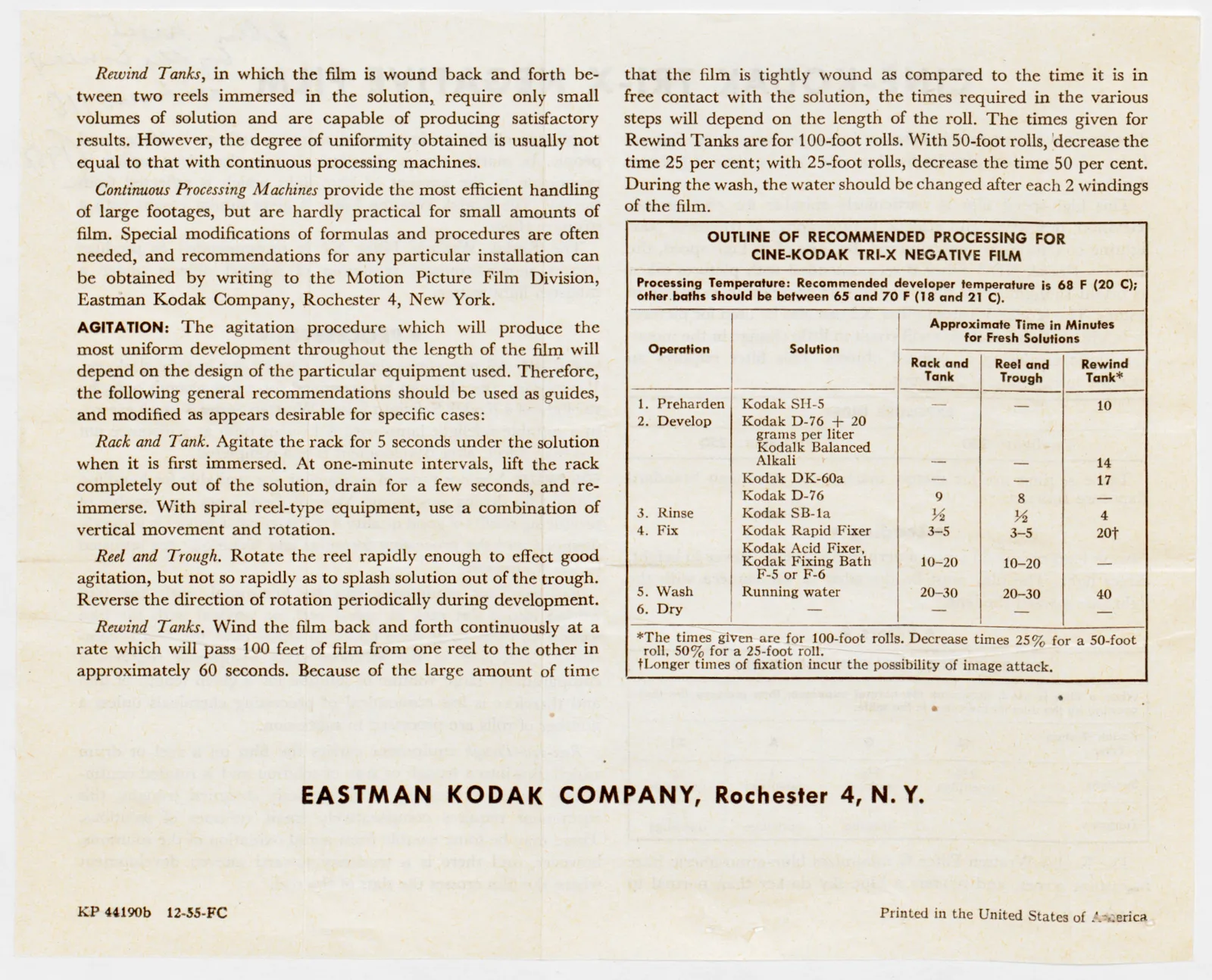
Rewind Tanks. Wind the film back and forth continuously at a rate which will pass 100 feet of film from one reel to the other in approximately 60 seconds. Because of the large amount of time
that the film is tightly wound as compared to the time it is in free contact with the solution, the times required in the various steps will depend on the length of the roll. The times given for Rewind Tanks are for 100-foot rolls. With 50-foot rolls, decrease the time 25 per cent; with 25-foot rolls, decrease the time 50 per cent. During the wash, the water should be changed after each 2 windings of the film.
OUTLINE OF RECOMMENDED PROCESSING FOR CINE-KODAK TRI-X NEGATIVE FILM
Processing Temperature: Recommended developer temperature is 68 F (20 C); other baths should be between 65 and 70 F (18 and 21 C).
| Approximate Time in Minutes for Fresh Solutions | ||||
| Operation | Solution | Rack and Tank | Reel and Trough | Rewind Tank* |
| 1. Preharden | Kodak SH-5 | — | — | 10 |
| 2. Develop | Kodak D-76 + 20 grams per liter Kodalk Balanced Alkali | — | — | 14 |
| Kodak DK-60a | — | — | 17 | |
| Kodak D-76 | 9 | 8 | — | |
| 3. Rinse | Kodak SB-1a | 1/2 | 1/2 | 4 |
| 4. Fix | Kodak Rapid Fixer | 3–5 | 3–5 | 20† |
| Kodak Acid Fixer, Kodak Fixing Bath F-5 or F-6 | 10–20 | 10–20 | — | |
| 5. Wash | Running water | 20–30 | 20–30 | 40 |
| 6. Dry | — | — | — | — |
*The times given are for 100-foot rolls. Decrease times 25% for a 50-foot roll, 50% for a 25-foot roll. †Longer times of fixation incur the possibility of image attack.
EASTMAN KODAK COMPANY, Rochester 4, N. Y.
| KP 44190b 12-55-FC | Printed in the United States of America |
65 figures hard to readstruck struck outadded written in above” jug ditto, and what it repeatsword reading not certain