
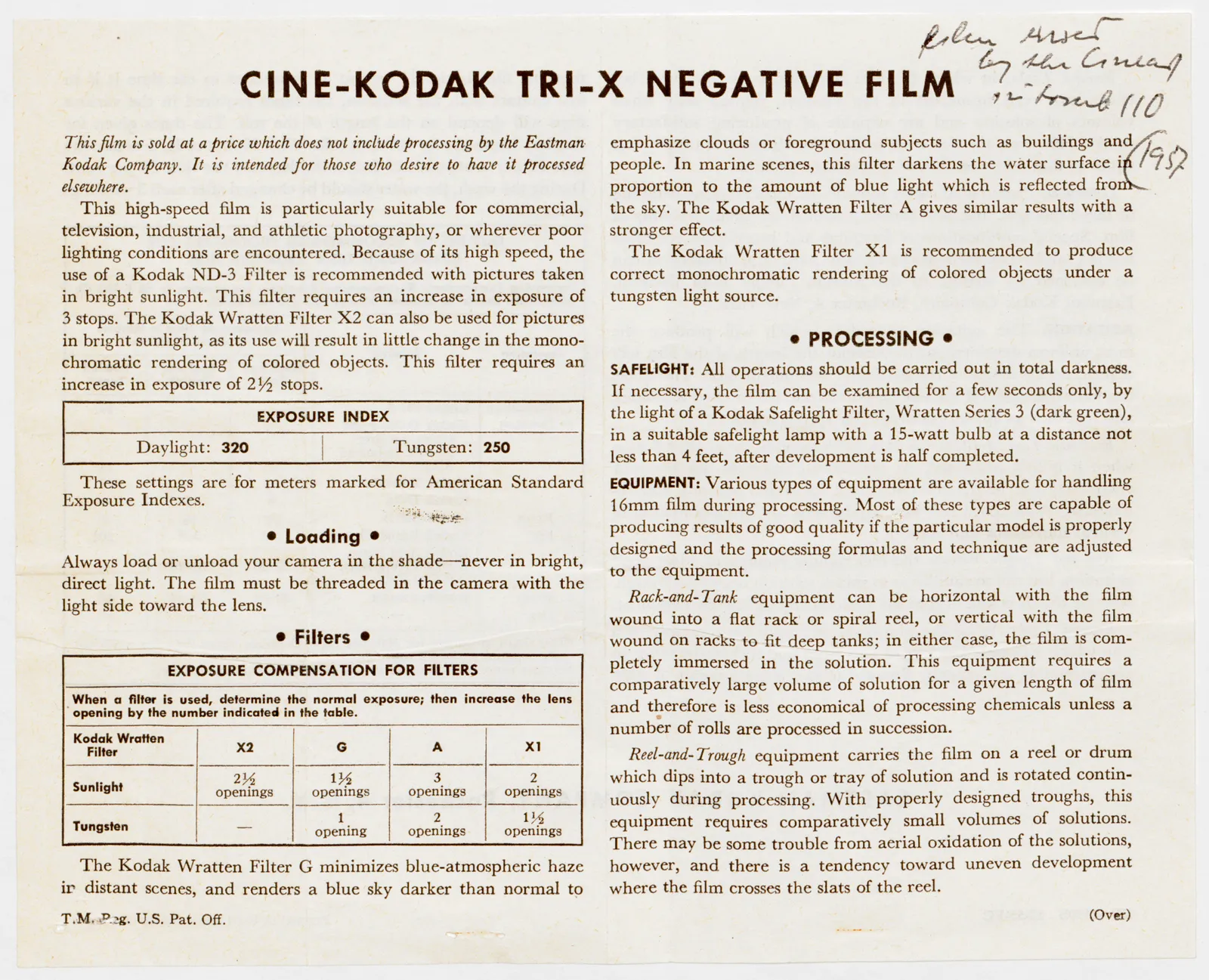
Unnumbered pageScan 264 of 343
Film used / by the [?Cineaf/ in tomb 110 / (1957]
Printed: CINE-KODAK TRI-X NEGATIVE FILM
Printed: This film is sold at a price which does not include processing by the Eastman
Printed: Kodak Company. It is intended for those who desire to have it processed
Printed: elsewhere.
Printed: This high-speed film is particularly suitable for commercial,
Printed: television, industrial, and athletic photography, or wherever poor
Printed: lighting conditions are encountered. Because of its high speed, the
Printed: use of a Kodak ND-3 Filter is recommended with pictures taken
Printed: in bright sunlight. This filter requires an increase in exposure of
Printed: 3 stops. The Kodak Wratten Filter X2 can also be used for pictures
Printed: in bright sunlight, as its use will result in little change in the mono-
Printed: chromatic rendering of colored objects. This filter requires an
Printed: increase in exposure of 2½ stops.
Printed: EXPOSURE INDEX
Printed: Daylight: 320 | Tungsten: 250
Printed: These settings are for meters marked for American Standard
Printed: Exposure Indexes.
Printed: • Loading •
Printed: Always load or unload your camera in the shade—never in bright,
Printed: direct light. The film must be threaded in the camera with the
Printed: light side toward the lens.
Printed: • Filters •
Printed: EXPOSURE COMPENSATION FOR FILTERS
Printed: When a filter is used, determine the normal exposure; then increase the lens
Printed: opening by the number indicated in the table.
Printed: Kodak Wratten Filter | X2 | G | A | X1
Printed: Sunlight | 2½ openings | 1½ openings | 3 openings | 2 openings
Printed: Tungsten | — | 1 opening | 2 openings | 1½ openings
Printed: The Kodak Wratten Filter G minimizes blue-atmospheric haze
Printed: in distant scenes, and renders a blue sky darker than normal to
Printed: T.M. Reg. U.S. Pat. Off.
Printed: emphasize clouds or foreground subjects such as buildings and
Printed: people. In marine scenes, this filter darkens the water surface in
Printed: proportion to the amount of blue light which is reflected from
Printed: the sky. The Kodak Wratten Filter A gives similar results with a
Printed: stronger effect.
Printed: The Kodak Wratten Filter X1 is recommended to produce
Printed: correct monochromatic rendering of colored objects under a
Printed: tungsten light source.
Printed: • PROCESSING •
Printed: SAFELIGHT: All operations should be carried out in total darkness.
Printed: If necessary, the film can be examined for a few seconds only, by
Printed: the light of a Kodak Safelight Filter, Wratten Series 3 (dark green),
Printed: in a suitable safelight lamp with a 15-watt bulb at a distance not
Printed: less than 4 feet, after development is half completed.
Printed: EQUIPMENT: Various types of equipment are available for handling
Printed: 16mm film during processing. Most of these types are capable of
Printed: producing results of good quality if the particular model is properly
Printed: designed and the processing formulas and technique are adjusted
Printed: to the equipment.
Printed: Rack-and-Tank equipment can be horizontal with the film
Printed: wound into a flat rack or spiral reel, or vertical with the film
Printed: wound on racks to fit deep tanks; in either case, the film is com-
Printed: pletely immersed in the solution. This equipment requires a
Printed: comparatively large volume of solution for a given length of film
Printed: and therefore is less economical of processing chemicals unless a
Printed: number of rolls are processed in succession.
Printed: Reel-and-Trough equipment carries the film on a reel or drum
Printed: which dips into a trough or tray of solution and is rotated contin-
Printed: uously during processing. With properly designed troughs, this
Printed: equipment requires comparatively small volumes of solutions.
Printed: There may be some trouble from aerial oxidation of the solutions,
Printed: however, and there is a tendency toward uneven development
Printed: where the film crosses the slats of the reel.
Printed: (Over)
65 figures hard to readstruck struck outadded written in above” jug ditto, and what it repeatsword reading not certain