
Page 17Scan 23 of 107
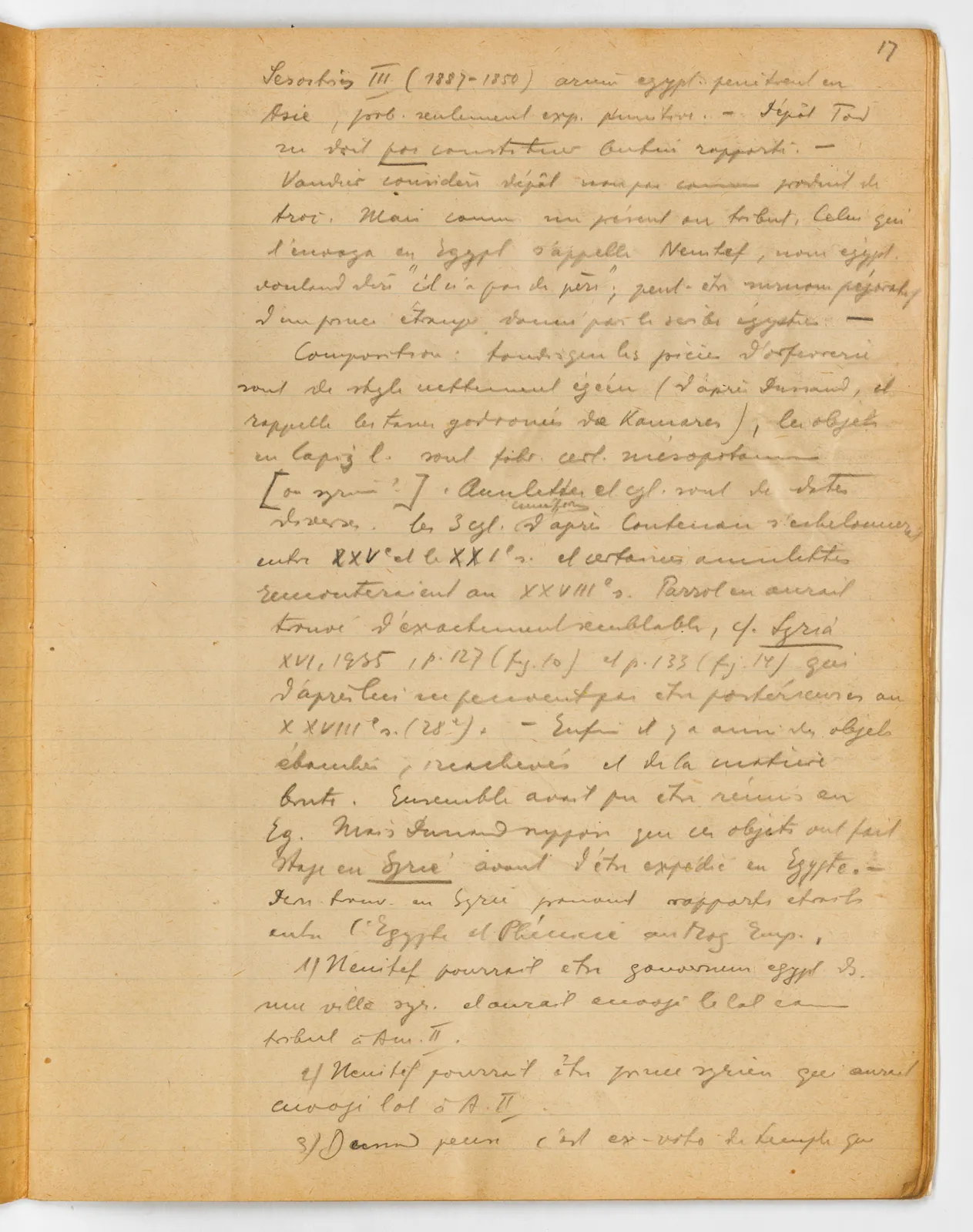
Sesostris III (1887-1850) Egyptian army penetrating into Asia, prob. only a punitive exp. - Tod deposit must not constitute booty brought back. — Vandier considers the deposit not as the product of Troy, but as a gift or tribute. He who sent it to Egypt is called Neuitef, Egyptian name. meaning "he has no father", perhaps a pejorative nickname of a foreign prince given by the Egyptian scribe. — Composition: whereas the goldsmith's pieces are clearly of Aegean style (according to Dussaud, it recalls the fluted cups of Kamares), the objects in lapis l. are certainly made in Mesopotamian [or Syrian ?] . Amulets and cyl. are of dates various. the 3 cuneiform cyl. according to Contenau range between XXVth and the XXIst c. and certain amulets would go back to the XXVIIIth c. Parrot would have found exactly similar ones, cf. Syria XVI, 1935, p. 127 (fig. 10) and p. 133 (fig. 14) which according to him cannot be later than the XXVIIIth c. (28th). — Finally there are also objects roughed out, unfinished and of raw material. The whole could have been gathered in Eg. But Dussaud supposes that these objects made a stage in Syria before being sent to Egypt. — Latest finds in Syria proving close relations between Egypt and Phoenicia in the Middle Empire, 1) Neuitef could be an Egyptian governor in a Syrian town and would have sent the lot as tribute to Am. II . 2) Neuitef could be a Syrian prince who would have sent the lot to A. II . 3) Dussaud thinks it is an ex-voto from a temple that … continues
65 figures hard to readstruck struck outadded written in above” jug ditto, and what it repeatsword reading not certain