
Unnumbered pageScan 22 of 107
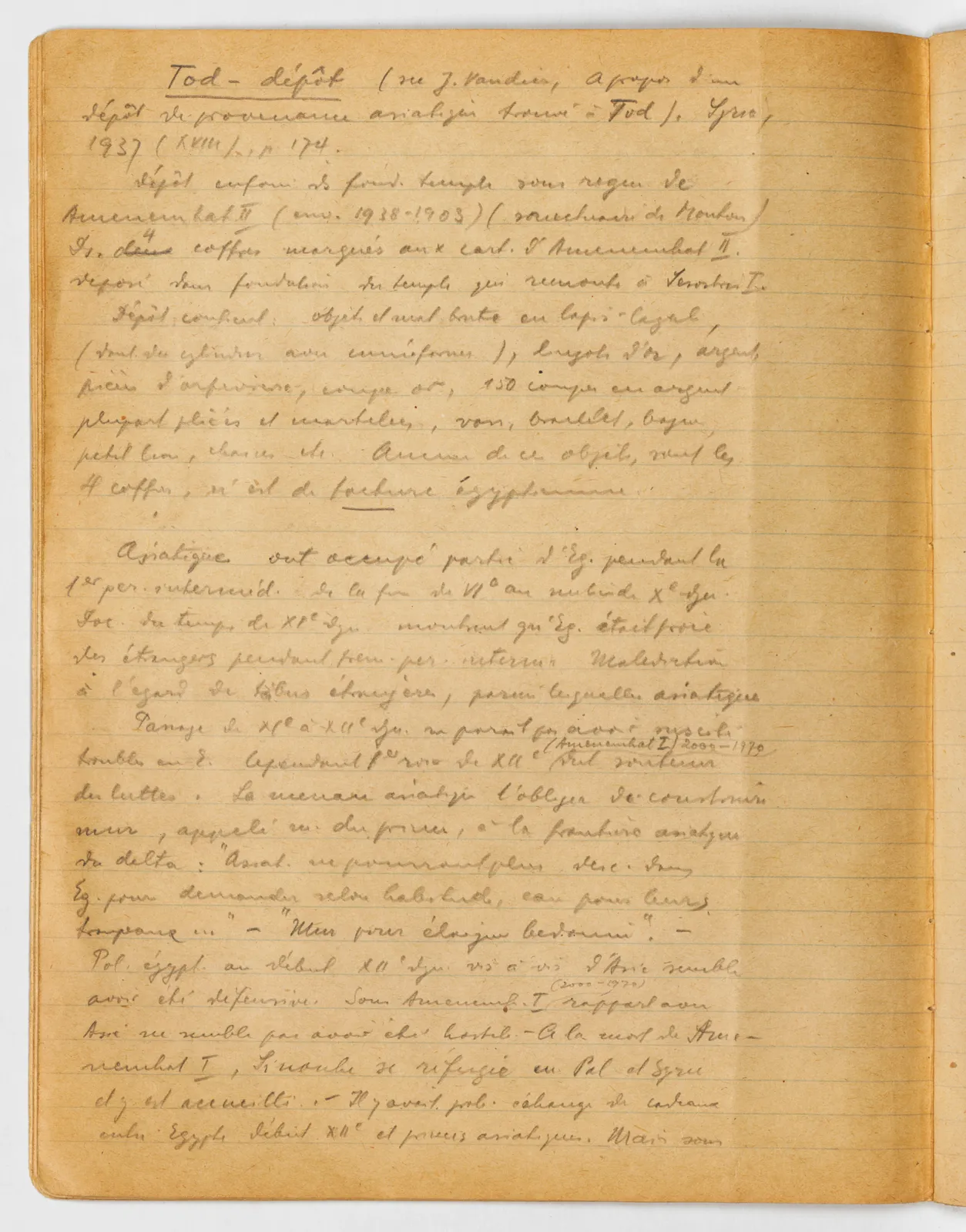
Tod - dépôt (see J. Vandier, A propos d'un deposit of Asiatic provenance found at Tod ), Syria, 1937 ( XVIII ), p 174. hoard buried in the foundation of the temple under the reign of Amenemhat II ( c. 1938-1903 ) ( sanctuary of Montu ) In two 4 chests marked with the cartouches of Amenemhat II. deposited in the foundation of the temple which goes back to Senusret I. hoard contains: objects and raw materials in lapis-lazuli, ( including cylinders with cuneiform ), ingots of gold, silver, pieces of goldsmiths' work, gold cup, 150 silver cups most folded and hammered, vessels, bracelets, rings, small lion, chains etc. None of these objects, except the 4 chests, is of Egyptian workmanship ."
Asiatics occupied part of Eg. during the 1st Intermediate Period, from the end of the 6th to the middle of the 10th dyn. Docs. of the time of the 11th dyn. show that Eg. was prey to foreigners during the First Intermediate Period. Curse against foreign tribes, among which Asiatics. Transition from the 11th to the 12th dyn. does not seem to have caused troubles in E. However, the 1st king of the 12th (Amenemhat I) 2000-1970 had to fight battles. The Asiatic threat obliged him to build a wall, called the wall of the prince, at the Asiatic frontier of the delta: "Asiatics will no longer be able to go down into Eg. to ask, as usual, for water for their flocks ..." - "Wall to keep away Bedouins" . - Egyptian policy at the beginning of the 12th dyn. towards Asia seems to have been defensive. Under Amenemh. I (2000-1970) relations with Asia do not seem to have been hostile. - At the death of Amenemhat I , Sinuhe took refuge in Pal. and Syria and was welcomed there . - There was probably an exchange of gifts between Egypt at the beginning of the 12th and Asiatic princes. But under
65 figures hard to readstruck struck outadded written in above” jug ditto, and what it repeatsword reading not certain