
Page 7Scan 12 of 107
Continued from scan 11
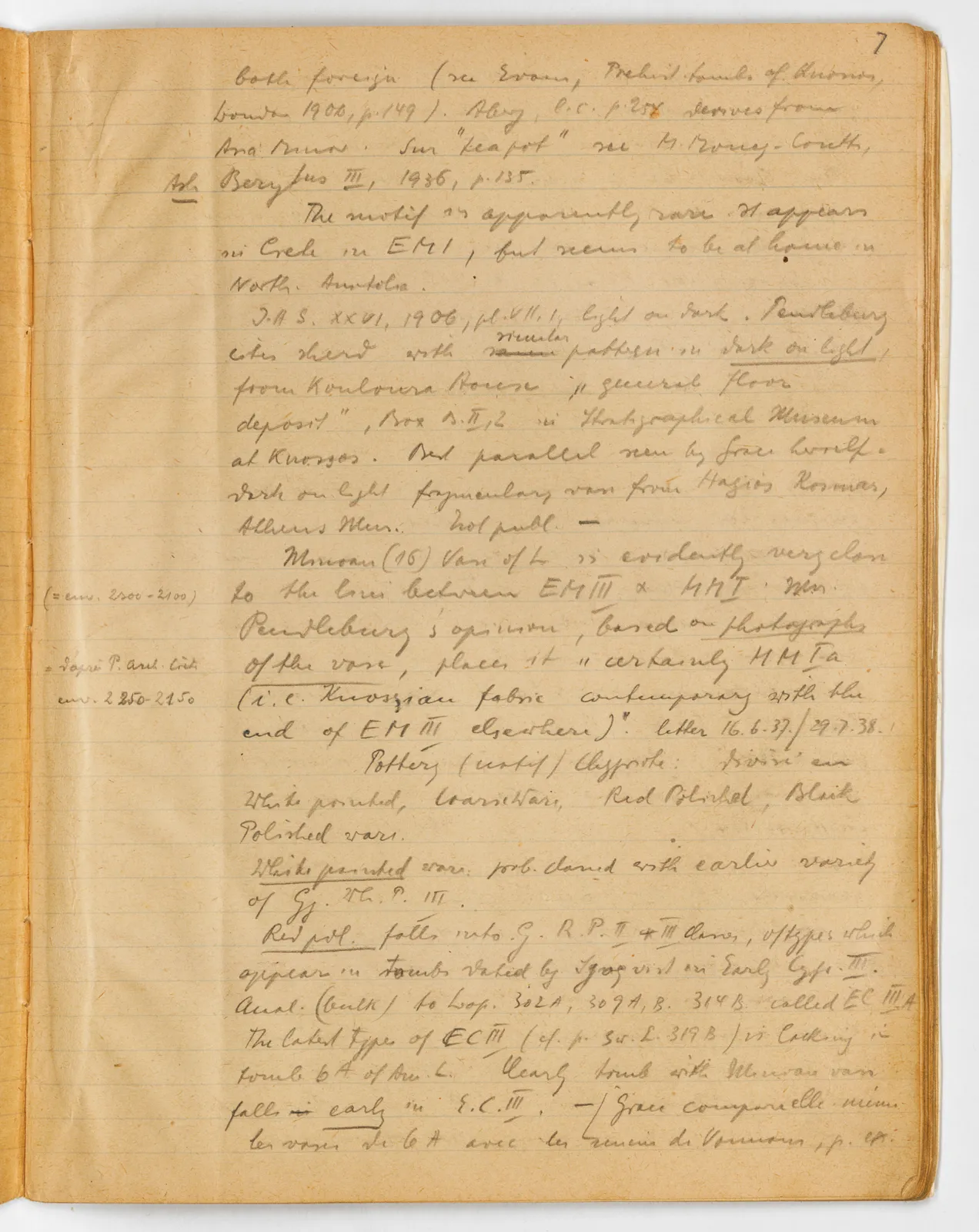
Ash.… both foreign (see Evans, Prehist. Tombs of Knossos, London 1906, p. 149). Åberg, l.c. p. 256 derives from Hagia Triada. On "tea-pot" see Mr Money-Coutts, Berytus III, 1936, p. 135.
(= c. 2400-2100)= d'après P. Arch. Cretec. 2250-2150The motif is apparently rare. It appears in Crete in EMI, but seems to be at home in North. Anatolia. J.H.S. XXVI, 1906, pl. VII, 1, light on dark. Pendlebury cites sherd with same similar pattern in dark on light, from Kouloura House "general floor deposit", Box B. II, 2 in Stratigraphical Museum at Knossos. Best parallel seen by Grace herself = dark on light fragmentary vase from Hagios Kosmas, Athens Mus. Not publ. — Minoan (16) Vase of t. is evidently very close to the line between EM III & MM I. Mr. Pendlebury's opinion, based on photographs of the vase, places it "certainly MM _I_a (i.e. Knossian fabric contemporary with the end of EM III elsewhere)". letter 16.6.37. / 29.7.38.
Pottery (native) Cypriot: divided into White painted, Coarse Ware, Red Polished, Black Polished ware. White painted ware: tmb. classed with earlier variety of Gj. Wh. P. III. Red pol. falls into Gj. R.P. II & III classes, of types which appear in tombs dated by Sjöqvist in Early Cyp. III. Anal. (bulk) to Lap. 302 A, 309 A, B. 314 B. called EC III A The latest types of EC III (cf. f. Sw. E. 319 B) is lacking in tomb 6A of An. L. Clearly tomb with Minoan vase falls in early in E.C. III. — / Grace compares herself the vases of 6A with the ancient ones of Vounous, p. CA:
65 figures hard to readstruck struck outadded written in above” jug ditto, and what it repeatsword reading not certain