
Unnumbered pageScan 11 of 107
Continued from p. 5
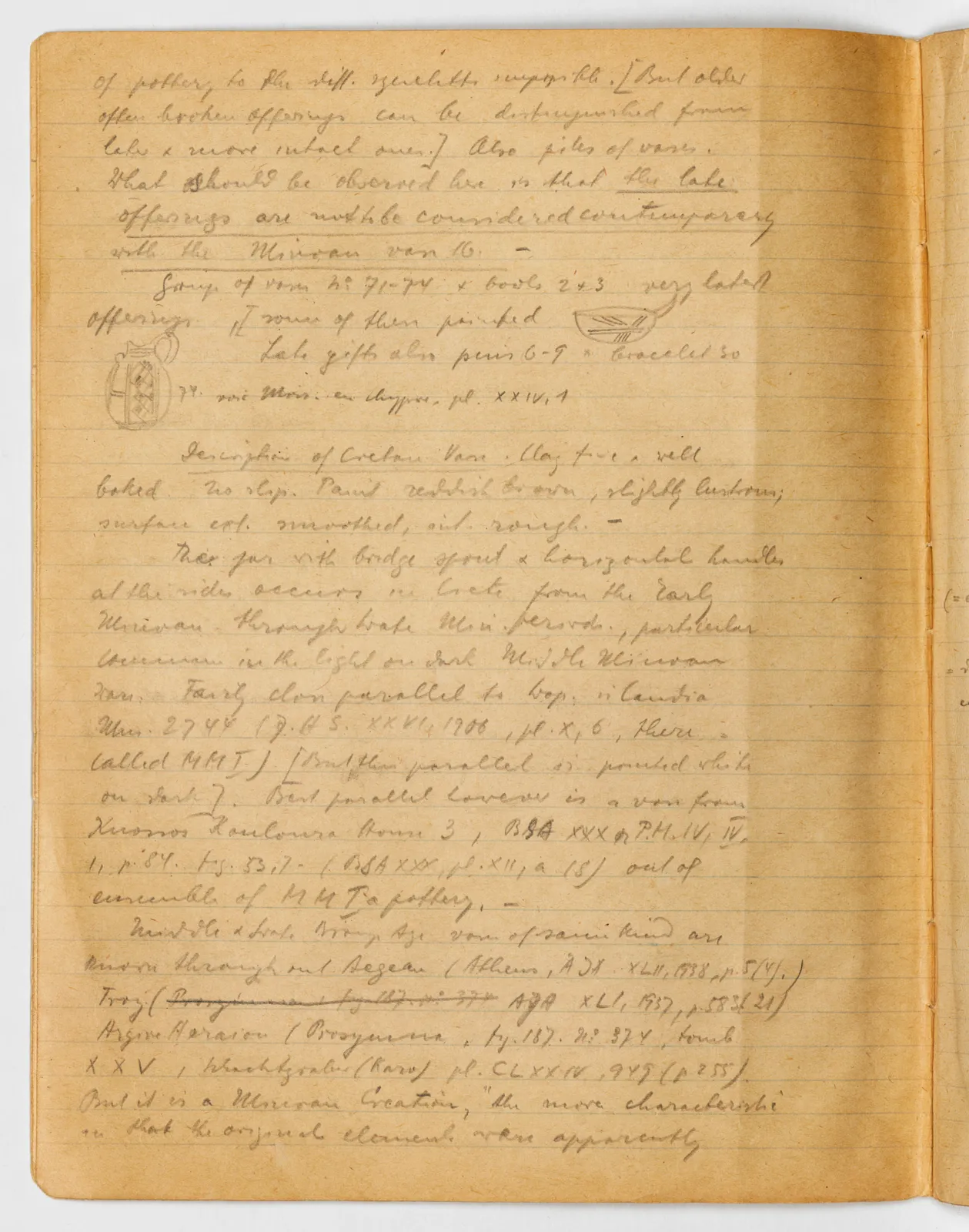
… of pottery to the diff. squeletts impossible. [But older often broken offerings can be distinguished from later & more intact ones.] Also piles of vases. What should be observed here is that the late offerings are not to be considered contemporary with the Minoan vase 16. — Group of vases no 71–74 & bowls 2 & 3 very latest offerings 1 some of them painted (drawing)
Drawing: globular jug with vertical handle and linear decoration; labels: 74.] Late gifts also pins 6–9 & bracelet 30
74. voir Miss. en Chypre, pl. XXIV, 1
Description of Cretan Vase. Clay fine & well baked. No slip. Paint reddish brown, slightly lustrous, surface ext. smoothed, int. rough. — That jar with bridge spout & horizontal handles at the sides occurs in Crete from the Early Minoan through Late Min. periods, particular common in the light on dark Middle Minoan ware. Fairly close parallel to Lap. is Candia Mus. 2744 (J.H.S. XXVI, 1906, pl. X, 6, there called MM I) [But this parallel is painted white on dark]. Best parallel however is a vase from Knossos Kouloures House 3, BSA XXX & P.M. IV, IV, 1, p. 84, fig. 53, 7. (BSA XXX, pl. XII, a 8) out of ensemble of MM Ia pottery. — Middle & Late Bronze Age vases of same kind are known through out Aegean (Athens, AJA XLII, 1938, p. 5 (4).) Troy (Prosymna, fig. 187. no 374 AJA XLI, 1937, p. 583 (21) Argive Heraion (Prosymna, fig. 187. no 374, tomb XXV, Schachtgräber (Karo) pl. CLXXIV, 949 (p 255). But it is a Minoan Creation, "the more characteristic in that the original elements were apparently … continues
65 figures hard to readstruck struck outadded written in above” jug ditto, and what it repeatsword reading not certain