
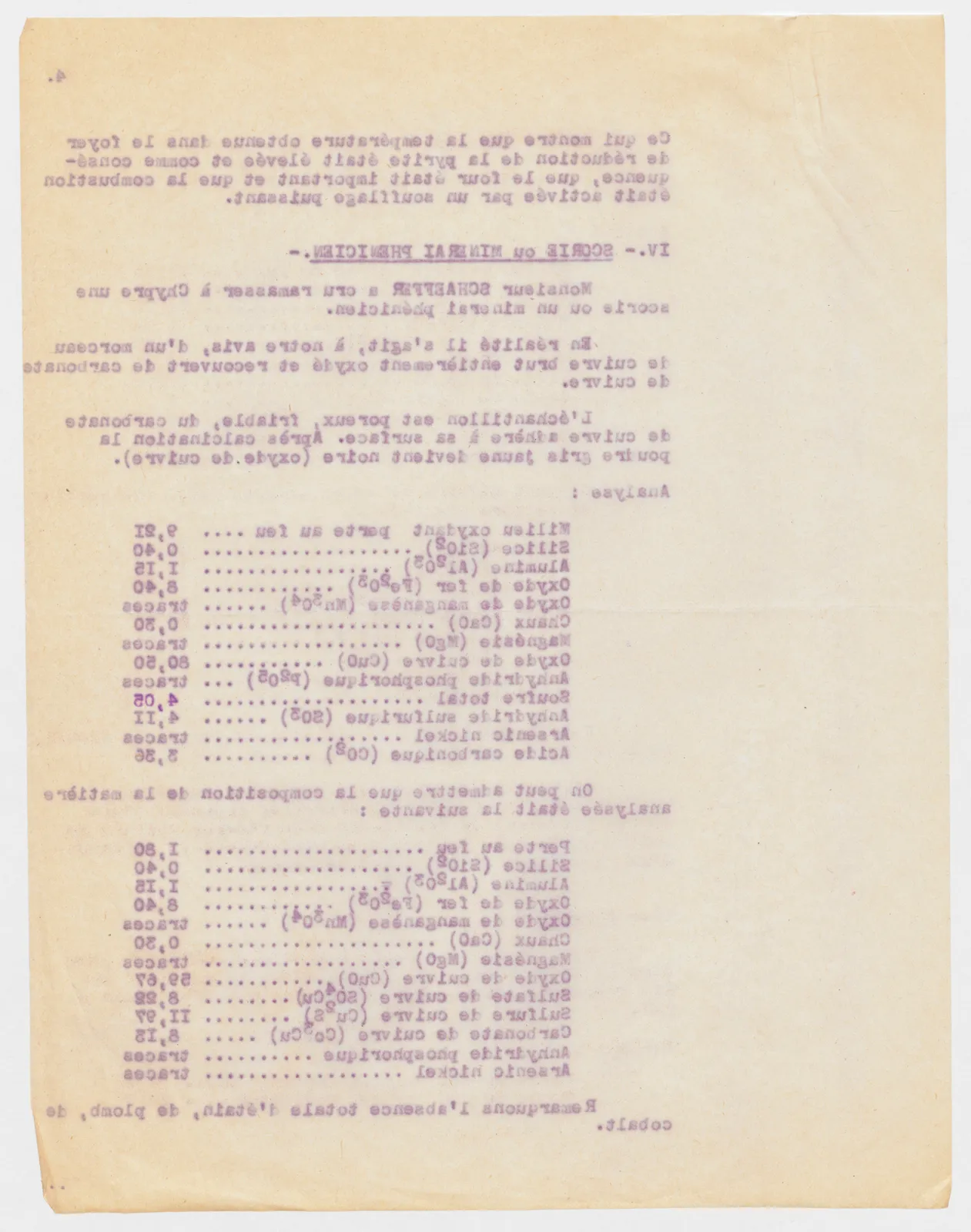
Unnumbered pageScan 8 of 12
4.
which shows that the temperature reached in the hearth of reduction of the pyrite was high, and as a consequence, that the kiln was large and that the combustion was activated by a powerful blast.
IV.- SLAG or PHOENICIAN ORE.-
Mr SCHAEFFER believed he had picked up in Cyprus a slag or a Phoenician ore.
In reality it is, in our opinion, a piece of raw copper entirely oxidised and covered with carbonate of copper.
The sample is porous, friable; carbonate of copper adheres to its surface. After calcination the grey-tan powder becomes black (copper oxide).
Analysis:
| Oxidising medium, iron part .... | 9,21 |
| Silica (SiO2) ................... | 0,40 |
| Alumina (Al2O3) ................. | 1,15 |
| Iron oxide (Fe2O3) ............ | 8,40 |
| Manganese oxide (Mn3O4) ..... | traces |
| Lime (CaO) ..................... | 0,50 |
| Magnesia (MgO) .................. | traces |
| Copper oxide (CuO) ........... | 80,50 |
| Phosphoric anhydride (P2O5) ... | traces |
| Total sulphur .................... | 4,05 |
| Sulphuric anhydride (SO3) ..... | 4,11 |
| Arsenic nickel ................. | traces |
| Carbonic acid (CO2) ......... | 3,36 |
It may be assumed that the composition of the material analysed was as follows:
| Iron part ................... | 1,80 |
| Silica (SiO2) ................... | 0,40 |
| Alumina (Al2O3) ................. | 1,15 |
| Iron oxide (Fe2O3) ............ | 8,40 |
| Manganese oxide (Mn3O4) ..... | traces |
| Lime (CaO) ..................... | 0,50 |
| Magnesia (MgO) .................. | traces |
| Copper oxide (CuO) ........... | 59,67 |
| Copper sulphate (SO4Cu) ....... | 8,22 |
| Copper sulphide (Cu2S) ....... | 11,97 |
| Copper carbonate (CO3Cu) ..... | 8,18 |
| Phosphoric anhydride .......... | traces |
| Arsenic nickel .................. | traces |
We note the total absence of tin, lead, of cobalt.
...
65 figures hard to readstruck struck outadded written in above” jug ditto, and what it repeatsword reading not certain