
Unnumbered pageScan 7 of 12
4.
This shows that the temperature reached in the hearth for reducing the pyrite was high and, as a consequence, that the furnace was large and that the combustion was stimulated by a powerful blast.
IV.- SLAG or PHOENICIAN ORE.-
Mr SCHAEFFER believed he had picked up at Cyprus a slag or a Phoenician ore.
In reality it is, in our opinion, a piece of raw copper entirely oxidised and covered with carbonate of copper.
The sample is porous, friable; carbonate of copper adheres to its surface. After calcination the yellow-grey powder becomes black (copper oxide).
Analysis:
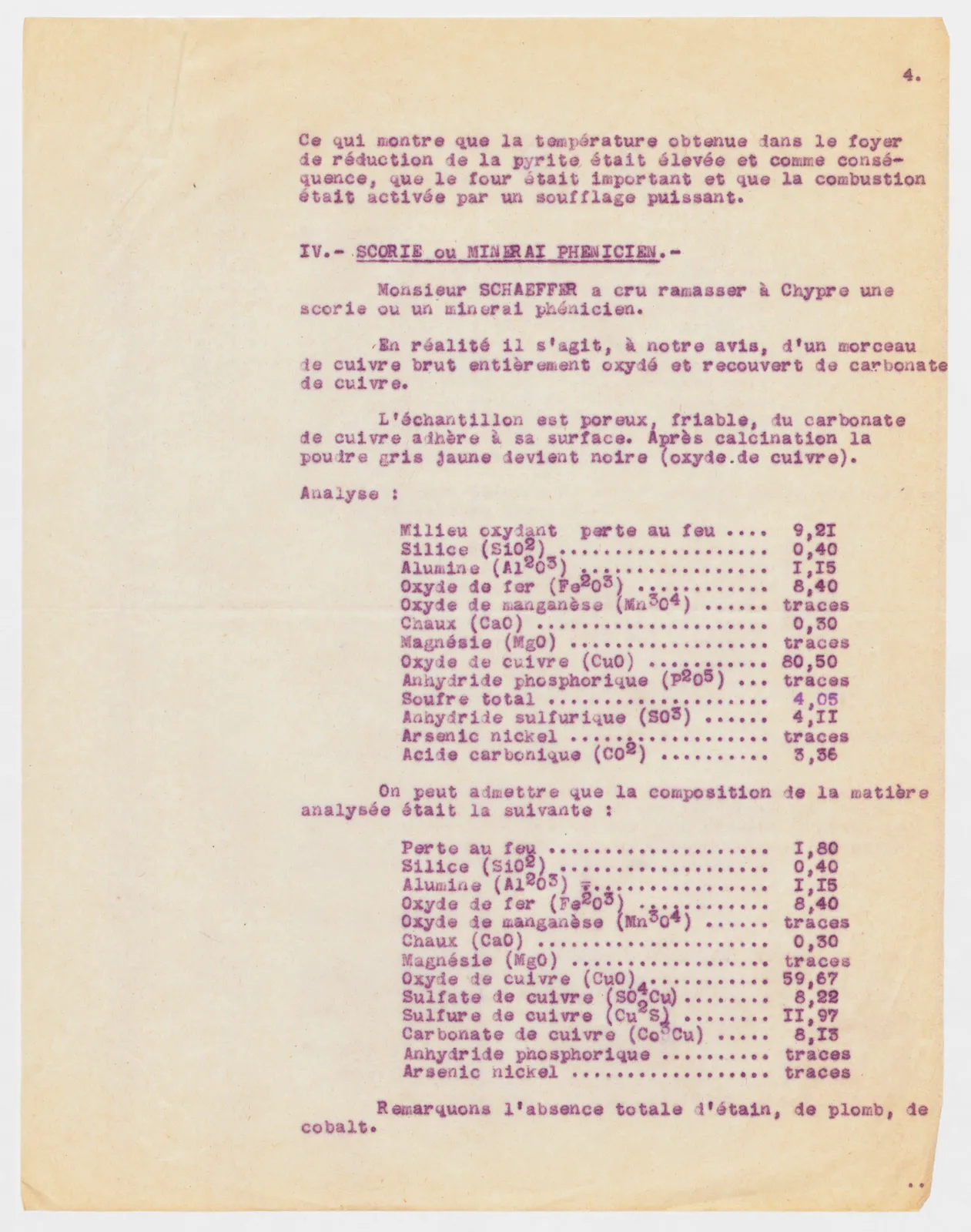
Oxidising medium loss on ignition .... 9,21 Silica (SiO2)...................... 0,40 Alumina (Al2O3) .................. I,I5 Iron oxide (Fe2O3) ............ 8,40 Manganese oxide (Mn3O4) ...... traces Lime (CaO) ..................... 0,30 Magnesia (MgO) .................. traces Copper oxide (CuO) ........... 80,50 Phosphoric anhydride (P2O5) ... traces Total sulphur .................... 4,05 Sulphuric anhydride (SO3) ...... 4,II Arsenic nickel .................. traces Carbonic acid (CO2) ......... 3,36
It may be accepted that the composition of the material analysed was as follows:
Loss on ignition .................... I,80 Silica (SiO2)..................... 0,40 Alumina (Al2O3) =................ I,I5 Iron oxide (Fe2O3) ............ 8,40 Manganese oxide (Mn3O4) ...... traces Lime (CaO) ..................... 0,30 Magnesia (MgO) .................. traces Copper oxide (CuO)............ 59,67 Copper sulphate (SO4Cu)........ 8,22 Copper sulphide (Cu2S) ........ II,97 Copper carbonate (CO3Cu) ..... 8,13 Phosphoric anhydride .......... traces Arsenic nickel .................. traces
We note the total absence of tin, of lead, of cobalt.
..
65 figures hard to readstruck struck outadded written in above” jug ditto, and what it repeatsword reading not certain