
Page 3Scan 6 of 12
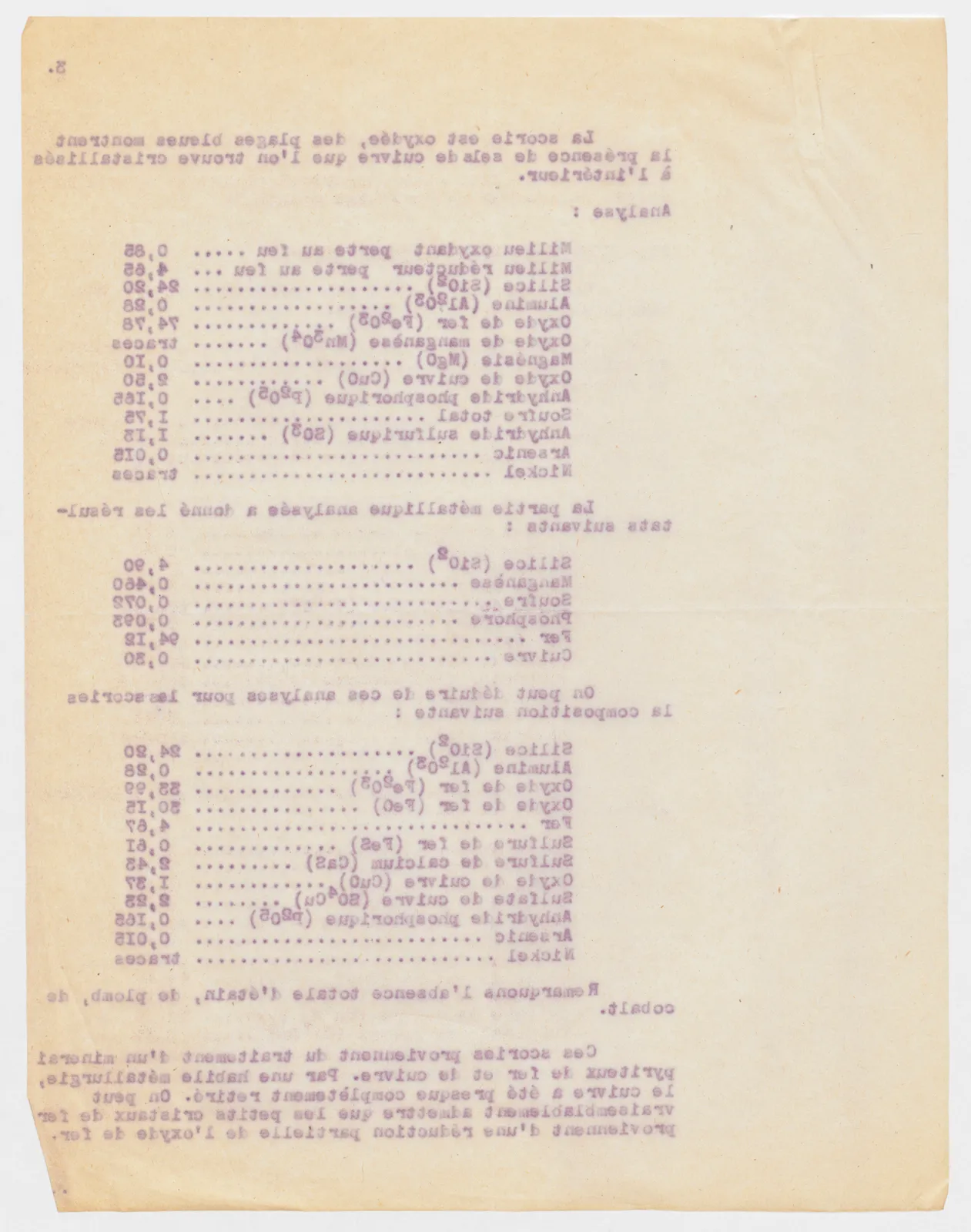
The slag is oxidised; blue patches show the presence of copper salts which are found crystallised inside.
Analysis:
Oxidising medium loss on iron ..... 0,85 Reducing medium loss on iron ... 4,65 Silica (SiO2) ..................... 24,20 Alumina (Al2O3) ................... 0,28 Iron oxide (Fe2O3) .............. 74,78 Manganese oxide (Mn3O4) ....... traces Magnesia (MgO) ................... 0,10 Copper oxide (CuO) ............ 2,50 Phosphoric anhydride (P2O5) .... 0,165 Total sulphur ..................... 1,75 Sulphuric anhydride (SO3) ...... 1,15 Arsenic ........................ 0,015 Nickel ......................... traces
The metallic part analysed gave the following results:
Silica (SiO2) ..................... 4,90 Manganese ........................ 0,460 Sulphur ............................ 0,072 Phosphorus ......................... 0,095 Iron ............................... 94,12 Copper ............................ 0,30
From these analyses one can deduce the following composition for the slags:
Silica (SiO2) ..................... 24,20 Alumina (Al2O3) ................... 0,28 Iron oxide (Fe2O3) .............. 55,99 Iron oxide (FeO) ................ 50,15 Iron .............................. 4,67 Iron sulphide (FeS) .............. 0,61 Calcium sulphide (CaS) ......... 2,45 Copper oxide (CuO) ............ 1,37 Copper sulphate (SO4Cu) ........ 2,25 Phosphoric anhydride (P2O5) .... 0,165 Arsenic ........................ 0,015 Nickel ......................... traces
We note the total absence of tin, lead, cobalt.
These slags come from the treatment of a pyritous ore of iron and copper. Through skilful metallurgy, the copper was almost completely extracted. It can plausibly be assumed that the small crystals of iron come from a partial reduction of the iron oxide.
65 figures hard to readstruck struck outadded written in above” jug ditto, and what it repeatsword reading not certain