
Unnumbered pageScan 5 of 12
3.
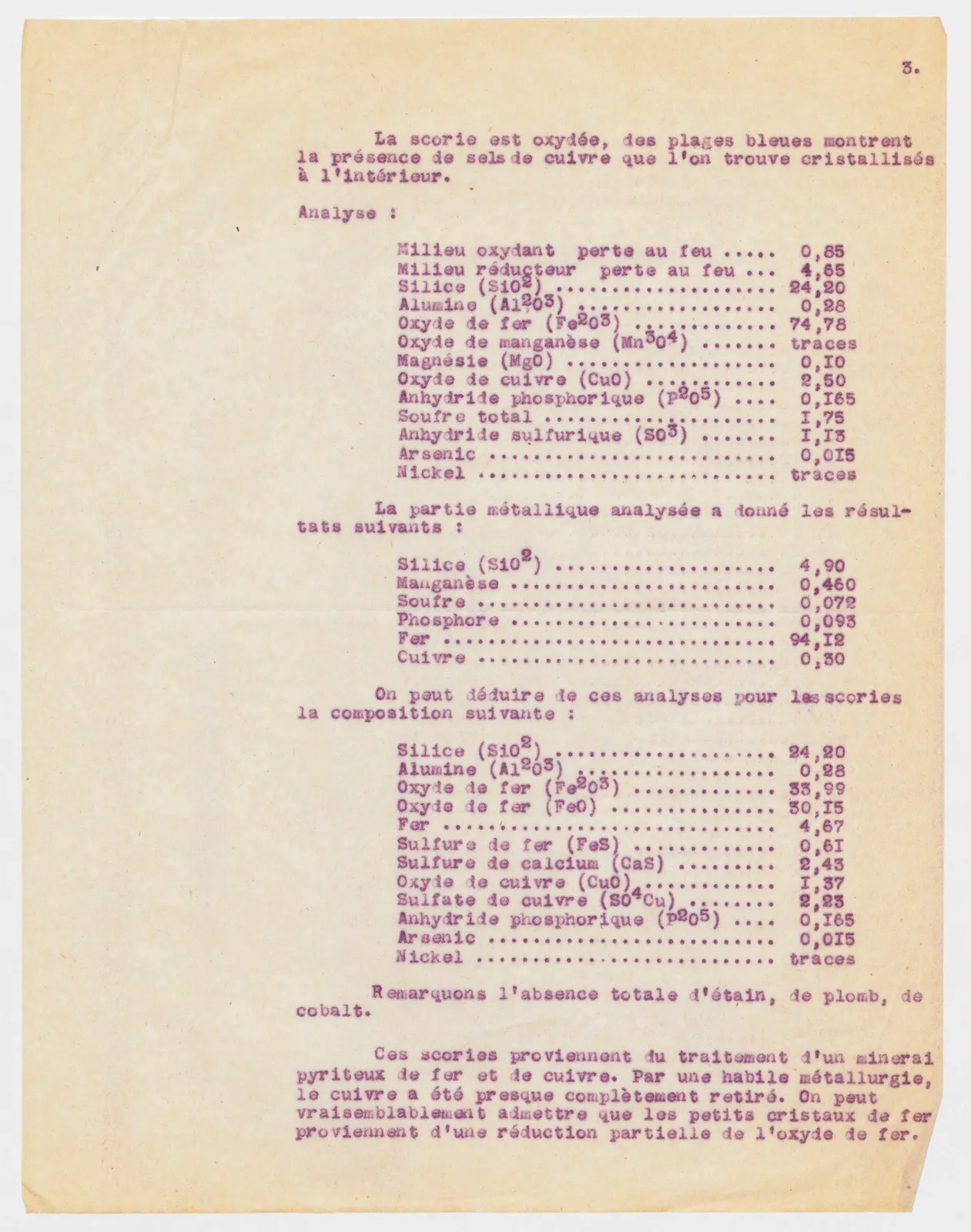
The slag is oxidised; blue patches show the presence of copper salts which are found crystallised inside.
Analysis:
Oxidising medium loss on ignition ..... 0,85 Reducing medium loss on ignition ... 4,65 Silica (SiO²) ..................... 24,20 Alumina (Al²O³) ................... 0,28 Iron oxide (Fe²O³) .............. 74,78 Manganese oxide (Mn³O⁴) ...... traces Magnesia (MgO) .................... 0,10 Copper oxide (CuO) ............. 2,50 Phosphoric anhydride (P²O⁵) .... 0,165 Total sulphur ...................... 1,75 Sulphuric anhydride (SO³) ...... 1,13 Arsenic ........................... 0,015 Nickel ............................ traces
The metallic part analysed gave the results as follows:
Silica (SiO²) .................... 4,90 Manganese ........................ 0,460 Sulphur ........................... 0,072 Phosphorus ........................ 0,093 Iron .............................. 94,12 Copper ........................... 0,30
From these analyses one can deduce for the slags the following composition:
Silica (SiO²)..................... 24,20 Alumina (Al²O³) ................. 0,28 Iron oxide (Fe²O³) ............. 33,99 Iron oxide (FeO) .............. 30,15 Iron ............................... 4,67 Iron sulphide (FeS) ............ 0,61 Calcium sulphide (CaS) ........ 2,43 Copper oxide (CuO)............ 1,37 Copper sulphate (SO⁴Cu) ........ 2,23 Phosphoric anhydride (P²O⁵) .... 0,165 Arsenic ........................... 0,015 Nickel ............................ traces
We note the total absence of tin, of lead, of cobalt.
These slags come from the treatment of a pyritic iron and copper ore. By skilful metallurgy, the copper was almost completely removed. One can probably admit that the small crystals of iron result from a partial reduction of the iron oxide.
65 figures hard to readstruck struck outadded written in above” jug ditto, and what it repeatsword reading not certain