
Page 2Scan 4 of 12
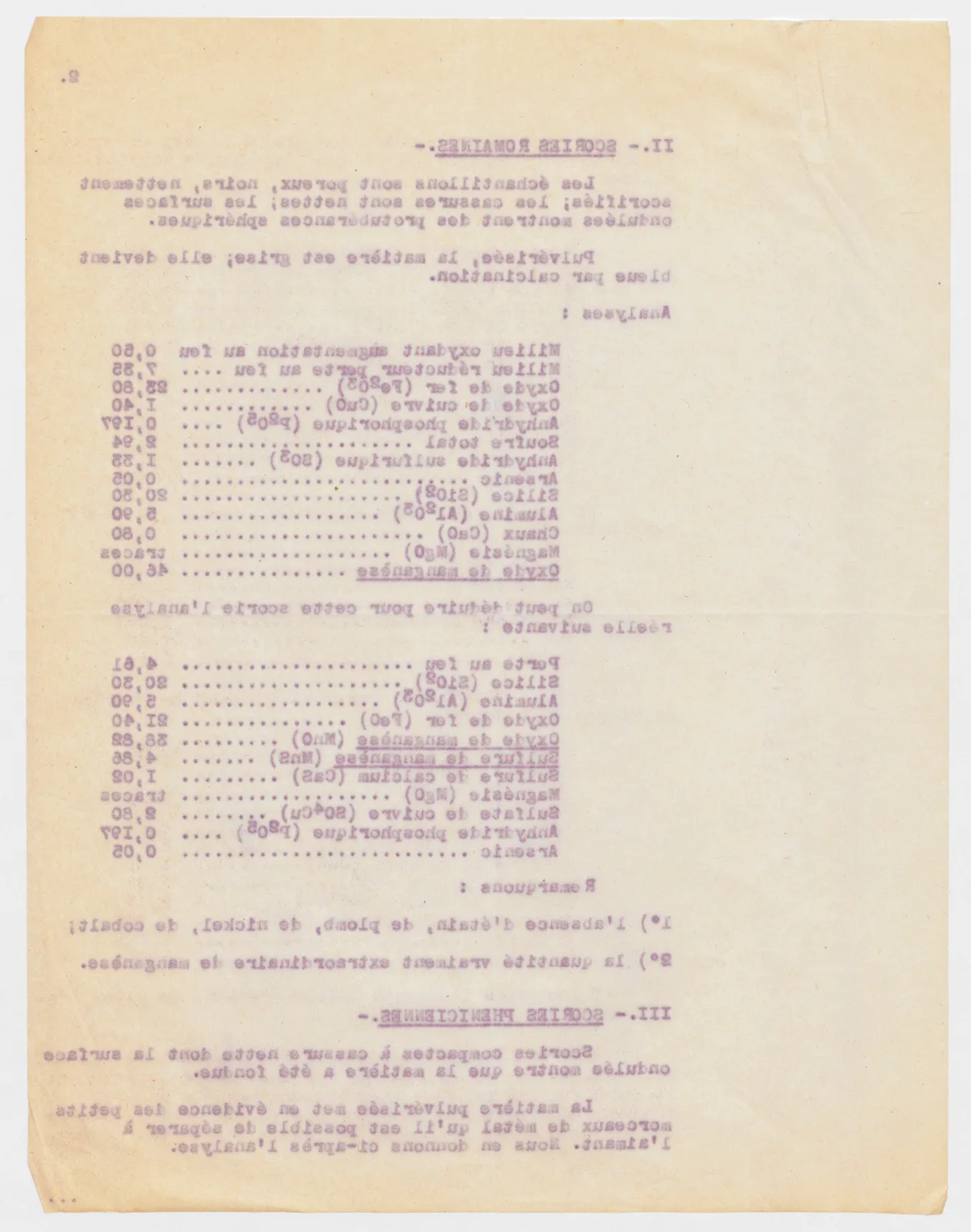
II.- ROMAN SLAGS.-
The samples are porous, black, clearly slagged; the breaks are clean; the surfaces undulating show spherical protuberances.
Pulverised, the material is grey; it becomes blue on calcination.
Analyses:
| Oxidising medium increase in iron | 0,50 |
| Reducing medium loss of iron .... | 7,55 |
| Iron oxide (Fe2O3) ............. | 25,80 |
| Copper oxide (CuO) ............ | 1,40 |
| Phosphoric anhydride (P2O5) .... | 0,197 |
| Total sulphur ..................... | 2,94 |
| Sulphuric anhydride (SO3) ....... | 1,35 |
| Arsenic .......................... | 0,05 |
| Silica (SiO2) .................... | 20,30 |
| Alumina (Al2O3) .................. | 5,90 |
| Lime (CaO) ...................... | 0,80 |
| Magnesia (MgO) ................... | traces |
| Manganese oxide ............. | 46,00 |
From this, one can deduce for this slag the analysis as follows:
| Loss on ignition ..................... | 4,61 |
| Silica (SiO2) .................... | 20,30 |
| Alumina (Al2O3) .................. | 5,90 |
| Iron oxide (FeO) ............... | 21,40 |
| Manganese oxide (MnO) ....... | 38,88 |
| Manganese sulphide (MnS) ...... | 4,86 |
| Calcium sulphide (CaS) ......... | 1,02 |
| Magnesia (MgO) ................... | traces |
| Copper sulphate (SO4Cu) ........ | 2,80 |
| Phosphoric anhydride (P2O5) .... | 0,197 |
| Arsenic .......................... | 0,05 |
Remarks:
1°) the absence of tin, lead, nickel, cobalt;
2°) the really extraordinary quantity of manganese.
III.- PHOENICIAN SLAGS.-
Compact slags with a clean break whose surface undulating shows that the material has been melted.
The pulverised material reveals small pieces of metal which it is possible to separate with a magnet. We give the analysis below.
Figure: none
65 figures hard to readstruck struck outadded written in above” jug ditto, and what it repeatsword reading not certain