
Unnumbered pageScan 3 of 12
2.
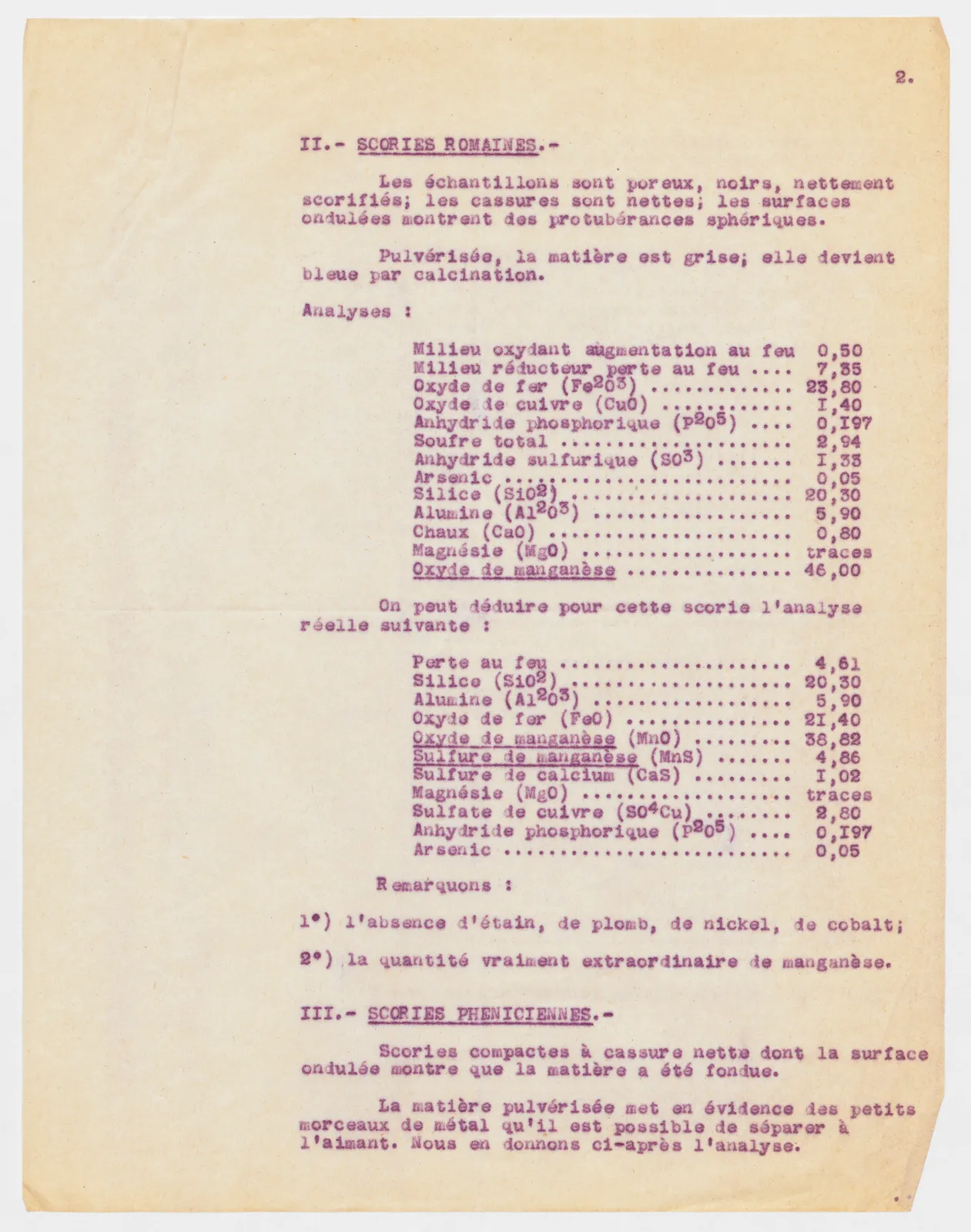
II.- ROMAN SLAGS.-
The samples are porous, black, clearly slagged; the fractures are clean; the surfaces undulating show spherical protuberances.
Pulverised, the material is grey; it becomes blue on calcination.
Analyses:
Oxidising medium, increase on ignition 0,50 Reducing medium, loss on ignition .... 7,35 Iron oxide (Fe2O3) ............ 23,80 Copper oxide (CuO) ........... 1,40 Phosphoric anhydride (P2O5) .... 0,197 Total sulphur ..................... 2,94 Sulphuric anhydride (SO3) ...... 1,33 Arsenic ......................... 0,05 Silica (SiO2) ................... 20,30 Alumina (Al2O3) ................. 5,90 Lime (CaO) ..................... 0,80 Magnesia (MgO) .................. traces Manganese oxide ............... 46,00
For this slag one can deduce the following actual analysis:
Loss on ignition .................... 4,61 Silica (SiO2) ................... 20,30 Alumina (Al2O3) ................. 5,90 Iron oxide (FeO) .............. 21,40 Manganese oxide (MnO) ........ 38,82 Manganese sulphide (MnS) ...... 4,86 Calcium sulphide (CaS) ........ 1,02 Magnesia (MgO) .................. traces Copper sulphate (SO4Cu) ....... 2,80 Phosphoric anhydride (P2O5) .... 0,197 Arsenic ......................... 0,05
We note:
1°) the absence of tin, lead, nickel, cobalt;
2°) the truly extraordinary quantity of manganese.
III.- PHOENICIAN SLAGS.-
Compact slags with clean fracture whose surface undulating shows that the material has been melted.
The pulverised material reveals small pieces of metal which it is possible to separate with a magnet. We give the analysis below.
65 figures hard to readstruck struck outadded written in above” jug ditto, and what it repeatsword reading not certain