
Unnumbered pageScan 4 of 6
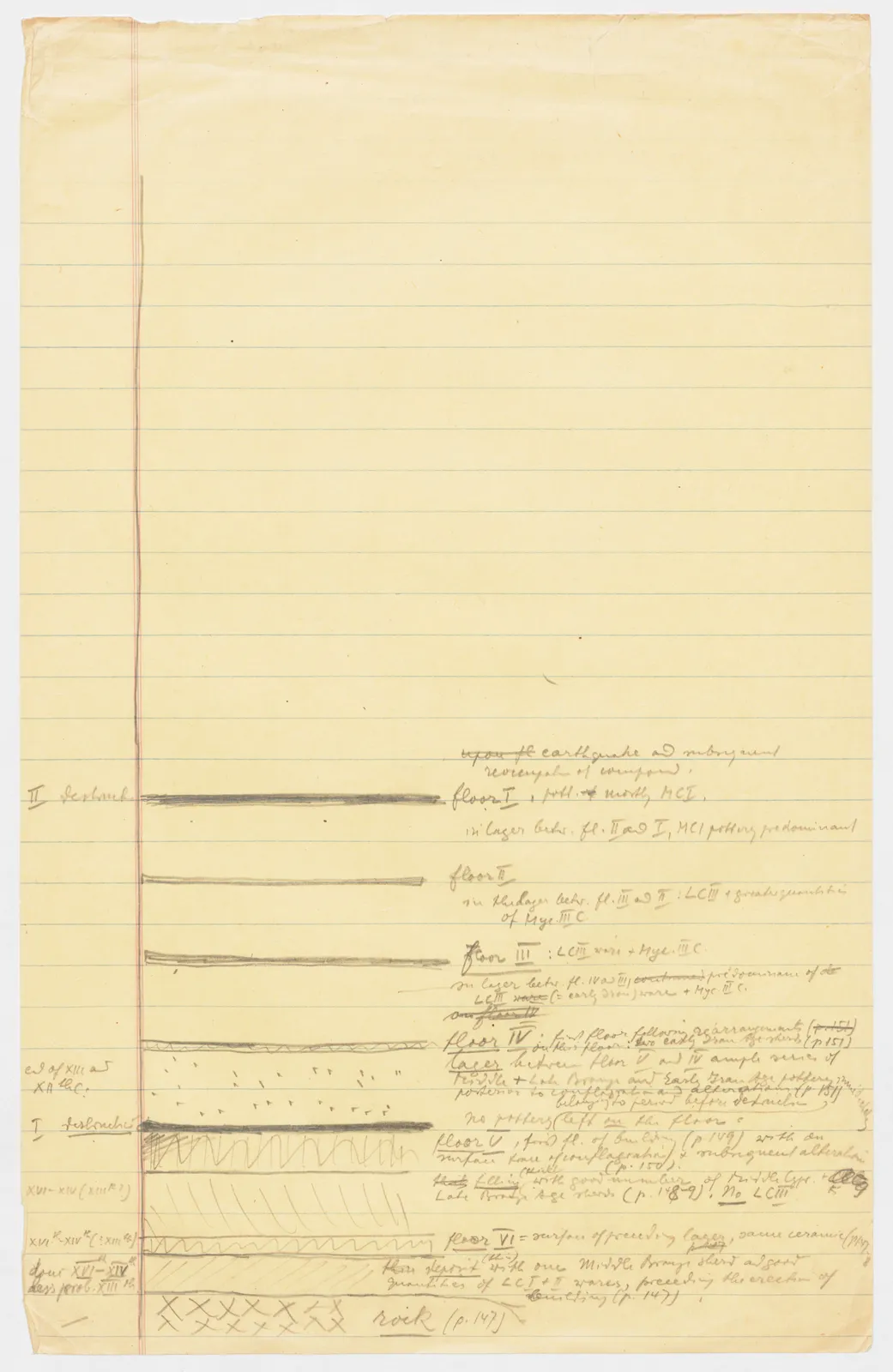
Drawing: stratigraphic diagram on the left showing six horizontal floor bands (I to VI), intermediate layers with stippling, hatching, and crosses at the base for rock
II destruct.upon fl. earthquake and subsequent reoccupat. of compound. floor I, pott. f mostly MCI, in layer betw. fl. II and I, MCI pottery predominant
floor II in the layer betw. fl. III and II: LC III + greater quantities of Myc. III C.
end of XIII andXII th C.I destructionXVI-XIV (XIII th?)floor III: LC III ware + Myc. III C. in layer betw. fl. IV and III: continued predominance of th LC III ware (= Early Iron) ware + Myc. III C. on floor IV floor IV: first floor following rearrangements (p. 151) on this floor: two Early Iron Age sherds (p 151) layer between floor V and IV ample series of rubble + Late Bronze and Early Iron Age pottery [written sideways: mixed together] posterior to conflagration and alterations (p. 151) belonging to period before destruction no pottery left on the floor floor V, first fl. of building (p 149) with on surface trace of conflagration + subsequent alterations ~(thick)~ (p. 150). thick filling with good number of Middle Cypr. + L C Late Bronze Age sherds (p. 148-9). No LC III
XVI th-XIV th (? XIII th)d'puis XVI th-XIV thless prob. XIII thfloor VI = surface of preceding layer, same ceramic (p 147 148) thin deposit ~(th.)~ with one Middle Bronze sherd and good quantities of LCI + II wares, preceding the erection of building (p. 147). rock (p. 147)
65 figures hard to readstruck struck outadded written in above” jug ditto, and what it repeatsword reading not certain