
Unnumbered pageScan 152 of 165
Continued from scan 151
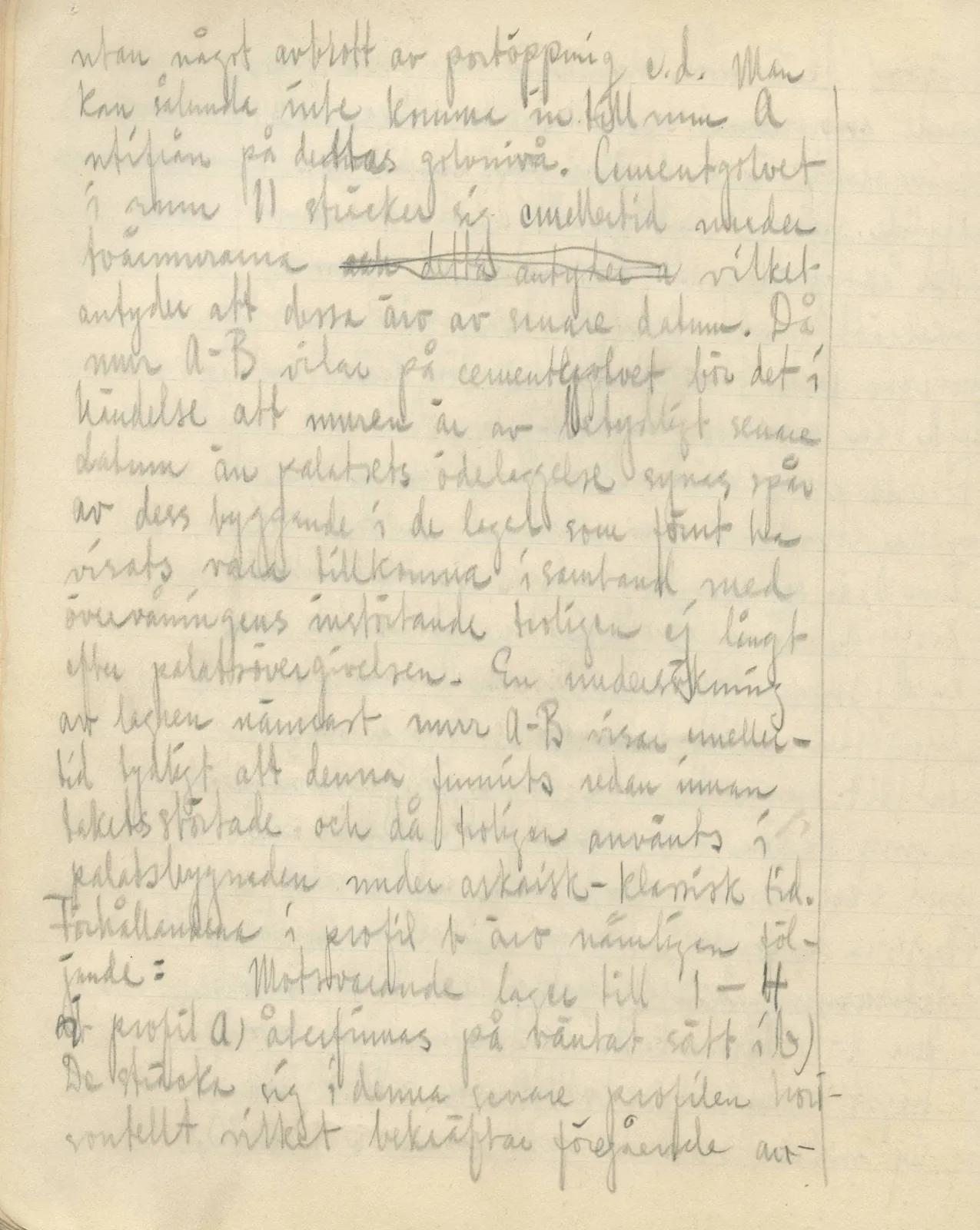
… without any break for a gateway or the like. One cannot thus enter room A from outside at the level of its floor. The cement floor in room II, however, extends beneath the transverse walls, and this suggests a which suggests that these are of later date. Since wall A-B rests on the cement floor, if the wall is of considerably later date than the destruction of the palace, traces of its construction should be visible in the layers that were earlier shown to have formed in connection with the collapse of the upper storey, probably not long after the abandonment of the palace. An examination of the layers closest to wall A-B shows, however, clearly that it was already there before the roof collapsed, and then probably used in the palace building during the Archaic-Classical period. The conditions in section b are namely as follows: The layers corresponding to 1-4 in section a) are found in the expected manner in b). In this latter section they extend horizontally, which confirms the preceding … continues
65 figures hard to readstruck struck outadded written in above” jug ditto, and what it repeatsword reading not certain