
Field photograph·Csn0223
Nicosia
Description
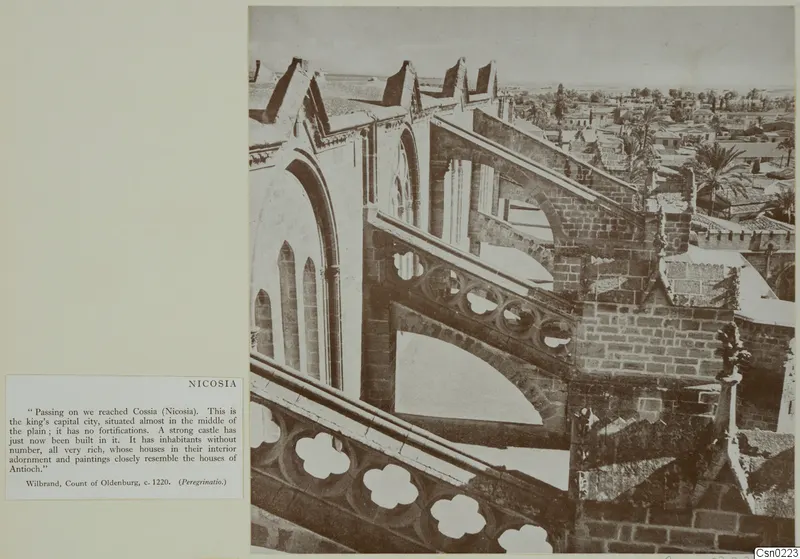
A photograph mounted on a card, taken from a high point over the roofs of Nicosia. In the foreground a stone building with pointed gables, arched openings and a balustrade of round panels runs diagonally across the frame. Beyond it, flat-roofed houses and palm trees stretch towards a hazy horizon, and a printed quotation sits on the card at left.
Other scan of this record (1)
- Description, scan 2
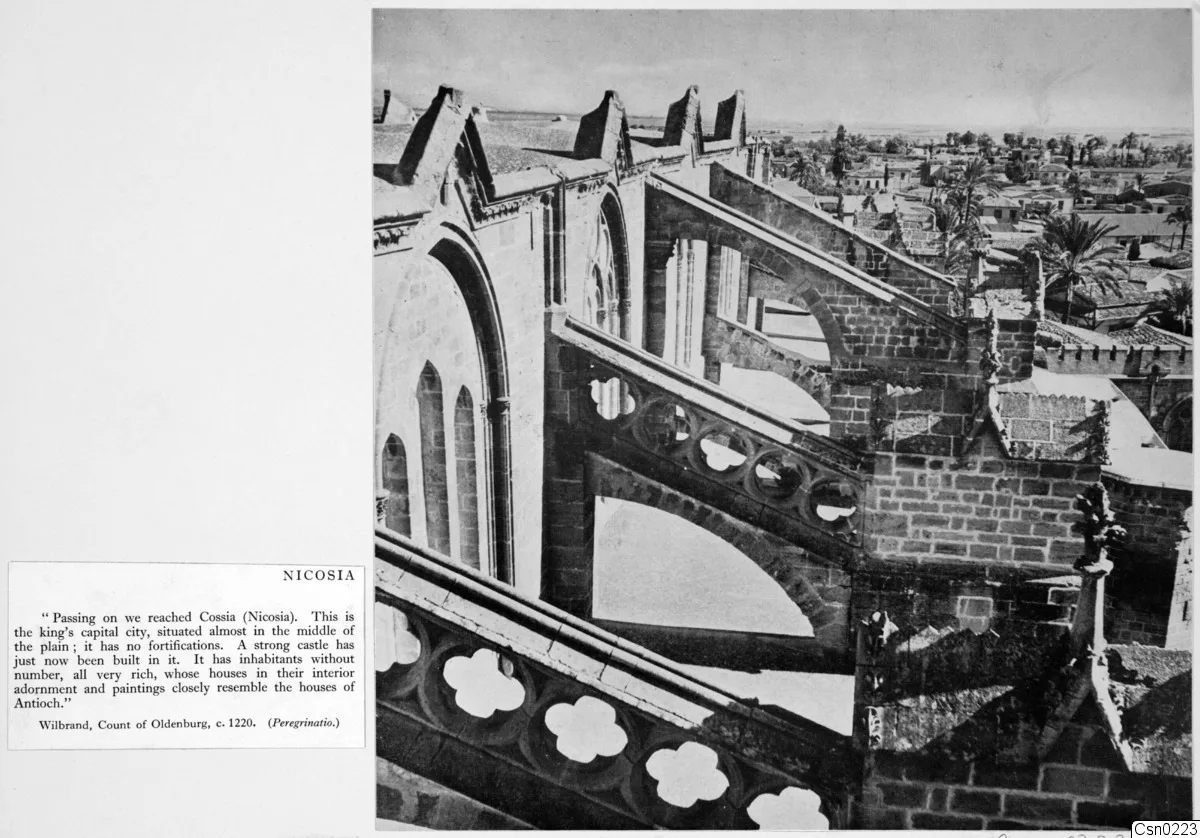
- A grey-toned photograph shows a stone building in the foreground with a row of pointed arched openings, a parapet with circular openings, and gabled roofs. Beyond it a town of low flat roofs and palm trees stretches to a flat horizon under an open sky. At left, a printed text block sits on the white page beside the photograph.
English, as on the record
NICOSIA "Passing on we reached Cossia (Nicosia). This is the king´s capital city, situated almost in the middle of the plain; it has no fortifications. A strong castle has just now been built in it. It has inhabitants without number, all very rich, whose houses in their interior adornment and paintings closely resemble the houses of Antioch." Wilbrand, Count of Oldenburg, c.1220. (Peregrinatio.) (Image is from "Cyprus Calendar" which was published at least 1950-1954. Copies can be seen for example on website for The Centre of Visual Arts and Research (CVAR)).