
Unnumbered pageScan 49 of 92
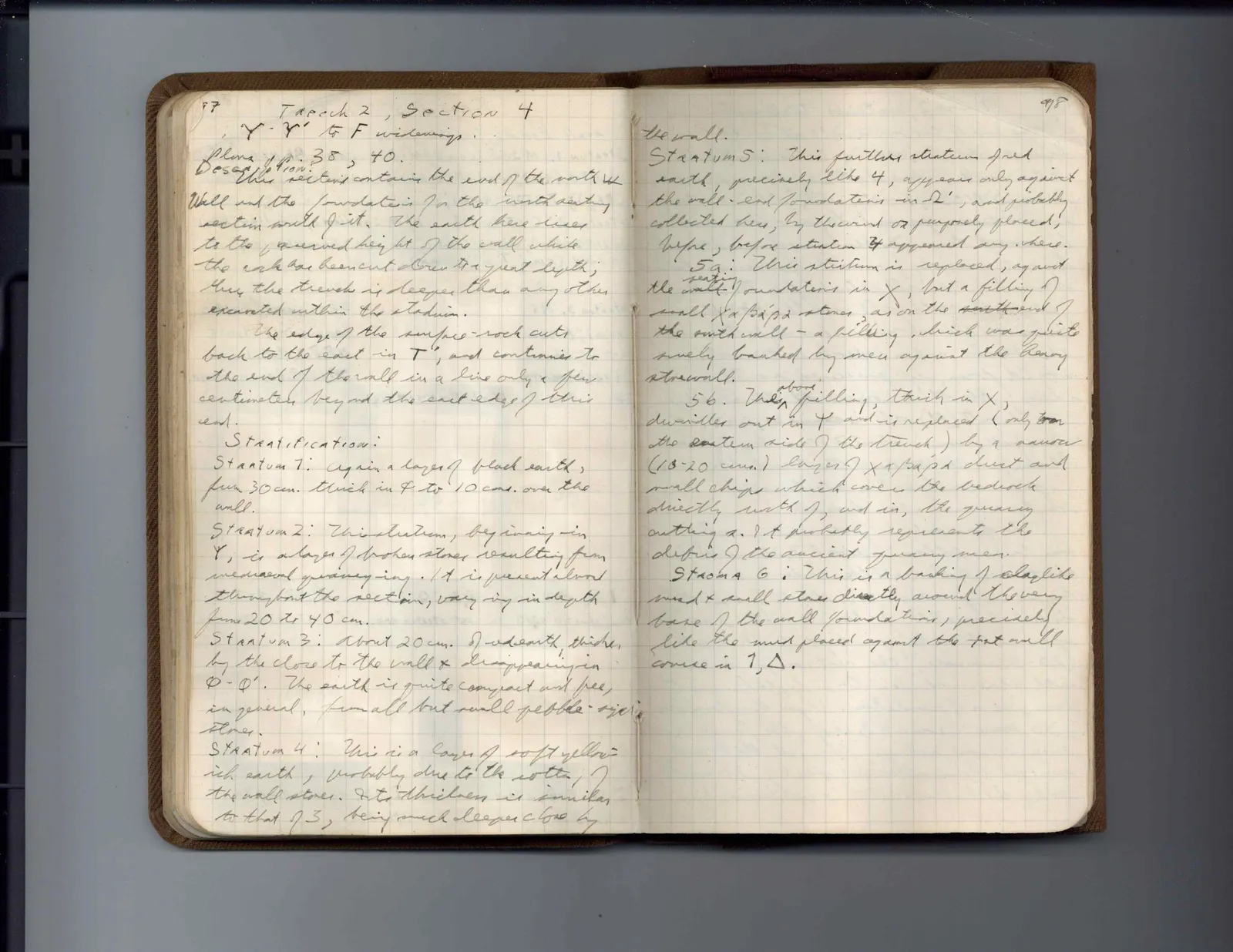
97 Trench 2, Section 4 Y-Y' to F widenings. Plans [illegible], 38, 40. Description: This section contains the end of the north [illegible] wall and the foundations for the north seating section south of it. The earth here rises to the preserved height of the wall while the rock has been cut down to a great depth; thus the trench is deeper than any other excavated within the stadium. The edge of the surface-rock cuts back to the east in T', and continues to the end of the wall in a line only a few centimeters beyond the east edge of this end.
Stratification: Stratum 1: Again a layer of black earth, from 30 cm. thick in F to 10 cms. over the wall. Stratum 2: This stratum, beginning in Y, is a layer of broken stones resulting from mediaeval quarrying. It is present almost throughout the section, varying in depth from 20 to 40 cm. Stratum 3: about 20 cm. of red earth, thicker by far close to the wall & disappearing in O-O'. The earth is quite compact and free, in general, from all but small pebble-sized stones. Stratum 4: This is a layer of soft yellowish earth, probably due to the rotting the wall stones. Its thickness is similar to that of 3, being much deeper close by
Right page
98 the wall. Stratum 5: This further stratum of red earth, precisely like 4, appears only against the wall-and foundations in Ω', and probably collected here, by the wind or purposely placed, before, before stratum 4 appeared anywhere. 5a: This stratum is replaced, against the wall- seating foundations in X, but a filling of small xapápa stones, as on the north end of the south wall - a filling which was quite surely banked by men against the heavy stone wall. 5b. This above filling, thick in X, dwindles out in Y and is replaced (only near the eastern side of the trench) by a narrow (10-20 cms.) layer of xapápa dust and small chips which cover the bedrock directly north of, and in, the quarry cutting a. It probably represents the debris of the ancient quarrymen. Stroma 6: This is a backing of claylike mud & small stones directly around the very base of the wall foundations, precisely like the mud placed against the first wall course in 1, Δ.
65 figures hard to readstruck struck outadded written in above” jug ditto, and what it repeatsword reading not certain