
Unnumbered pageScan 36 of 92
Trench 7
71
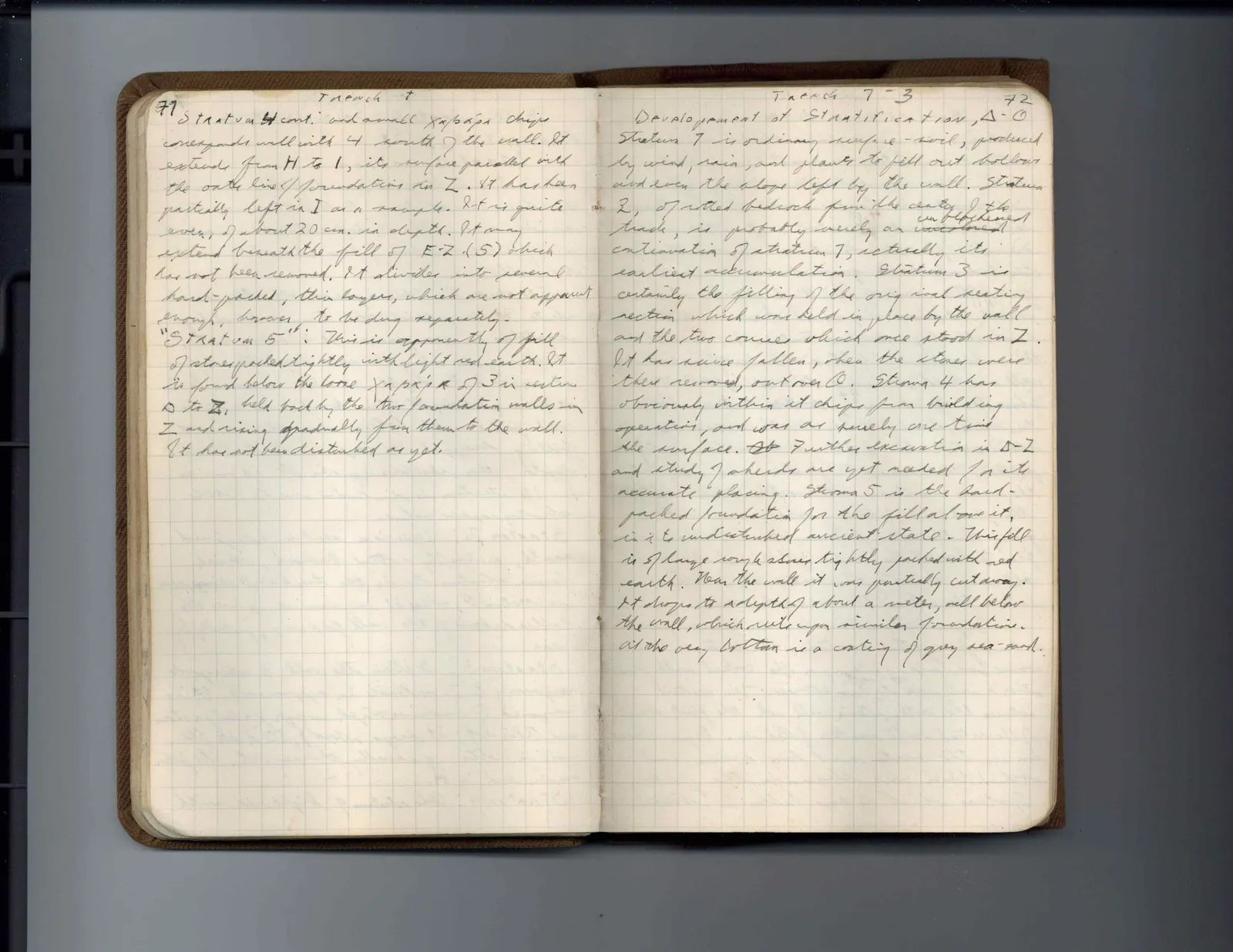
Stratum 4 cont. and small χαλίκι chips corresponds well with 4 south of the wall. It extends from H to I, its surface parallel with the outer line of foundations in Z. It has been partially left in I as a sample. It is quite even, of about 20 cm. in depth. It may extend beneath the fill of E Z (5) which has not been removed. It divides into several hard-packed, thin layers, which are not apparent enough, however, to be dug separately.
"Stratum 5": This is apparently of fill of stones packed tightly with light red earth. It is found below the loose χαλίκι of 3 in sections Δ to Z, held back by the two foundation walls in Z and rising gradually from them to the wall. It has not been disturbed as yet.
Right page
Trench 7-3
72
Developement of Stratification, Δ - Θ Stratum 1 is ordinary surface-soil, produced by wind, rain, and plants to fill out hollows and even the slope left by the wall. Stratum 2, of rotted bedrock from the donkey unbleached track track, is probably merely an uncolored continuation of stratum 1, actually its earliest accumulation. Stratum 3 is certainly the filling of the original seating section which was held in place by the wall and the two courses which once stood in Z. It has since fallen, when the stones were then removed, out over Θ. Stratum 4 has obviously within it chips from building operation, and was as surely one time the surface. Yet further excavation in Δ-Z and study of sherds are yet needed for its accurate placing. Stratum 5 is the hardpacked foundation for the fill above it, in its undisturbed ancient state. This fill is of large rough stones tightly packed with red earth. Near the wall it was partially cut away. It drops to a depth of about a meter, well below the wall, which rests upon similar foundation. At the very bottom is a coating of grey sea-sand.
65 figures hard to readstruck struck outadded written in above” jug ditto, and what it repeatsword reading not certain