
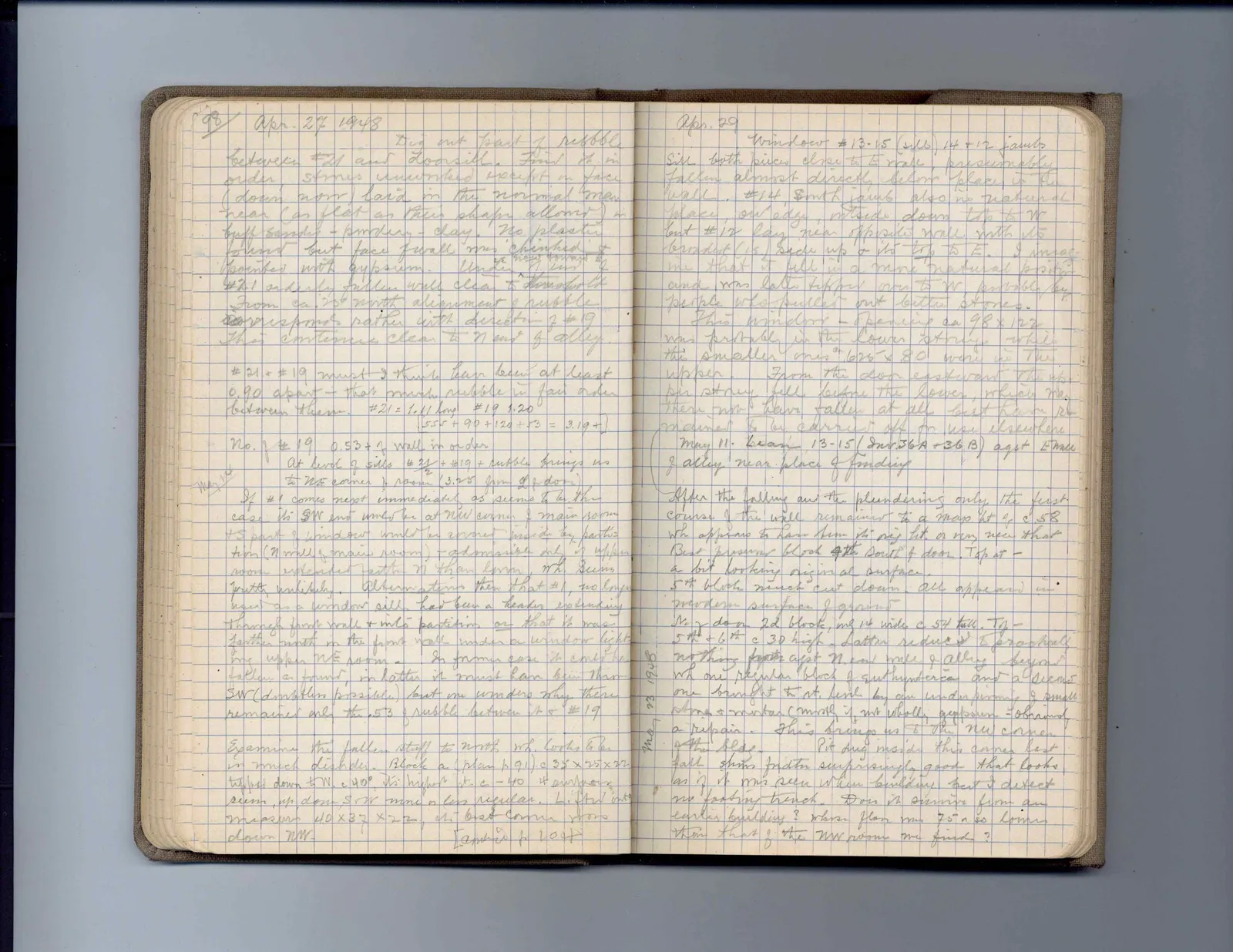
Page 98Scan 42 of 63
Apr. 27 1948
Dig out is now cleared to part of rubble between #21 and doorsill. Find it in order, stones unworked except on face (down now) laid in the normal manner (as flat as their shapes allowed) in buff sandy - powdery - clay. No plaster found but face is now toward E wall was "chinked" & pointed with gypsum. Under N end of #21 orderly fallen wall clear to doorsill From ca. 75m north alignment of rubble corresponds rather with direction of #19. This continues clear to N end of alley.
#21 + #19 must I think have been at least 0.90 apart - that much rubble in fair order between them. #21 = 1.11 long #19 1.20
5.55 + 90 + 120 + .53 = 3.19 +
No. of #19 0.53 + of wall in order. At level of sills [diagram] #21 + #19 + rubble brings us to NE corner of room (3.25 from E of door)
Margin left: May 10
If #1 comes next immediately as seems to be the case its SW end would be at NW corner of main room + E part of window would be covered inside by partition (N wall of main room) - admissible only if upper room extended farther N than lower, wh. seems pretty unlikely. Alternatives then that #1, no longer used as a window sill, had been a header extending through front wall + into partition or that it was farther north on the front wall under a window lighting upper NE room. In former case it could ha fallen as found; in latter it must have been thrown SW (doubtless possible) but one wonders why there remained only the .53 of rubble between it & #19
Examine the fallen stuff to north, wh. looks to be in much disorder. Block a (plan p 91) c 35 × 25 × 22 tipped down to W. c 40° its highest pt. c. - 40 #bnext seen, up down S + N more or less regular. Lintel onto measures 40 × 37 × 22. its best corner now down NW. [continued to p 100]
Right page
Apr. 29 Window #13-15 (sills) 14 + 12 jambs Sill both pieces close to E wall, presumably fallen almost directly below 'places' in the wall. #14 South jamb also no natural place on edge, inside down top to W but #12 lay near opposite wall with its broadest (1st) side up & its top to E. I imagine that it fell in a more natural position and was later tipped over to W probably by people who pulled out better stones. This window - opening ca 98 × 127 was probably in the lower story, while the smaller ones 76-80? × 80 were in the upper. From the door eastward the upper story fell before the lower, which mathen not have fallen at all but have pr [illegible] & by carried off for use elsewhere
May 11Lean 13-15 (Inv. 36 A + 36 B) agst E wall of alley near place of finding
After the falling and the plundering only the first course of the wall remained to a max ht of c 58 wh appears to have been its orig ht, or very near that Best preserved block 4th South of door. Top pt - a bit looking original surface. 5th block much cut down all appeared in modern surface of ground N of door 2d block, only 14 wide, c 54 tall. Tif- 5th + 6th c 30 high. Latter reduced to practically nothing from agst N end wall of alley, beyond wh one regular block of quithynterca and a second one brought to st. level by an underpinning of small stones + mortar (mostly if not wholly gypsum - obviously a repair. This brings us to the NW corner of the bldg.
Margin left: May 23 1948
Pit dug inside this corner last fall shows plaster surprisingly good that looks as if it was seen when building, but I detect no footing trench. Does it survive from an earlier building? whose floor was 75 or so lower than that of the NW room we find?
65 figures hard to readstruck struck outadded written in above” jug ditto, and what it repeatsword reading not certain