
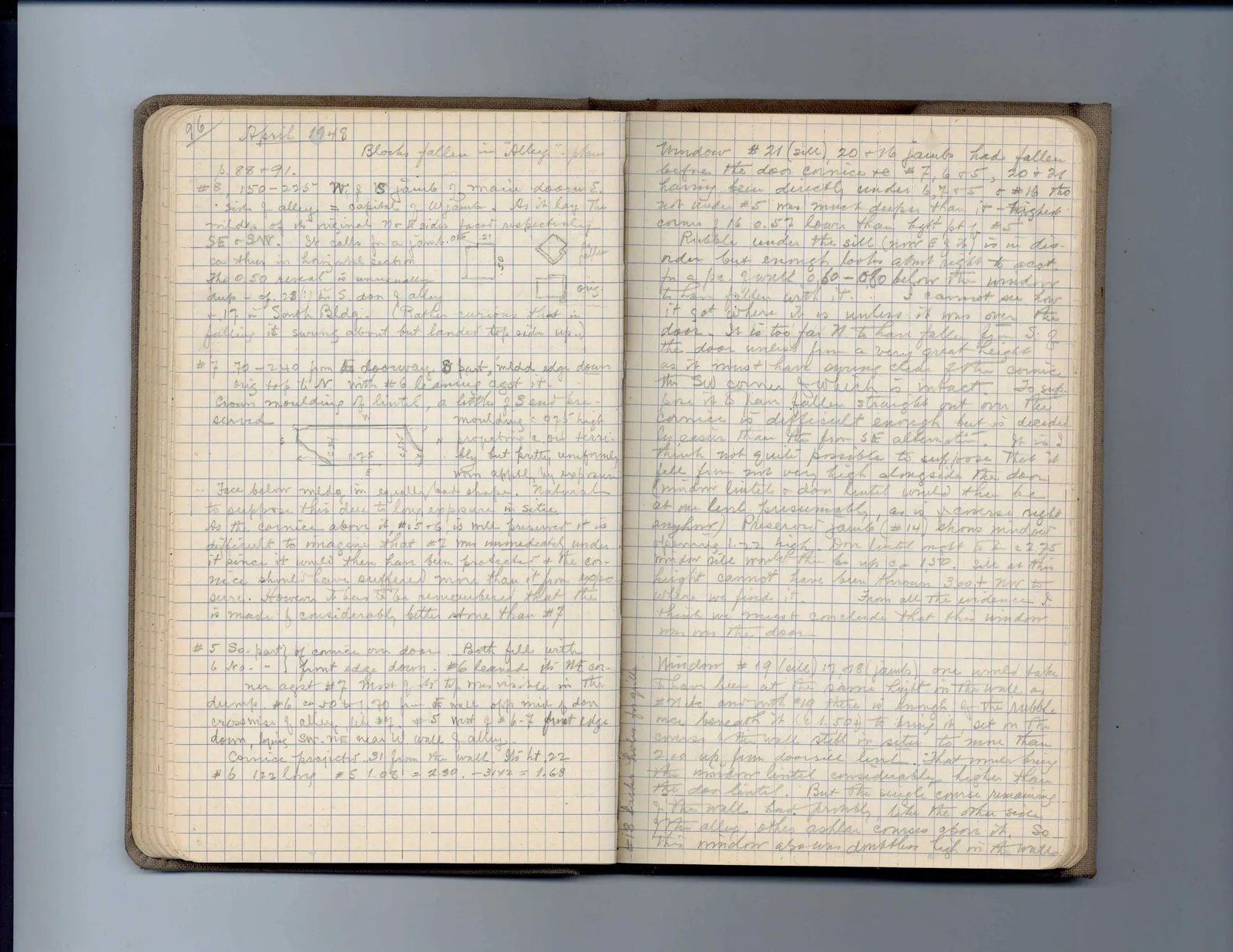
Page 96Scan 41 of 63
April 1948 Blocks fallen in "Alley" - plan p. 88 + 91.
#8 1.50 - 2.25 W. of E jamb of main door in E. side of alley = capital of W jamb. As it lay the mldgs on its originals N & E sides faced respectively SE & SW. It calls for a jamb ca thus in horizontal section
Drawing: L-shaped plan; labels: .085, .21, .50
Drawing: square with central square pattern; labels: pillar, orig.
The 0.50 reveal is unusually deep - cf. .28(?) in S. door of alley & .17 in South Bldg. (Rather curious that in falling it swung about but landed top side up.)
#7 .70 - 2.40 from to doorway, E part, mldd edge down, orig. top to N. with #6 leaning agst it. Crown moulding of lintel, a little of E end preserved.
Drawing: cross section of block; labels: S, W, 1.75, E, N, 0.25
moulding c .075 high projecting c .04 terribly but pretty uniformly worn off all, by exposure. Face below mldg. in equally bad shape. Natural to suppose this due to long exposure in situ. As the cornice above it, #s 5 & 6, is well preserved it is difficult to imagine that #7 was immediately under it since it would then have been protected & the cornice should have suffered more than it from exposure. However it has to be remembered that the is made of considerably better stone than #7.
#5 So. part) of cornice over door. Both fell with 6 No. - ) front edge down. #6 leaned its NE corner agst #7. Most of its W. was visible in the dump. #6 ca .50 to 1.70 from W wall opp mid of door crosswise of alley, like #7. #5 west of #6-7, front edge down, facing SW - NE, near W. wall of alley.
Cornice projects .31 from the wall. Its ht .22 #6 1.22 long #5 1.08 = 2.30 - .31x2 = 1.68
Right page
Window #21 (sill), 20 & 16 jambs had fallen before the door cornice +c #7, 6 & 5. 20 & 21 having been directly under 6, 7 & 5 & #16 tho not under #5 was much deeper than it - highest corner of 16 0.57 lower than hgst pt of #5. Rubble under the sill (now E of it) is in disorder, but enough looks about right to acc't for a pc. of wall 0.60 - 0.80 below the window to have fallen with it. I cannot see how it got where it is unless it was over the door. It is too far N to have fall from S. of the door, unless from a very great height as it must have sprung clear of the cornic the SW corner of which is intact. To suppose it to have fallen straight out over the cornice is difficult enough, but is decidedly easier than the from SE alternative. It is I think not quite possible to suppose that it fell from not very high alongside the door (window lintel & door lintel would then be at one level, presumably, as is of course right anyhow). Preserved jamb (#14) shows window opening 1.22 high. Door lintel ought to be c 2.75 window sill would then be up ca 1.50. Sill at this height cannot have been thrown 3.00+ NW to where we find it. From all the evidence I think we must conclude that this window was over the door.
Margin left: #18 looks rather too quite
Window #19 (sill) 17 & 18 (jambs) one would take to have been at the same height in the wall as #Ns to and with #19 there is enough of the rubble now beneath it (c 1.50+) to bring it set on the courses of ashlar wall still in situ to more than 2.00 up from doorsill level. That would bring the window lintel considerably higher than the door lintel. But the single course remaining of the wall had probably, like the other side of the alley, other ashlar courses above it. So this window also was doubtless high in the wall.
65 figures hard to readstruck struck outadded written in above” jug ditto, and what it repeatsword reading not certain