
Page 76Scan 32 of 34
Erimi tomb, cont'd
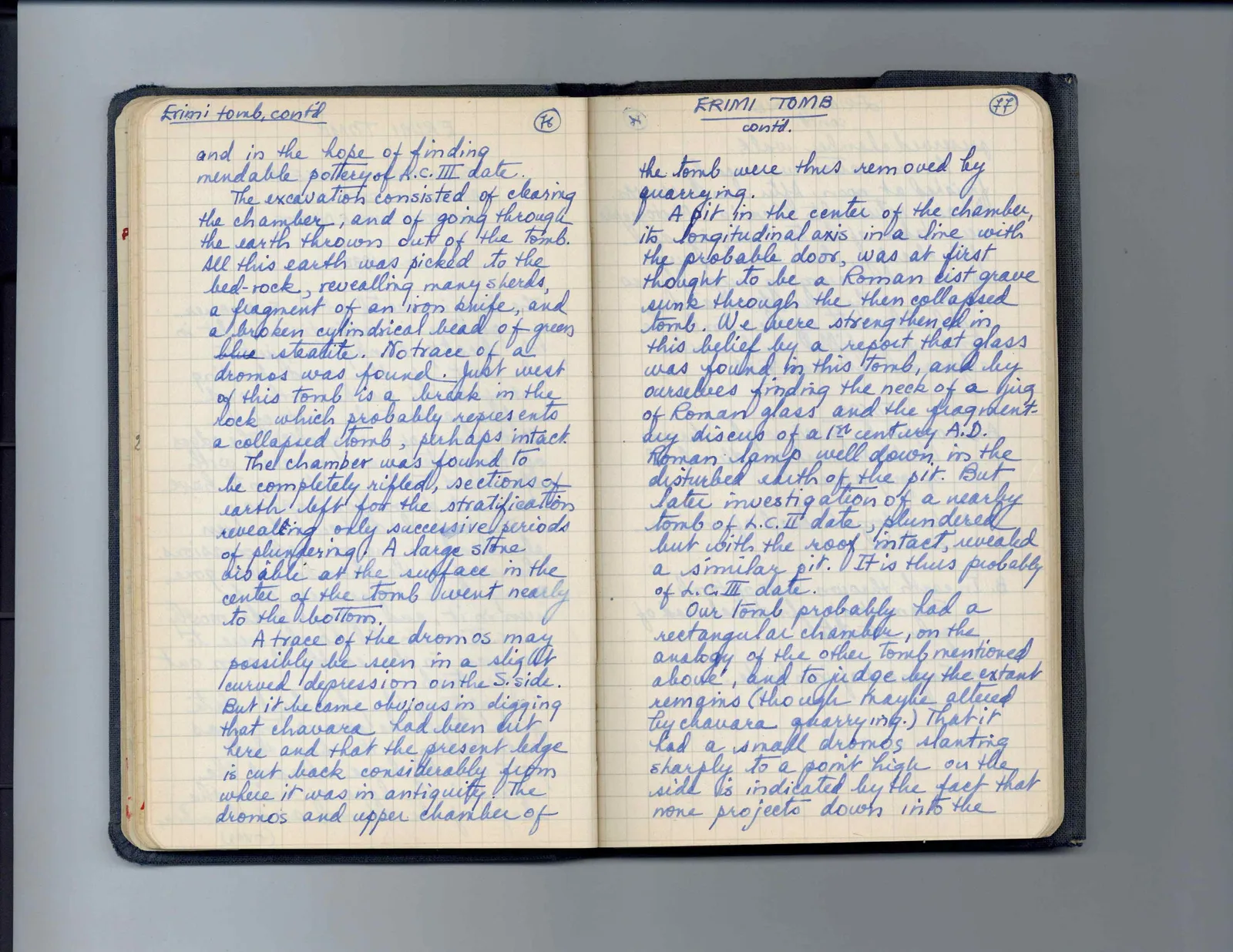
and in the hope of finding mendable pottery of L.C. III date. The excavation consisted of clearing the chamber, and of going through the earth thrown out of the tomb. All this earth was picked to the bed-rock, revealing many sherds, a fragment of an iron knife, and a broken cylindrical bead of green blue steatite. No trace of a dromos was found. Just west of this tomb is a break in the rock which probably represents a collapsed tomb, perhaps intact. The chamber was found to be completely rifled, sections of earth left for the stratification revealing only successive periods of plundering. A large stone visable at the surface in the center of the tomb went nearly to the bottom. A trace of the dromos may possibly be seen in a slight curved depression on the S. side. But it became obvious in digging that chavara had been cut here and that the present ledge is cut back considerably from where it was in antiquity. The dromos and upper chamber of
Right page
ERIMI TOMB cont'd.
the tomb were thus removed by quarrying. A pit in the center of the chamber, its longitudinal axis in a line with the probable door, was at first thought to be a Roman cist grave sunk through the then collapsed tomb. We were strengthened in this belief by a report that glass was found in this tomb, and by ourselves finding the neck of a jug of Roman glass and the fragmentary discus of a 1^st century A.D. Roman lamp well down in the disturbed earth of the pit. But later investigation of a nearby tomb of L.C. II date, plundered but with the roof intact, revealed a similar pit. It is thus probably of L.C. III date. Our tomb probably had a rectangular chamber, on the analogy of the other tomb mentioned above, and to judge by the extant remains (though maybe altered by chavara quarrying.) That it had a small dromos slanting sharply to a point high on the side is indicated by the fact that none projects down into the
65 figures hard to readstruck struck outadded written in above” jug ditto, and what it repeatsword reading not certain