
Unnumbered pageScan 12 of 67
12
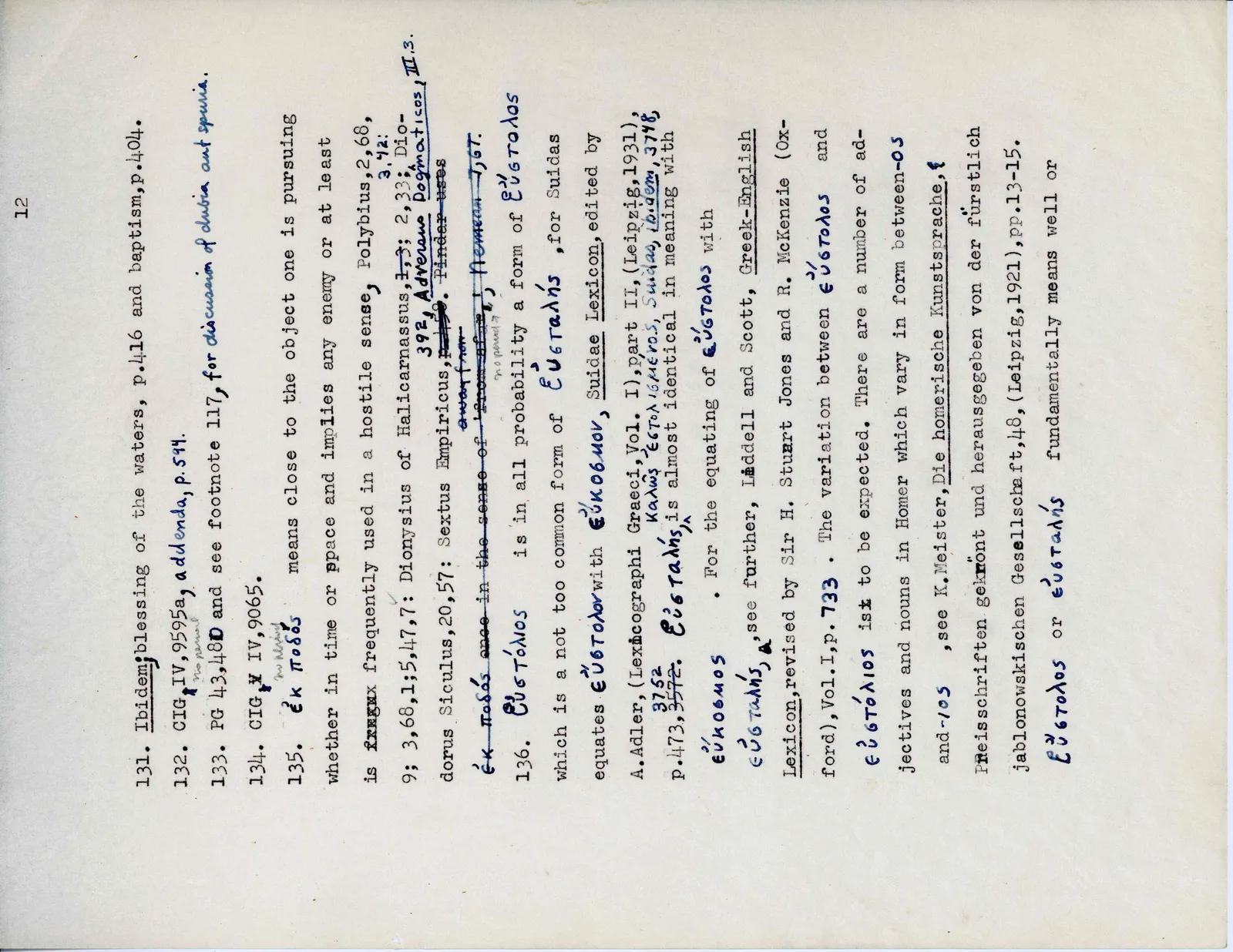
131.Ibidem, blessing of the waters, p.416 and baptism,p.404.
132.CIG IV,9595a, [handwritten: addenda, p.594] and see footnote 117, [handwritten: for discussion of chrisma and spunia].
133.PG 43,48D and see footnote 117 [handwritten: no nemand]
134.CIG IV IV,9065. [handwritten: no hdnd]
135.[handwritten: ἐκ ποδὸς] means close to the object one is pursuing whether in time or space and implies any enemy or at least is xxxx frequently used in a hostile sense, Polybius,2,68,9; 3,68,1;5,47,7; Dionysius of Halicarnassus,1,73; 2,33; [handwritten: 392, Adversus Dogmaticos, III.3; 3.42:] Diodorus Siculus,20,57: Sextus Empiricus,Pyrr. Pindar uses [handwritten: ἐκ ποδὸς once in the sense of 'from']
Nemean 1,67.
Handwritten: ἐκ ποδὸς once in the sense of 'from' ... no parallel
136. [handwritten: Εὐσταλὸς] is in all probability a form of [handwritten: Εὔσταλὴς], for Suidas which is a not too common form of [handwritten: εὐκόλονον] equates [handwritten: εὐστολον] with [handwritten: εὐκοσμον], Suidae Lexicon, edited by A.Adler, (Lexicographi Graeci, Vol. I),part II,(Leipzig,1931), p.473, 3572. [handwritten: Εὐστάλης], [handwritten: Καλὼς ἐὐστολιήμερος, Suidas, ibidem, 3748, 3752] is almost identical in meaning with [handwritten: εὐκόσμον]
{hw: · For the equating of εὐκόσμος with εὐκόσμος, see further, Liddell and Scott, Greek-English Lexicon,revised by Sir H. Stuart Jones and R. McKenzie (Oxford), Vol.I,p.733. The variation between εὐστόλιος and εὐστολος is to be expected. There are a number of adjectives and nouns in Homer which vary in form between -os and -ios, see K.Meister,Die homerische Kunstsprache, §and-105, Preisschriften gekrönt und herausgegeben von der fürstlich jablonowskischen Gesellschaft,48,(Leipzig,1921),pp.13-15. εὔστολος or εὐστάλης fundamentally means well or
65 figures hard to readstruck struck outadded written in above” jug ditto, and what it repeatsword reading not certain