
Vounous: the Bronze Age society we know only from its dead
Three teams of diggers opened more than 160 rock-cut tombs on a hill above Bellapais and built almost everything we know about Early Bronze Age Cyprus out of how one community buried its dead. The village those people lived in has never been found, and since 1974 the cemetery itself has lain out of reach.
Alexis Drakopoulos
June 16, 2026·Archeology · History·21 min read


Alexis Drakopoulos is a Greek Cypriot Machine Learning Engineer working in Financial Crimes. He is passionate about Archeology and making it accessible to everyone. About Me.
In Tomb 19 on the Vounous hill, two people were laid side by side and arranged so that their hands met. Small bowls had been tucked into the crook of an arm, close to the face, where a sleeper might keep a cup of water. Under both bodies, and heaped around them, were the bones of cattle. Among the things left with the dead lay a single bronze dagger of a kind no Cypriot smith made: a flat, riveted blade cast on Crete, at the far western edge of the sea, somewhere around the turn of the second millennium BC. [1]
Almost everything this chapter can tell you about the people of Vounous is in that one chamber. The care taken over the dead. The meat of slaughtered oxen. The rare foreign object that fixes a date and hints at a wider world. And the catch that shadows all of it: a tomb is the only kind of place these people left us. The settlement where they lived, ate, spun wool, argued and slept has never been found, and not for want of looking. We meet the community of Vounous only at its own funerals.
The hill sits on the narrow coastal shelf of north Cyprus, below the steep limestone wall of the Kyrenia range, about two and a half kilometres from the village of Bellapais and its later Gothic abbey. The people buried there belonged to the Early Bronze Age, a world with no kings, no cities, no temples and no writing of any kind. [15] Porphyrios Dikaios, the Cyprus Museum curator who first cleared the cemetery in 1931 and 1932, sorted his tombs into three periods and dated them roughly 2600 to 2100 BC. The relative order he built has held; the calendar has not. Radiocarbon from later settlement digs has since pulled the whole Early Cypriot sequence down by two or three centuries, into a span around 2400 to 2000 BC. [5] Vounous runs across most of it, from its earliest graves to the threshold of the Middle Bronze Age.
A hill chosen because the rock was soft
The cemetery covers the north-facing slope of a low hillock, hemmed by ravines on east and west, falling away toward the sea. [1] The spot was chosen for a practical reason. The bedrock here is a soft, even limestone, easy to quarry with simple tools yet firm enough to hold a roof over a hollowed-out room. [13] Dikaios noted that the same softness made his job and the robbers' equally easy: where the rock was good, the digging was good, for everyone.
The standard tomb has three parts. An open trench, the dromos, is cut down into the rock and ends at a low doorway, the stomion, sealed with a limestone slab or wedged stones. Behind the door lies a rounded underground chamber two to four metres across, sometimes two or three chambers off a single passage. The doorways almost all face north, down the slope toward the water.
A tomb was not a single grave. It was a facility, opened and reopened across generations for one burial after another. When the floor filled, the older occupants were treated with what reads, to us, as startling unconcern: their bones and their grave goods were swept aside, gathered against the back wall, or piled at the front to make room. In Tomb 17 the earlier dead were pushed against the rear wall; in Tomb 36, where nine people were eventually buried, the oldest were heaped at the entrance, and only one skeleton survived in one piece. [1]
Some of the handling was more deliberate than tidying, and it focused on the skull. Bodies are sometimes represented by a skull alone; long bones are found grouped together; and at Tomb 164A, in the earliest sector, two complete skeletons were laid out without their heads, the skulls set symmetrically nearby. The anatomist who examined them found no sign of decapitation. The heads had been taken later, once the flesh was gone, and put back in a new arrangement. [2] This singling-out of the skull is more pronounced at Vounous than almost anywhere else on the island.
Against that, Tomb 19 stands out for its tenderness, and so do the smaller kindnesses elsewhere: a bowl set into a dead hand near the face, a pair laid to hold hands. The same cemetery that swept its grandparents into a corner could also bury two people with evident care.
Over the cemetery's life the chambers grew larger and held more people. Average floor space roughly doubled, from about 3.7 to 7.2 square metres, and the number of burials per chamber rose from around one and a half to nearly three. [2] The tomb was becoming the permanent property of a kin group, a fixed point a family came back to. And one tomb was prepared for a burial that never came: Tomb 10 was found finished and empty, its door-slab in place, its dromos already filled with earth. [1] It shows that the passages were backfilled between burials and dug out again for the next. It also leaves, on the hill, a single grave cut for someone who was never laid in it.
Oxen at the graveside
About a third of the Vounous tombs, early and late alike, held the bones of animals, and most of those bones were cattle. [2] They are not the neat leftovers of joints carried up ready to eat. Skulls, jaws and foot bones turn up alongside the meat-bearing parts, which means whole adult cattle were brought to the cemetery and butchered there. [3] In Tomb 13 a large inverted bowl, when lifted, revealed smaller bowls among animal bones, some still packed with bone as though they had gone into the ground full of meat; the floor was strewn with a good part of one animal. In Tomb 36 the floor carried much of an ox skeleton, a bowl ringed with relief bulls' heads and snakes held more ox bone, and two model ox-horns lay beside it. [1]
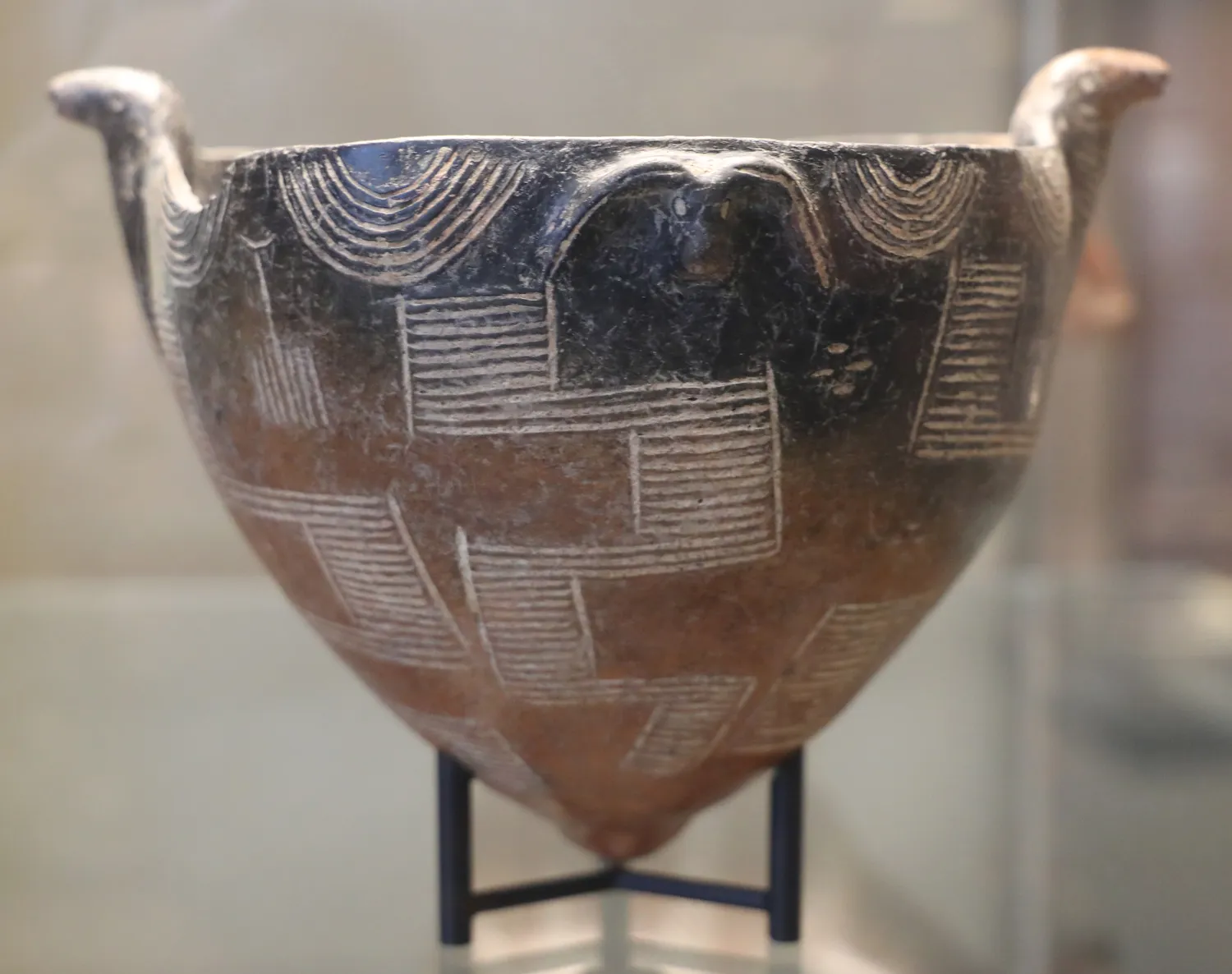
The picture is of a funeral that was also a feast. An animal was killed at the graveside, the dead given joints of beef along with the skull and feet, and the rest eaten by the mourners. Slaughtering adult cattle on this scale was not cheap, and the regularity of it across the cemetery points to a community producing a real surplus. [3] The drinking equipment says the same thing: tall conical cups known as tulip bowls, often incised and packed with white filling, read as single-serving vessels for exactly this kind of shared drinking.
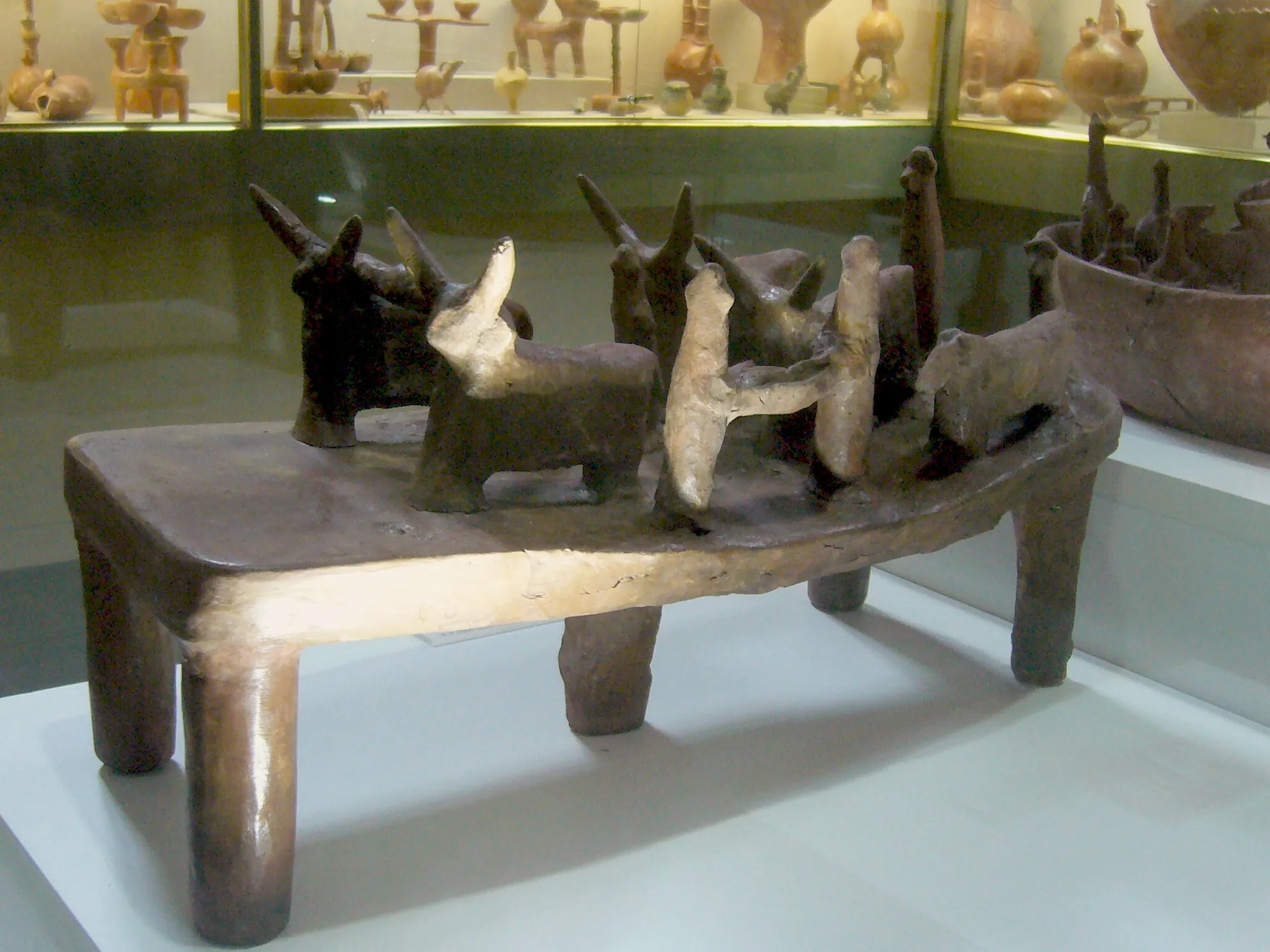
Cattle had only recently become central to Cypriot life. The Early Bronze Age brought what Andrew Sherratt named the secondary products revolution: the ox-drawn ard plough, the donkey, animals worked for traction and milk and wool rather than only killed for meat. The plough opened drier ground to cereals, and the herd became the main form of movable wealth. A looted Vounous tomb produced a clay model that puts the whole system on a tabletop: two yoked pairs of oxen drawing hook-ploughs, each with a ploughman, a pair carrying a seed-trough, a pack animal, an attendant, the wooden plough modelled in full. [9] The ox in the chamber, the ploughing model and the bulls' heads moulded onto the pottery are three faces of one cattle-centred economy.
The food itself has to be borrowed from the better-dug villages elsewhere on the island, since Vounous yields none of its own. Communities of this period grew wheat, barley, olives, pulses and grapes, kept sheep, goats, cattle, donkeys and pigs, and hunted wild deer to round out the diet. [15] Dikaios, looking at the rows of deep open bowls in the tombs, simply called them milk-bowls and read a pastoral life behind them. [1] Spindle whorls of clay and bone turn up in tomb after tomb, in well-stocked and meagre graves alike, the residue of spinning and weaving that probably filled much of the working day.
The politics of the funeral
Whether the people of Vounous were rich is a question the cemetery answers in two parts: some funerals were far better furnished than others, and the differences never hardened into a fixed aristocracy. [2] Across the 164 excavated tombs, 367 metal objects were recovered, knives, daggers, pins, tweezers and ornaments. [4] That is a respectable haul for an Early Cypriot site, and a meagre one beside what came out of the ground next door at Lapithos. The interesting thing is the spread inside Vounous.
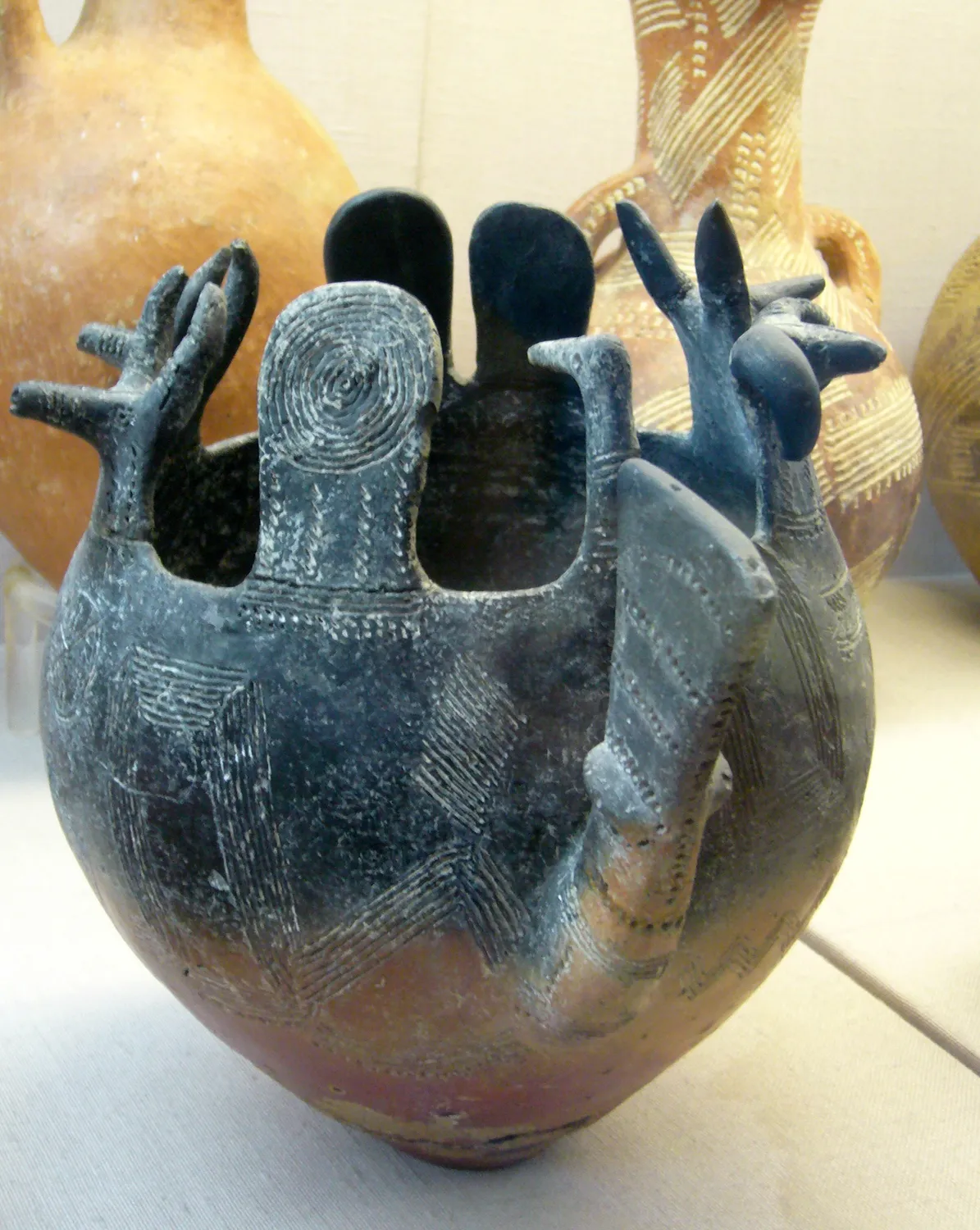
Priscilla Keswani's study of the cemetery found wealth that rose and fell rather than accumulating in a few hereditary hands. The objects that made Vounous famous, the modelled cult vessels, were scattered widely through the tombs, present in nearly half the early graves and over two-thirds of the late ones, and often missing from the richest assemblages; the great sanctuary model from Tomb 22 came from an otherwise unimpressive, looted chamber. [2] These were shared ceremonial gear rather than the badges of a ruling class.
Metal behaved the same way. It was present in about half the early tombs in small amounts, then dipped sharply in the middle phase, so sharply that five tombs made do with clay models of daggers and their sheaths in place of the real thing, and then surged in the latest phase, when three-quarters of chambers held metal and hook-tang weapons became common. [2] Those weapons run from 12 to 47.5 centimetres, some far too long to be used, which is competitive display in its plainest form: a thing made bigger than it needs to be because someone else's was big. The whole range shifted upward over time, the median along with the peak, so heavy spending at the graveside reached well below any narrow elite.
This is where the politics of Vounous actually lived. With no chiefs, no offices and no writing, authority had to be made and remade in public, and the public arena was the funeral. A family that could slaughter the most cattle, bury the most metal and gather the most mourners advanced its standing, and the next family answered at the next death. [2] The collective tomb did political work of its own. In a society without title deeds, a chamber full of one's named ancestors was the charter to the land around it, a claim staked in bone and renewed at every burial. The most lavish ritual fell on groups rather than individuals; standing rested on belonging to a group, and the group's hold on its ground was written in its dead.
Vounous also mattered, for a time, beyond its own slope, though in a way easy to misname. The north coast went in for elaboration, soft pottery worked with incision, relief and modelled scenes, while the centre and south used a plainer, harder ware with almost no decoration at all. [12] Edgar Peltenburg read the contrast as two antipathetic social systems sharing one island, an emulous north and a conformist, levelling south, and Webb and Frankel later gave the idea its fullest demonstration. On this reading Vounous was the leading ceremonial centre of the north coast for a couple of centuries, its standing resting on ritual and display rather than on force or trade. It was a centre of reputation rather than a capital.
The bowl from Tomb 22
The single most argued-over object from the cemetery came out of Tomb 22 in pieces, scattered across the floor where ancient robbers had apparently smashed it as worthless. [1] Reassembled, it is a shallow circular bowl about 37 centimetres across, its low wall broken on one side by a doorway with a raised lintel. Inside, modelled in clay, stands a crowd: about nineteen human figures and four cattle penned behind parapets, with a twentieth figure clinging to the outside of the wall, head and shoulders over the rim, looking in. [9] One figure holds an infant in a cradle. Others sit on benches with their arms folded. Three figures stand in relief against the wall opposite the door, horns rising from their heads and a wavy line hanging from their joined hands. One figure kneels. At the centre, on a tall-backed chair, sits a large figure in a head-dress, facing the three on the wall.
Vassos Karageorghis calls it the boldest piece of Bronze Age modelling on the island. The figures themselves are crude; what carries it is the arrangement. [9] What the scene shows has never been agreed. Dikaios saw a religious rite in a sacred enclosure: the three horned figures were gods or idols, the wavy line a snake, the penned oxen sacrificial, the man on the outer wall proof that the ceremony was secret and only the initiated could watch. [1] An entire snake cult, his critics later pointed out, rested on two small relief squiggles. In 1985 Desmond Morris took the reading apart and offered an ordinary village scene in its place: the round shape is just the shape of the bowl, the doorway is where a spout was removed, the man on the wall is leaning out of a window, the folded arms mean relaxation, the seated figure is the headman, the oxen are penned for the night, and the snakes are hanging ropes. [7]
From the early 1990s the question changed from which gods to which society. Sturt Manning, in a 1993 paper, read the seated figure as a particular person, a self-made big man surrounded by the sources of his standing: cattle, a mother and child, an assembled audience. Peltenburg argued that the composition itself, the wall, the controlled doorway, the excluded onlooker, encoded a new language of inclusion and exclusion, as northern families worked out who was inside the circle of authority and who was not. [8] Louise Steel, surveying the whole tangle in 2013, read the model as a costly, non-functional object whose making and burial advertised its owner's wealth, whatever ceremony it might show. [6]
There is no consensus, and the reason is built into the object. It is unique, broken, schematic and silent, and eighty years of changing assumptions have each found in it what they brought. What everyone accepts is the minimum: someone composed a careful, crowded, ranked scene around a seated figure and a walled doorway, and buried it in a grave, in a cemetery where the rituals of death were unusually elaborate.
Talking to the neighbours
How a community on this coast came to spend so much metal is a real puzzle, because the north coast has no copper of its own. [4] The island's ores lie in the lavas around the Troodos, 35 to 40 kilometres south, with the Kyrenia range in between. Every dagger and pin in the Vounous tombs arrived across that barrier, through routes over the mountain passes and along the Morphou Bay corridor to the sea, and a single clay blowpipe tip from one tomb shows that at least some melting and casting was done on the spot. [4] The wealth of Vounous came from its place on a network, not from anything under its own feet.
Within Cyprus, Vounous belonged to a tight north-coast circle, with its sister cemeteries at Lapithos and Karmi and the earlier centre at Vasilia. Pottery, copper, livestock and marriage partners moved along this coast and inland, and the elaborate Vounous style was shared, with local variation, by its neighbours. [12] Beyond the island, the story runs the other way. For all its display, Early Bronze Age Cyprus was an inward-looking place by the standards of the international Cyprus that came later, and the foreign objects in the Vounous tombs can almost be counted on two hands. [15] The Cretan dagger from Tomb 19 is the clearest Aegean import. [1] Catling and Karageorghis re-examined it in 1960 as a Minoan blade, now in the Birmingham museum, its herringbone perhaps added after it reached the island. [17] In Stewart's 1961 dig at the neighbouring cemetery of Karmi, a man was buried with an imported Minoan Kamares cup. A few plain storage jars came from the Syrian and Palestinian coast, along with faience beads, scraps of gold and a couple of foreign pins. [14] These cluster in the wealthiest tombs, which tells you they were prized exotica rather than everyday trade, and almost nothing demonstrably Cypriot travelled the other way before the very end of the sequence.
The wider trajectory of the north coast eventually left Vounous behind. When foreign demand for Cypriot copper revived toward the Middle Bronze Age, the advantage passed west to Lapithos, which lay beside a sheltered bay better suited to seaborne trade. [4] The contrast in the graves is stark: Lapithos's 122 tombs produced over 1,740 metal objects, nearly five times the Vounous total from fewer burials. By the start of the Middle Bronze Age Vounous was in decline, and burial on the hill ended in the following phase. The concentration of weapons in the tombs of both sites has been read as a sign that the handover was not entirely peaceful.
The village that was never found
For all the precision with which we can describe the dead of Vounous, the living have no address. The settlement that buried its people on the hill has never been located, and not for lack of trying. [10] Dikaios picked up a stone axe-head on a rise called Tzeranies across the western ravine, dug a trial trench, and found nothing under what looked like Byzantine debris. He noted a surface scatter of Bronze Age material on the slope between Bellapais and its Greek cemetery, but never excavated it. Robert Merrillees later mentioned a reported Early Cypriot site nearby, at a place called Gerani, that none of the three excavators ever tested. [10] Stewart, convinced that the Tomb 22 model copied a real sanctuary somewhere within reach of the cemetery, hunted for the building and never found it.
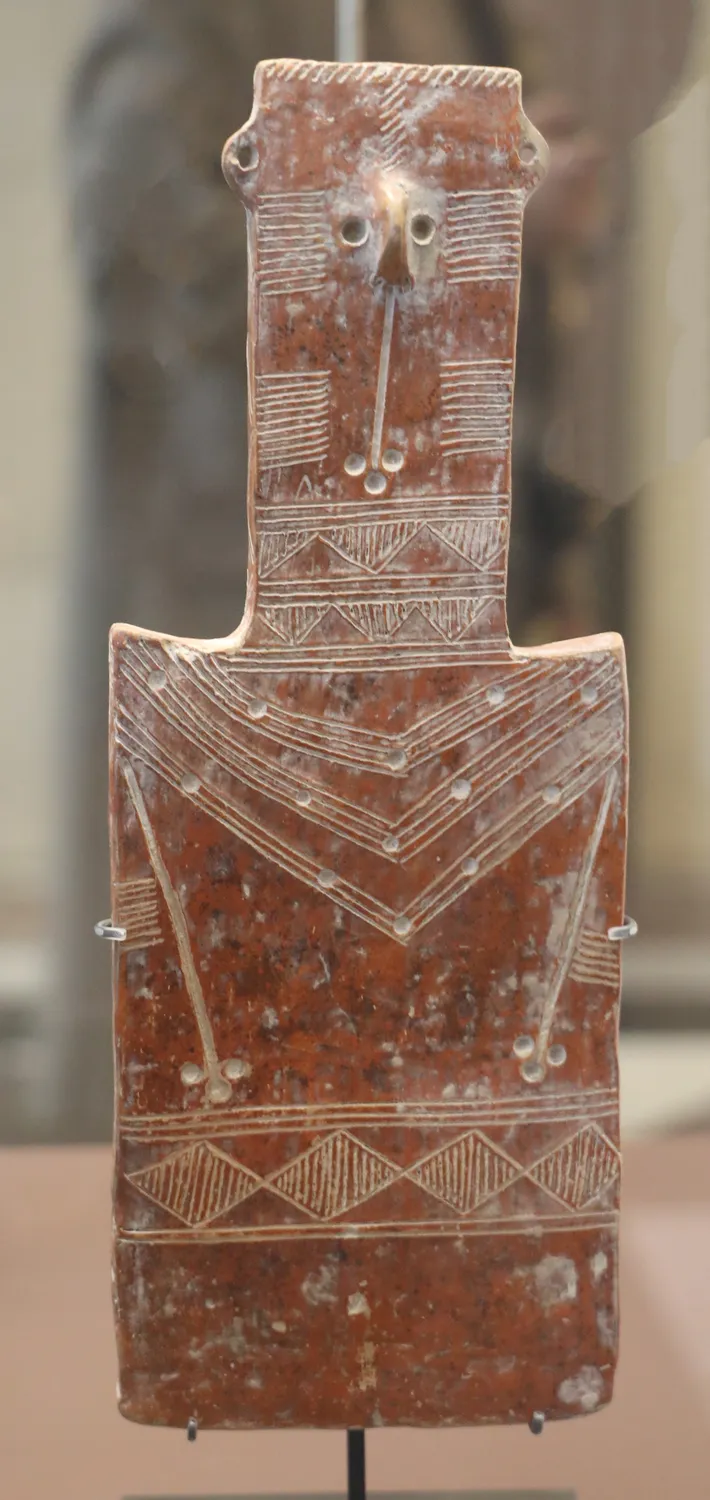
The blank is part of a wider pattern. Merrillees complained in 1973 that Cypriot prehistory had given us nothing to show for several decades of excavation but large cities of the dead, and that on the published record you might think Bronze Age Cypriots had been troglodytes. [10] Tombs are easy to find, easy to loot and full of saleable things; flat mudbrick villages are none of these, and for decades they went undug. The tomb evidence is also a distorting mirror. Weinberg's soundings at a southern settlement showed that the pottery people used at home was well fired and practical, while much of the pottery they put in graves was poorly fired and sometimes too heavy to use, made specifically for the dead. [10] The scenic jugs, the plank figures, the cult bowl were funerary objects, designed by the living for burial. We cannot safely read them back into daily life, or be sure that the religion of the graves was the religion of the kitchen.
What the lost village probably looked like can be borrowed from the ones that have been dug, above all Marki in the centre of the island, occupied for roughly the same five centuries as the Vounous cemetery. [15] There, families lived in courtyard compounds of around a hundred square metres: a walled yard with two or three small mudbrick-on-stone rooms at the back, hearths, ovens, animal pens and work areas. No house was grand enough to mark out a ruling family, storage was household by household with no communal granary a chief might control, and the same compounds kept their boundaries for three or four centuries, the signature of stable, land-holding families. The Vounous village was most likely a loose cluster of such compounds on the level, watered ground toward the sea, a few dozen to a few hundred people, exactly the kind of faint site that disappears once a later village, a Hellenistic farm or a modern olive grove has passed over it. Three of the earliest tombs even have their stone doorways carved to imitate timber house-fronts, with uprights, a lintel and, in one case, what may be an upper storey, which Stewart recorded as the nearest thing we have to a picture of the houses themselves.
How the cemetery was dug, and scattered
The cemetery entered the record the way it is now leaving it: through robbery. Early in 1931 the police at Kyrenia forwarded to the Cyprus Museum a batch of Red Polished vases that had turned up for sale, "collected on the site of Vounous." [1] Dikaios went out, found villagers actively digging, and got the museum committee's permission to excavate, on almost no money, as a rescue. He cleared 48 tombs in three short seasons, paid for by private donations, while word kept arriving that the looting had resumed.
Two foreign expeditions followed, and they decided where the finds would end up. In 1933 Claude Schaeffer, the excavator of Ugarit, dug some thirty tombs for the museums of France; under the colonial system of partage, which split finds between excavator and state, his share was divided, and Vounous material went to the Louvre and elsewhere in France. [11] In 1937 and 1938 the Australian James Stewart and his wife Eleanor opened the eastern sector, the earliest part of the cemetery, around 84 tombs; their share scattered further still, to Birmingham, to the Nicholson Museum in Sydney, and, after Stewart's early death in 1962, out of his own home. The continuous tomb numbers, 1 to 164, run by order of digging, not by date or place, which is why the sector Stewart dug last holds the oldest graves.
The publication record was as uneven as the dispersal. Dikaios brought out his tombs promptly and well, in 1940, and that report is still the foundation of everything written since. [1] Stewart's appeared in 1950. Schaeffer's never appeared at all in his lifetime: the material sat in limbo for seventy years, passed from hand to hand, until Anne-Elizabeth Dunn-Vaturi finally published it in 2003, reconstructed from notes, drawings and photographs, with half the vases no longer securely identifiable. [11]
Since the site itself can no longer be touched, the modern advances have come from going back over the old digs, what Webb and Frankel have called excavating the old excavations: re-studying the finds, the archives and the field records. It was settlement excavation elsewhere, at Marki above all, that fixed two things the cemetery never could, the place of the Philia phase before the Early Cypriot sequence, and, through radiocarbon, the real dates that pulled Dikaios's calendar down. [5] The relative order Dikaios read off his tombs survived. The dates did not.
The hill in the occupied north
Bellapais-Vounous lies in the part of Cyprus that Turkey occupied in 1974. The village below is now officially Beylerbeyi. The invasion stopped every archaeological project on the island at once, and no excavation or survey under internationally recognised authority has taken place in the north since. [13] The Republic's own Department of Antiquities cannot reach the cemetery that its first Cypriot curator opened. And the looting that first drew Dikaios to the hill in 1931 has resumed; the Oxford encyclopaedia records flatly that since 1974 "this seemingly inexhaustible burial ground has suffered from repeated bouts of looting." [13] The hill is not deserted. Netice Yildiz, who has written about the site from the northern side, describes schoolchildren visiting the open tombs at weekends, and a terracotta symposium held on the necropolis itself. [16] It is visited as a curiosity rather than studied as a site.
So the only Vounous that can now be examined is the dispersed one: the cult bowl and the ploughing model in Nicosia, the jugs in the Louvre, the tulip bowls in Sydney and Cambridge, the Cretan dagger in Birmingham. The cemetery has become its scattered objects, in cities its makers never heard of. The village they actually lived in is still out there, under an olive grove or a Hellenistic floor on the plain toward the sea, narrowed down to a few hillsides and never found. And on the slope above Bellapais, Tomb 10 is still cut into the rock, finished, swept and sealed for a burial it never received, a grave waiting on a hill that no archaeologist of the island's own museum has stood on in fifty years.
References
- Dikaios, P. (1940). The Excavations at Vounous-Bellapais in Cyprus, 1931–2. Archaeologia, 88, 1–174.
- Keswani, P. S. (2004). Mortuary Ritual and Society in Bronze Age Cyprus. London: Equinox.
- Webb, J. M., & Frankel, D. (2010). Social Strategies, Ritual and Cosmology in Early Bronze Age Cyprus. Levant, 42(2), 185–209.
- Webb, J. M. (2017). Vounoi (Vounous) and Lapithos … north-coast cemeteries of the Early and Middle Cypriot Bronze Age. In Four Decades of Hiatus in Archaeological Research in Cyprus, 128–139.
- Manning, S. W. (2013). A New Radiocarbon Chronology for Prehistoric and Protohistoric Cyprus, ca. 11,000–1050 cal BC. In A. B. Knapp, The Archaeology of Cyprus (Cambridge University Press), 485–533.
- Steel, L. (2013). The Social World of Early–Middle Bronze Age Cyprus: Rethinking the Vounous Bowl. Journal of Mediterranean Archaeology, 26, 51–73.
- Morris, D. (1985). The Art of Ancient Cyprus. Oxford: Phaidon (the 'village scene' reading, 280–283).
- Peltenburg, E. (1994). Constructing Authority: The Vounous Enclosure Model. Opuscula Atheniensia, 20, 157–162.
- Karageorghis, V. (1991). The Coroplastic Art of Ancient Cyprus I: Chalcolithic–Late Cypriote I. Nicosia: A. G. Leventis Foundation (the Tomb 22 model and the ploughing model, 148–152).
- Merrillees, R. S. (1973). The Cypriot Bronze Age (the cemetery-bias 'vicious circle'; Stewart's vain search for the settlement; Weinberg on tomb vs settlement pottery, 63–66).
- Dunn-Vaturi, A.-E. (2003). Vounous: C. F.-A. Schaeffer's Excavations in 1933. Studies in Mediterranean Archaeology 130. Sävedalen: Paul Åströms Förlag.
- Webb, J. M., & Frankel, D. (2013). Cultural Regionalism and Divergent Social Trajectories in Early Bronze Age Cyprus. American Journal of Archaeology, 117(1), 59–81.
- Swiny, S. (1997). Vounous. In The Oxford Encyclopedia of Archaeology in the Near East, vol. 5, 166. New York: Oxford University Press.
- Ross, J. F. (1994). The Vounous Jars Revisited. Bulletin of the American Schools of Oriental Research, 296, 15–30.
- Knapp, A. B. (2013). The Archaeology of Cyprus: From Earliest Prehistory through the Bronze Age. Cambridge: Cambridge University Press.
- Yildiz, N. (2018). Vounous revisited. Arts & Humanities Open Access Journal, 2(1).
- Catling, H. W., & Karageorghis, V. (1960). Minoika in Cyprus. The Annual of the British School at Athens, 55, 108–127.