
The Newest String: A Middle Bronze Age Cypriot Faience Necklace
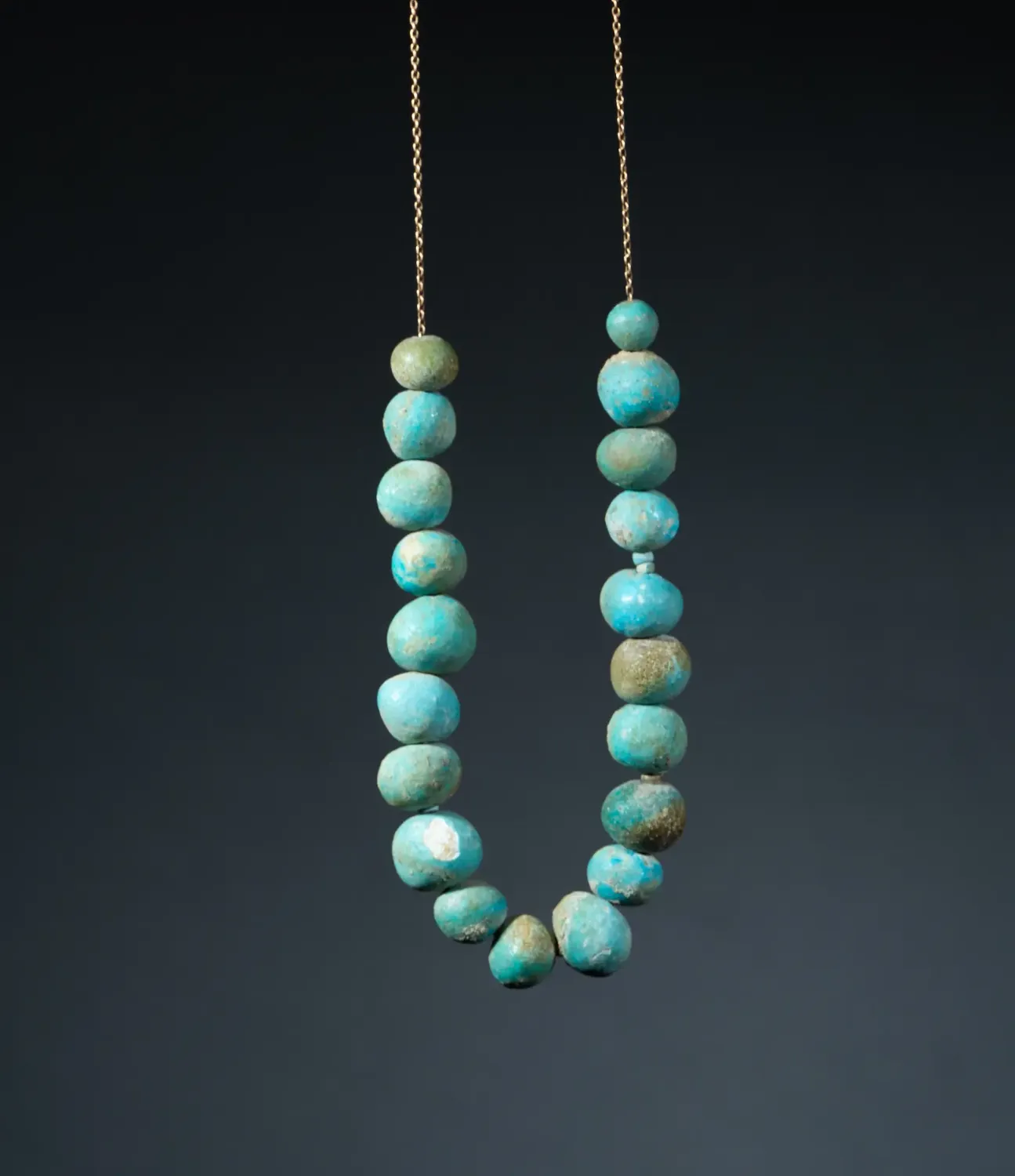
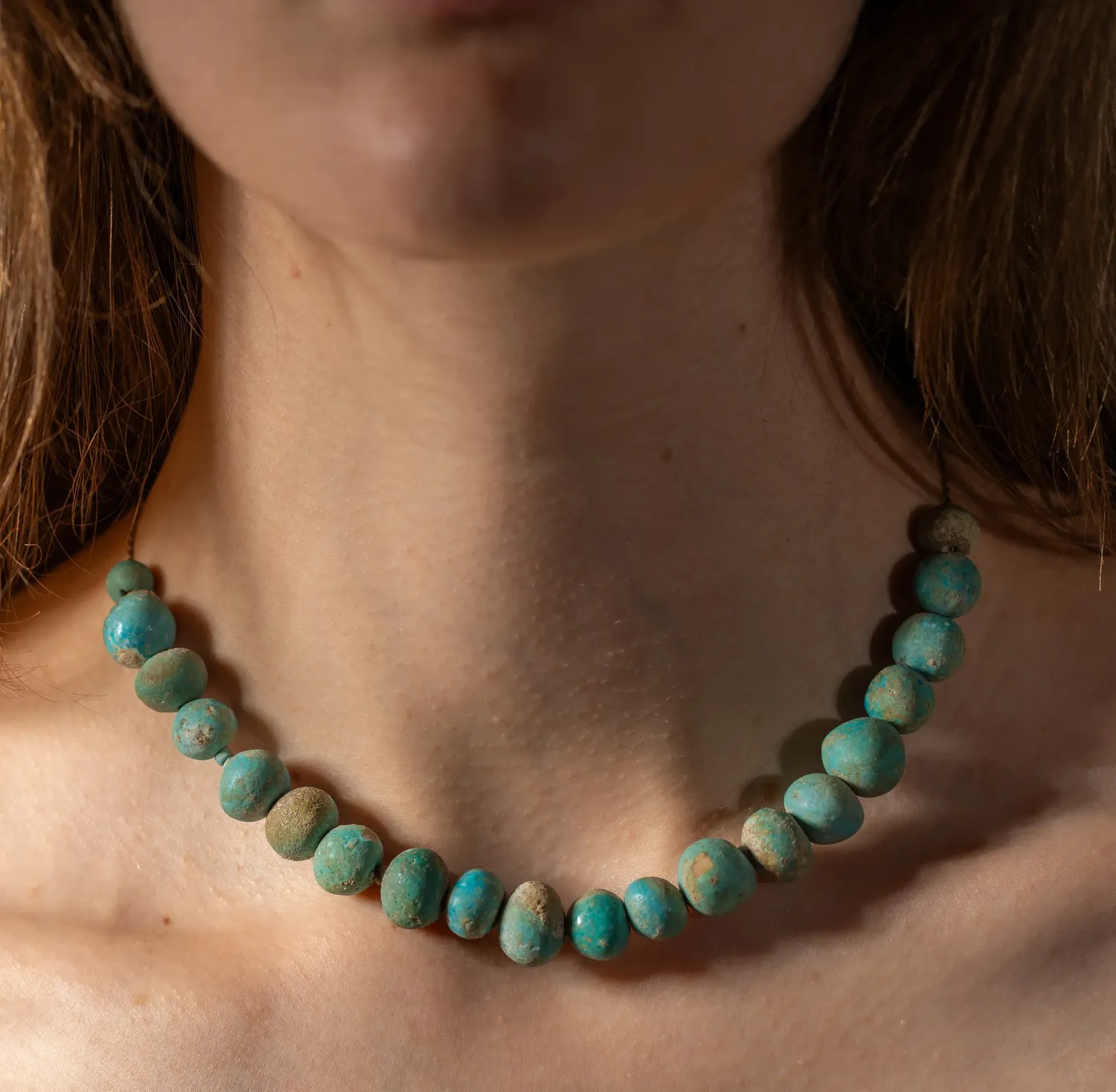
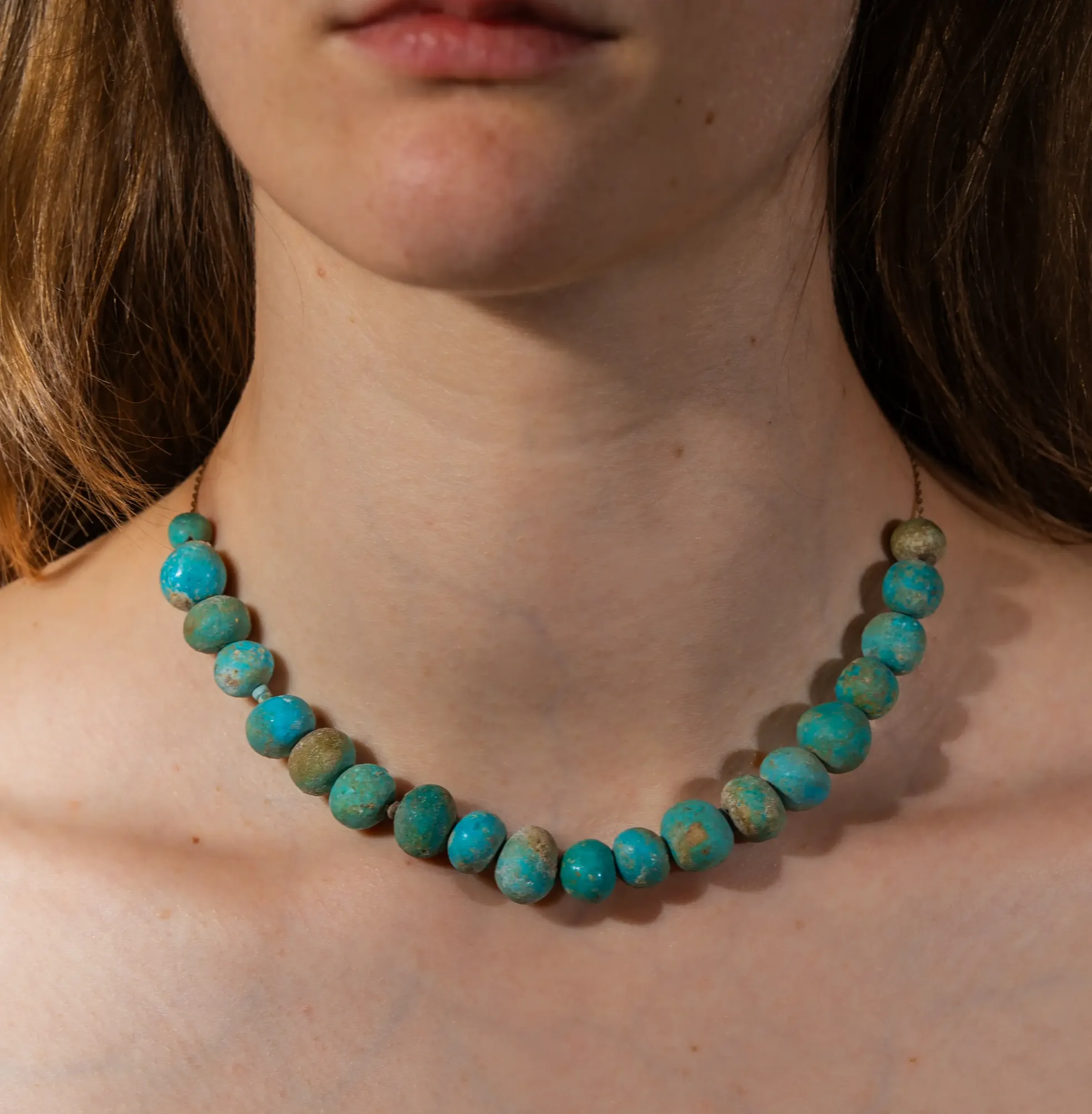
A string of faience beads, their striking turquoise glaze gone matte and clouded with buff, hung on a modern gold chain. The beads are the kind Middle Bronze Age Cyprus buried by the hundred: made to dazzle, almost certainly carried in by sea, and re-strung so many times that the gold is only the latest knot.

Alexis Drakopoulos
June 17, 2026·Artifact · Collection · Archeology·13 min read


Share


Alexis Drakopoulos is a Greek Cypriot Machine Learning Engineer working in Financial Crimes. He is passionate about Archeology and making it accessible to everyone. About Me.
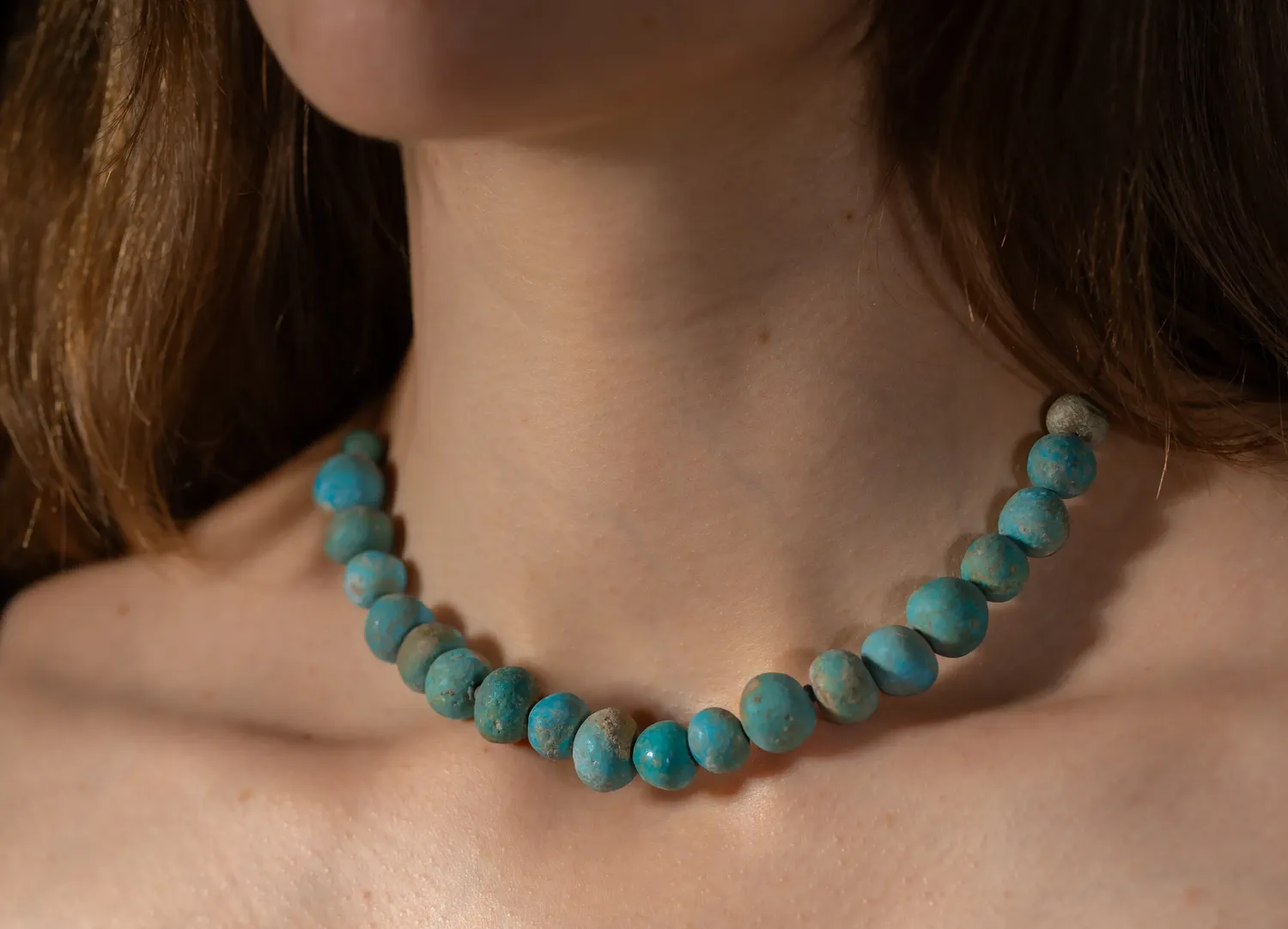
The chain is modern: fine gold cable links and a small spring clasp, the kind a jeweller would sell today. Threaded onto it are two dozen beads that are not modern at all. They are an assortment of sizes, the larger globular beads interspersed with smaller spacer beads, strung in whatever order a modern hand chose. Their glaze is a striking turquoise, clouded in places with chalky buff. The gold holds them together, and it is the newest thing that ever has.
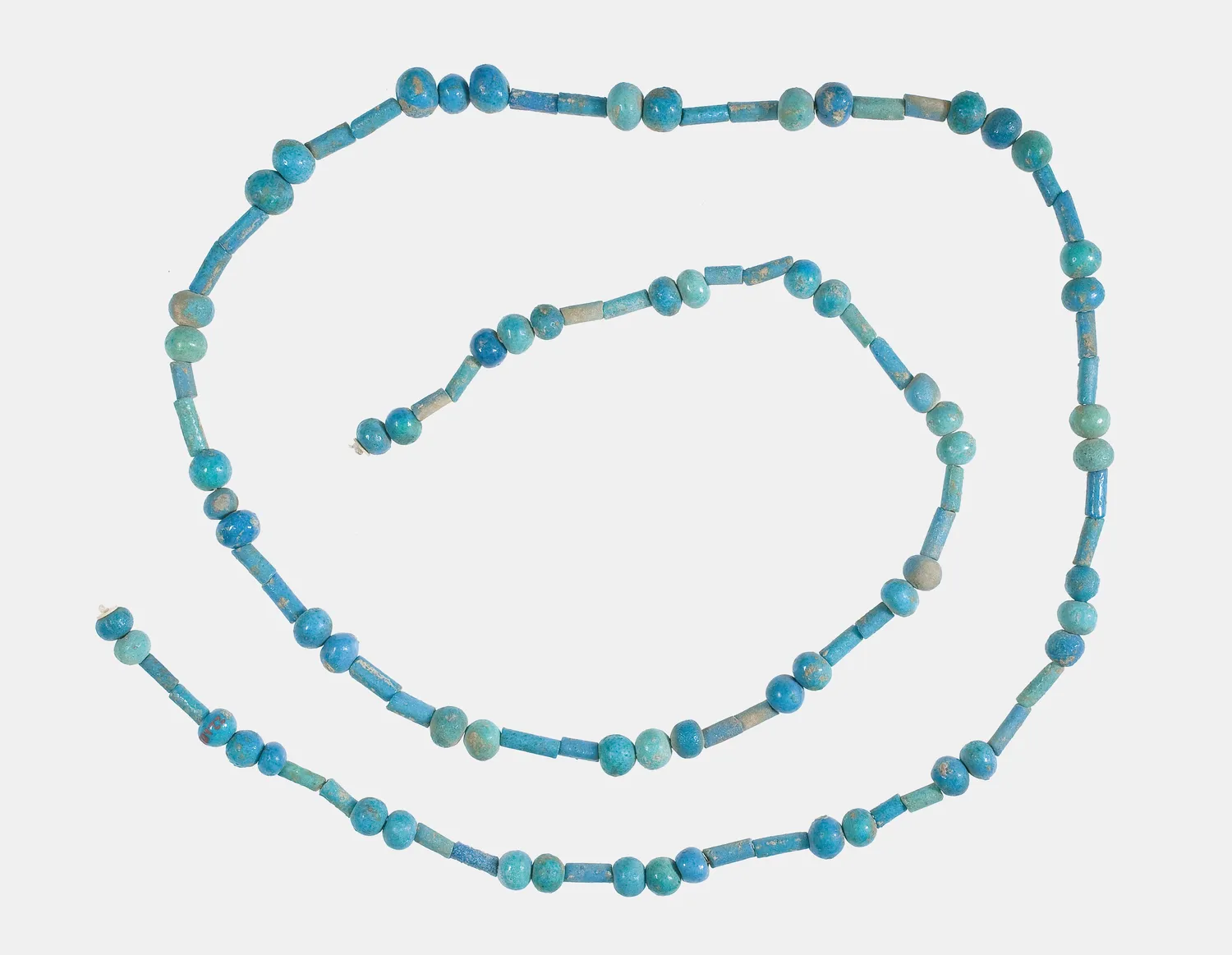
The beads are faience: not stone, not quite glass, and not clay. A faience bead is a body of crushed quartz, ground fine and held together with a little lime and alkali, then coated in a thin glassy glaze. Whether each of these particular beads is faience in the strict sense, or the related "paste" and glass that older catalogues file under the same word, only a cut section and a microscope would settle. Paul Åström, assembling the standard Cypriot corpus, admitted as much and lumped the materials together for convenience, noting that "we cannot be sure that they are all made of faience." [2] By eye they look the part of Middle Bronze Age Cyprus, roughly 2000 to 1650 BC, when the island's tombs filled with globular faience beads very like these.
How a bead is made from sand
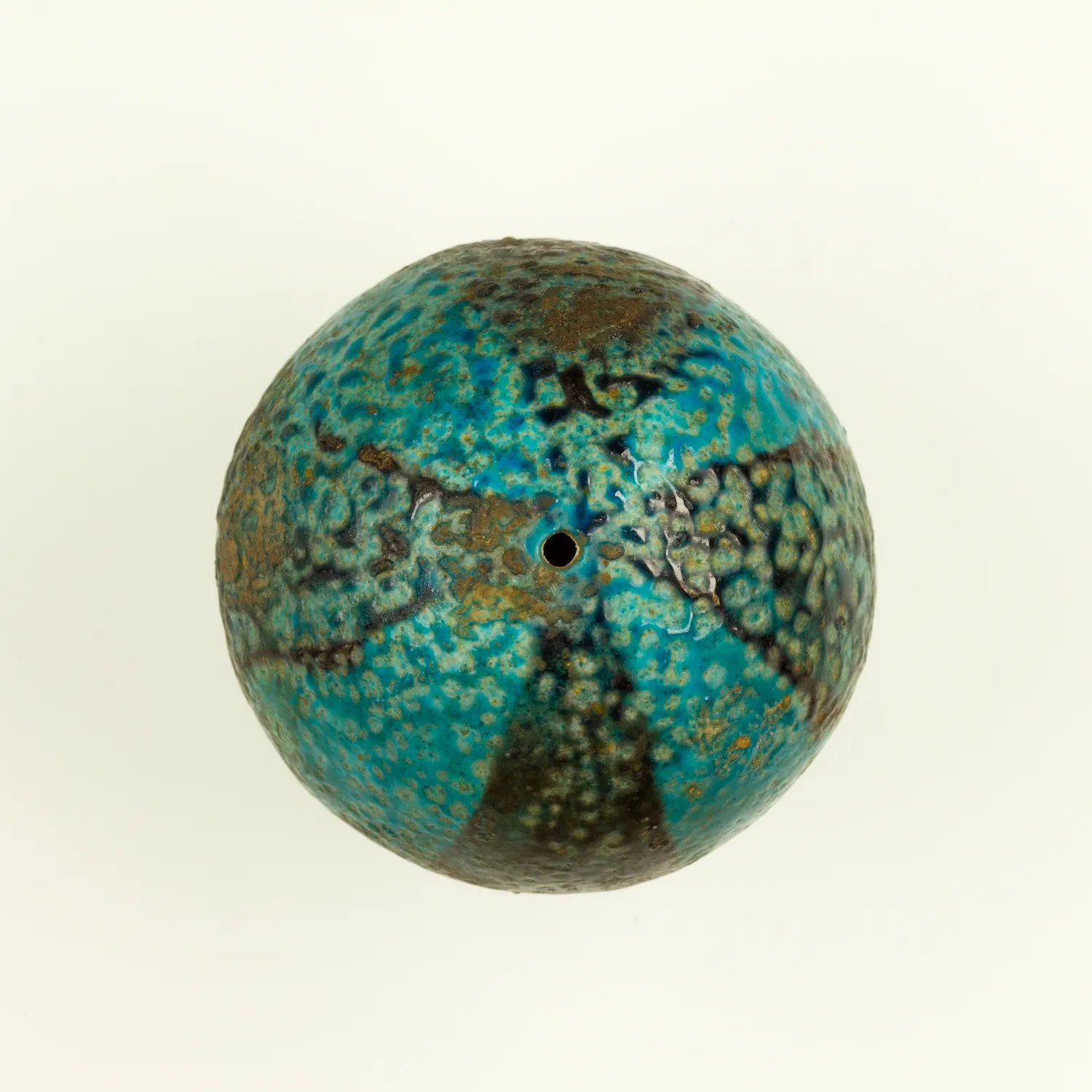
A faience body is mostly silica: crushed quartz pebbles or clean sand, more than nine parts in ten, with a little lime and a pinch of alkali, the soda or plant-ash that lowers the melting point and lets the grains begin to fuse. [7] That body has none of the give of a potter's clay. You cannot raise it on a wheel; you model it the way you would work a soft stone, or, for a bead, you wet the powder into a stiff paste and roll a pellet of it around a straw, a reed, or a length of plant stem. You cut the rolled tube into bead lengths, let them dry, and fire them once, a firing that hardens the body and forms the glaze together. In the kiln the plant core burns away, and the hole it leaves is the hole the thread runs through; every faience bead carries the ghost of the thing it was wrapped around. [3][5]
A faience bead could be glazed in any of three ways. The plainest was to paint or dip a glassy slurry onto the dried bead, much as a potter glazes a pot. [7] The other two are stranger, because the bead glazes itself. In the cementation method, still practised within living memory at the Iranian village of Qom, the dried bead is buried in a glazing powder and fired, and its surface reacts with the powder packed around it. [7] The commonest trick for beads was efflorescence: the glazing salts are mixed into the wet paste from the start, and as the bead dries they travel to the surface with the evaporating water and settle there as a faint bloom, which melts to a glaze in the fire. [7] A bead made this way asks for no second hand at all. The maker mixes, rolls, dries, and fires, and the blue arrives on its own.
The colour came from copper, which turns the glaze blue and blue-green and turquoise, and on a copper island that is worth pausing over. Faience was the bright material of the Bronze Age, an artificial stone made to stand in for lapis, turquoise and carnelian, and valued for a quality the Egyptians named in one word, tjehnet, "dazzling." [8] One modern account calls it "the first high-tech ceramic," an engineered substance built to catch light. [7] Copper does a second, quieter job in the recipe: it lowers the temperature at which the glaze fuses, so the colourant and the flux are the same ingredient. [7] What the centuries take is exactly that ingredient. As buried glaze weathers, water leaches out the alkalis and some of the copper, the blue slides to green and then to a chalky off-white, and the thin glassy skin can go altogether, baring the quartz core. [5][7] A bead now the colour of old bone may have been bright blue when it went into the ground. On this string the turquoise has mostly held, dried to a matte, clouded surface; what is gone is the shine the material was made for.
Almost certainly carried in by sea
A Cypriot would not have made them: the long-standing scholarly view, set out by J.R. Stewart in 1962 and still the default in the most recent analytical work, is that the faience beads of Early and Middle Bronze Age Cyprus were imported, from Egypt or the Levantine coast. [9][1] There is a small irony in that: copper is the metal Cyprus is famous for, and copper is what gives faience its blue, yet these beads still came from across the sea. No faience kiln, no mould, no failed and discarded bead has ever been dug up on the island to prove local manufacture. The one study to put Cypriot faience under instruments read its chemistry as most consistent with an Egyptian source, allowing the Levant as a second possibility. [10]
Some scholars, struck by the sheer abundance of beads in Cypriot tombs, have argued the islanders must have been making at least some of them; others, following Marina Panagiotaki, have floated Crete as the supplier of the globular type. [1][4] All that is certain is that beads of this exact shape are common everywhere around the eastern Mediterranean, the surest sign that they travelled.
A merchant ship that sank off the southern Turkish coast around 1320 BC, near a headland called Uluburun, went down with ten tons of Cypriot copper, a ton of tin, and an astonishing freight of beads: on the order of 75,000 faience beads and 9,500 of glass. [5][6] The simplest types, the tiny ones and the plain globular ones, ran into the tens of thousands and were carried as cargo, not as anyone's jewellery. Faience beads had become, in Karen Foster's phrase, attractive and inexpensive trinkets that reached nearly every part of the world Near Eastern traders knew. [3] That is the mechanism by which a Cypriot tomb came to hold a hundred near-identical beads, and by which two dozen of them could end up, much later, on a gold chain.
The first beads came to the west
The earliest faience on Cyprus is not Middle Bronze Age at all; it is more than a thousand years older, and it comes from the far south-west of the island. In the fourth millennium BC, while the rest of Cyprus was still working stone, the Chalcolithic villages of the Paphos region were burying faience beads with their dead: at Souskiou, in the hills behind Palaipaphos, and at Kissonerga and Lemba on the coast nearby. The beads from the cemetery at Souskiou-Laona are the earliest securely dated faience known from Cyprus, and possibly from anywhere in the eastern Mediterranean. [14]
Most carry the same copper that colours the later beads blue, but several hold a trace of tin in the glaze, and Cyprus has no tin; the colourant, or the beads themselves, had crossed the sea from the Near East. [14] These were the people archaeologists call the Erimi culture, after a village in the Kouris valley, and they already loved blue-green: they quarried picrolite, the soft serpentine the island's rivers carry down from the Troodos, and carved it into the cruciform figurines that are the signature of Chalcolithic Cyprus. The first faience landed among people who were mining a blue-green stone of their own. It was a foreign version of a colour they already prized, and when, much later, the women of Lapithos went into their tombs in faience, they were the inheritors of an import older than the Bronze Age itself.
After the beads, the flood
The beads came first, and for the whole Middle Bronze Age they came almost alone. Then, around 1700 to 1600 BC, Cyprus opened its copper to the wider sea, the coastal port-towns rose, Enkomi and Hala Sultan Tekke among them, and faience arrived in flood and in variety: bowls, juglets, scarabs, small figures, and the dish-shaped tripod plates that the islanders bent to a local form. With it came the Egyptian goddess Hathor, "Lady of Turquoise" and guardian of the mines, whose faience bowls cluster on copper-rich Cyprus more thickly than anywhere outside Egypt. Edgar Peltenburg read that clustering as the meeting of the colour and the metal, faience flowing to the people who dug the copper. [11] All of that belongs to the Late Bronze Age and to other chapters. In the period these beads most likely come from, faience on Cyprus still meant, overwhelmingly, a string of beads in a grave.
Worn, and worn by the hundred
At Lapithos, the great cemetery on the north coast, one Middle Bronze Age chamber, Tomb 201A, gave up a single necklace of 413 globular faience beads, found with a woman; across twenty-nine other Lapithos chambers the count of similar beads runs past a thousand. [1] At Kalavasos some 432 turned up across fifteen tombs; at Dhenia, necklaces are recorded with up to about 900 beads apiece. [1][4] Against those strings of hundreds, a string of two dozen assorted beads is a modest cousin, the everyday end of a habit the island practised on an enormous scale.
Faience adornment is found more often with women and with children than with men, though never only with them, and the bead necklace was the commonest ornament of all. [12] It was not the only use: the same little beads were sewn onto cloth and leather and pressed, while the clay was still wet, into the sides of painted pots. [13] And when a Cypriot woman put one of these strings on, she did not see what we see. She saw the same turquoise, but glossy and wet-bright, the dazzle the material was built for. The matte chalk and the buff mottling came afterward, with the centuries. The colour she chose is mostly still there; what has gone is the shine.
Pins and picrolite
A faience necklace rarely went into a grave alone. It belonged to a small kit of ornament, and the rest of it shows both what the islanders had and what they could not get. The signature metal ornament of the period was the toggle pin, a long bronze pin fastened to a garment by a thread passed through a hole in its shaft and used to gather a robe at the shoulder; the Middle Cypriot examples often carry a swelling mushroom head. [4] The better ones were cast not in plain copper but in tin-bronze, which on this island is worth a second look. Cyprus had copper to spare and no tin at all, so the tin in a good pin had itself crossed the sea before the pin was poured.
Cypriot women strung beads of jasper, calcite and quartz, and pendants and disc beads of picrolite, the same blue-green stone the Chalcolithic carvers had used, a few of which travelled from the southern rivers up to the north-coast tombs. [1] The Lapithos burial that held the largest faience necklace also wore a string of jasper and calcite beads and a single picrolite pendant. [1] What is absent says as much as what is present. Carnelian, agate and the warm translucent stones that crowd Cypriot necklaces a few centuries later are essentially missing from Early and Middle Bronze Age graves; they become common only in the Late Bronze Age. [15] The bright colour a Middle Cypriot owned was blue and blue-green: the imported blue of faience, the home-quarried blue-green of picrolite. Gold and silver reached only the wealthiest tombs, and of the two it was silver, the harder one for us to picture as the rarer, that turned up more often. [12]
What the tomb keeps, and what it loses
The beads are quartz and glaze and they last; the thread that strung them was flax or wool or sinew, and it does not. Once the string rots, the beads slip apart and scatter across the floor of the chamber, so that what an excavator recovers is a spill of loose beads, never an intact necklace, and what goes into the museum case is a reconstruction, a modern stringing of an ancient handful. [4] The order is a guess. The number is whatever was found. The "necklace" is, in a real sense, made in the present tense every time.
Cypriot tombs make this plainer still, because they were opened and reused across generations, the older dead pushed aside for the new, beads of one burial mingling with beads of another. Durable ornaments outlived their owners and were kept, handed on, restrung. A bead that began on one woman's throat could be buried, recovered, and worn again while the Bronze Age was still running. The thread was always the thing that failed, and someone was always tying the next one.
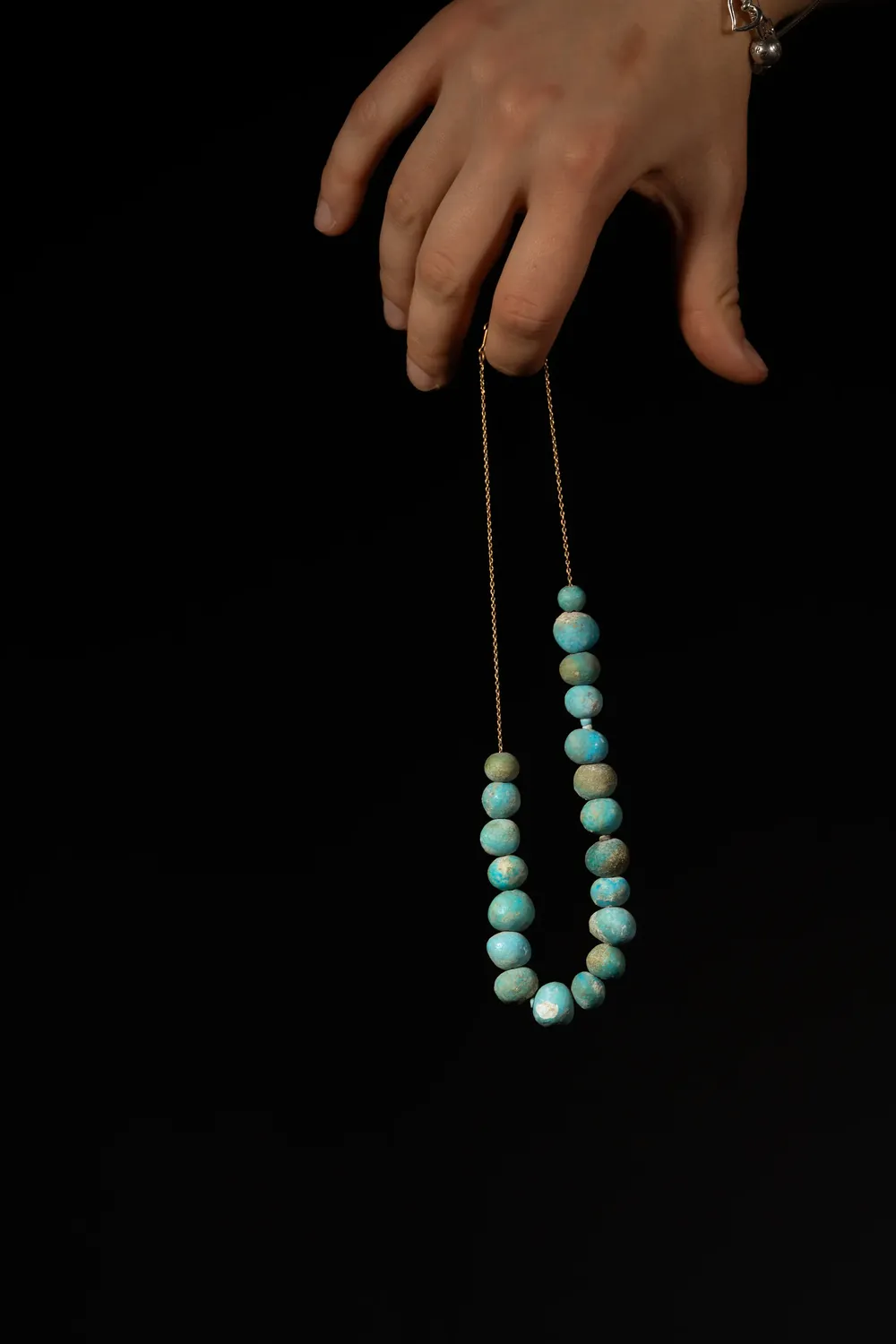
The chain that carries these beads now is the most recent in a line of strings that reaches back to the first one that rotted in a tomb. Its documented part is short and modern: the beads were in an American collection in Cyprus, acquired there sometime between 1957 and 1969 and brought to the United States in 1969; they passed by descent, in April 1997, into a private collection in Lake Worth, Florida; from there they have come into the Drakopoulos Collection of Cypriot Antiquities. Before the 1950s the record runs out. There is no tomb number, no excavation, no name for the woman who first wore them, and, absent a cut section, not even final certainty that every bead is faience rather than its glassy cousins. The chain is the only part of the object whose history is fully known, and it is the youngest part by some four thousand years.
So what is left is the beads, most still holding their worn turquoise, gone matte and patched with buff; a few have clouded almost to the pale quartz they were ground from. Through every one of them runs the small round hole left by a reed that burned away in a kiln before the alphabet, waiting, as it has waited each time the thread gave out, for the next string to be pulled through.
References
- 1.Herscher, E. & Webb, J.M. (2018). Lapithos Tomb 201A: a singular Middle Bronze Age tomb (publication of the 413-bead globular faience necklace, the 1,000+ beads across 29 other Lapithos chambers, the accompanying jasper/calcite bead string and picrolite pendant, and the review of the import / local-manufacture / Minoan-source debate).
- 2.Åström, P. (1972). The Swedish Cyprus Expedition IV:1C. The Late Cypriote Bronze Age: Other Arts and Crafts, esp. pp. 62–65, 131–133 (the master faience-bead typology and the caveat on faience/paste/glass terminology).
- 3.Foster, K.P. (1979). Aegean Faience of the Bronze Age. New Haven: Yale University Press, esp. pp. 27–37, 60, 75–81.
- 4.Pilides, D. & Papadimitriou, N. (eds) (2012). Ancient Cyprus: Cultures in Dialogue. Nicosia: Department of Antiquities, Cyprus, cat. 72, 196, 197 (Kalopsidha necklace; the Dhenia 'up to 900 beads' figure; bead scatter after the string decays; the local-manufacture hypothesis; the engraved Middle Cypriot III toggle pin from Ayia Paraskevi).
- 5.Ingram, R.S. (2014). Vitreous beads from the Uluburun shipwreck. In Beyond Ornamentation (Polish Archaeology in the Mediterranean 23/2), pp. 225–246 (c. 75,000 faience and 9,500 glass beads; combustible-core manufacture; trade-versus-personal cargo; post-excavation colour loss).
- 6.Pulak, C. (1998). The Uluburun shipwreck: an overview. International Journal of Nautical Archaeology, 27, 188–224.
- 7.Nicholson, P.T., with Peltenburg, E.J. (2000). Egyptian faience. In P.T. Nicholson & I. Shaw (eds), Ancient Egyptian Materials and Technology. Cambridge: Cambridge University Press, pp. 177–194 (definition, body composition, the three glazing methods, copper colourant and flux, single firing; faience as 'the first high-tech ceramic,' after Vandiver & Kingery 1987).
- 8.Nicholson, P.T. (1993). Egyptian Faience and Glass (Shire Egyptology). Princes Risborough (faience as an imitation of semi-precious stone; the Egyptian term tjehnet, 'dazzling').
- 9.Stewart, J.R. (1962). The Swedish Cyprus Expedition IV:1A, p. 280 (the foundational statement that Cypriot faience beads are imports).
- 10.Maniatis, Y., Panagiotaki, M. & Kaczmarczyk, A. (2008). Faience production in the Eastern Mediterranean. In M.S. Tite & A.J. Shortland (eds), Production Technology of Faience and Related Early Vitreous Materials (Oxford School of Archaeology Monograph 72), p. 127 (the chemical profile of Cypriot faience points to Egypt, with the Levant a possibility).
- 11.Peltenburg, E.J. (2007). Hathor, faience and copper on Late Bronze Age Cyprus. Cahiers du Centre d'Études Chypriotes, 37, 375–394.
- 12.Keswani, P.S. (2004). Mortuary Ritual and Society in Bronze Age Cyprus. London: Equinox (the funerary distribution of faience and its association with women's and children's burials; the rarity of gold and silver in Middle Cypriot tombs).
- 13.Hughes-Brock, H. (2013). The beads. In V. Karageorghis et al., Kouklia (Palaepaphos), p. 235 (faience disc beads as necklace components, and their use sewn onto cloth or leather and inlaid in pottery).
- 14.Peltenburg, E.J., Bolger, D. & Crewe, L. (eds) (2019). The Figurine Makers of Prehistoric Cyprus: Settlement and Cemeteries at Souskiou. Oxford: Oxbow, esp. ch. 16 (Kassianidou & Charalambous, pp. 427–431): the Souskiou-Laona and Souskiou-Vathyrkakas faience beads as the earliest securely dated faience on Cyprus, and the tin in their glaze read as a sign of import rather than a late date.
- 15.Gjerstad, E. et al. (1937). The Swedish Cyprus Expedition, vol. III. Stockholm, p. 148 (no semi-precious stones recorded from the Early or Middle Cypriote periods; carnelian and the like become common only in the Late Bronze Age).