
Page Tarsus 55Scan 69 of 107
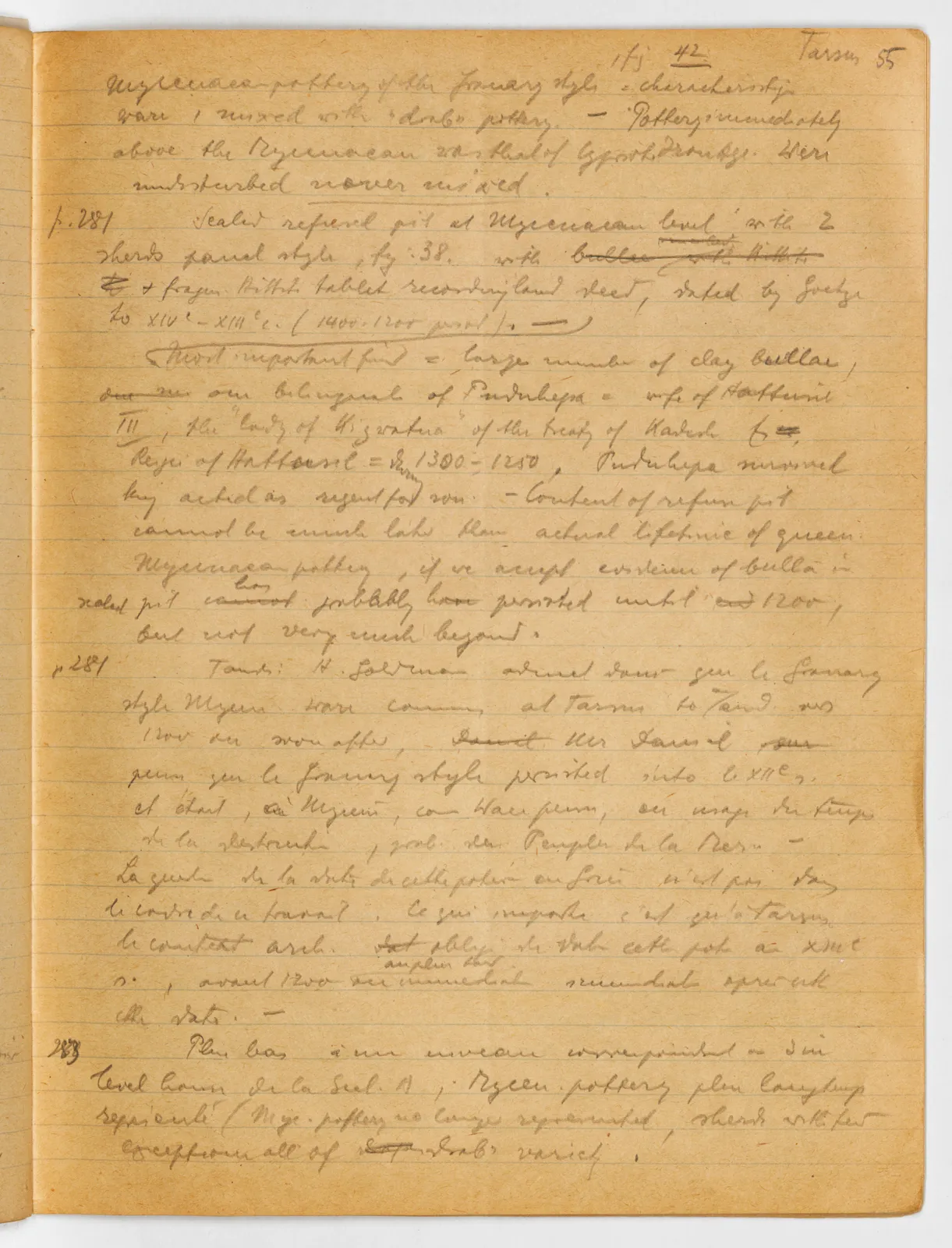
ifs 42 Mycenaean pottery of the Granary style = characteristic ware, mixed with "drab" pottery. — Pottery immediately above the Mycenaean was that of Cypro-Iron Age. When undisturbed never mixed.
p. 281 Sealed refuse pit at Mycenaean level with 2 sherds panel style, fig. 38, with bullae seal<s>/ with Hittite & + fragm. Hittite tablet recording land deed, dated by Goetze to 14th–13th c. (1400–1200 period). — Most important find = large number of clay bullae, one in one bilingual of Puduhepa = wife of Hattusil III, the "lady of Kizwatna" of the treaty of Kadesh = Reign of Hattousil = c. 1300–1250, Puduhepa survived him, king acted as regent for son. — Content of refuse pit cannot be much later than actual lifetime of queen. Mycenaean pottery, if we accept evidence of bulla in sealed pit has cannot probably have persisted until ca 1200, but not very much beyond.
p 281 Whereas H. Goldman therefore admits that the Granary style Mycen. ware begins at Tarsus in the 2nd vers 1200 or soon after, — damit she gives pense proof that the Granary style persisted into the 12th c. and was, at Mycenae, as Wace thinks, in use at the time of the destruction, prob. of the Sea Peoples. — The question of the date of this pottery in Greece is not within the scope of this work. What matters is that at Tarsus the arch. context fait requires dating this pot. to the 13th c., before 1200 at the latest ou immédiat. immédiat. after this date. —
283 Lower down, at a level corresponding to the 10th level house of sect. A, Mycen. pottery more lengthily représenté (Myc. pottery no longer represented, sherds with few exceptions all of "drab" "drab" variety. — … continues
65 figures hard to readstruck struck outadded written in above” jug ditto, and what it repeatsword reading not certain