
Page 9Scan 15 of 107
Continued from scan 14
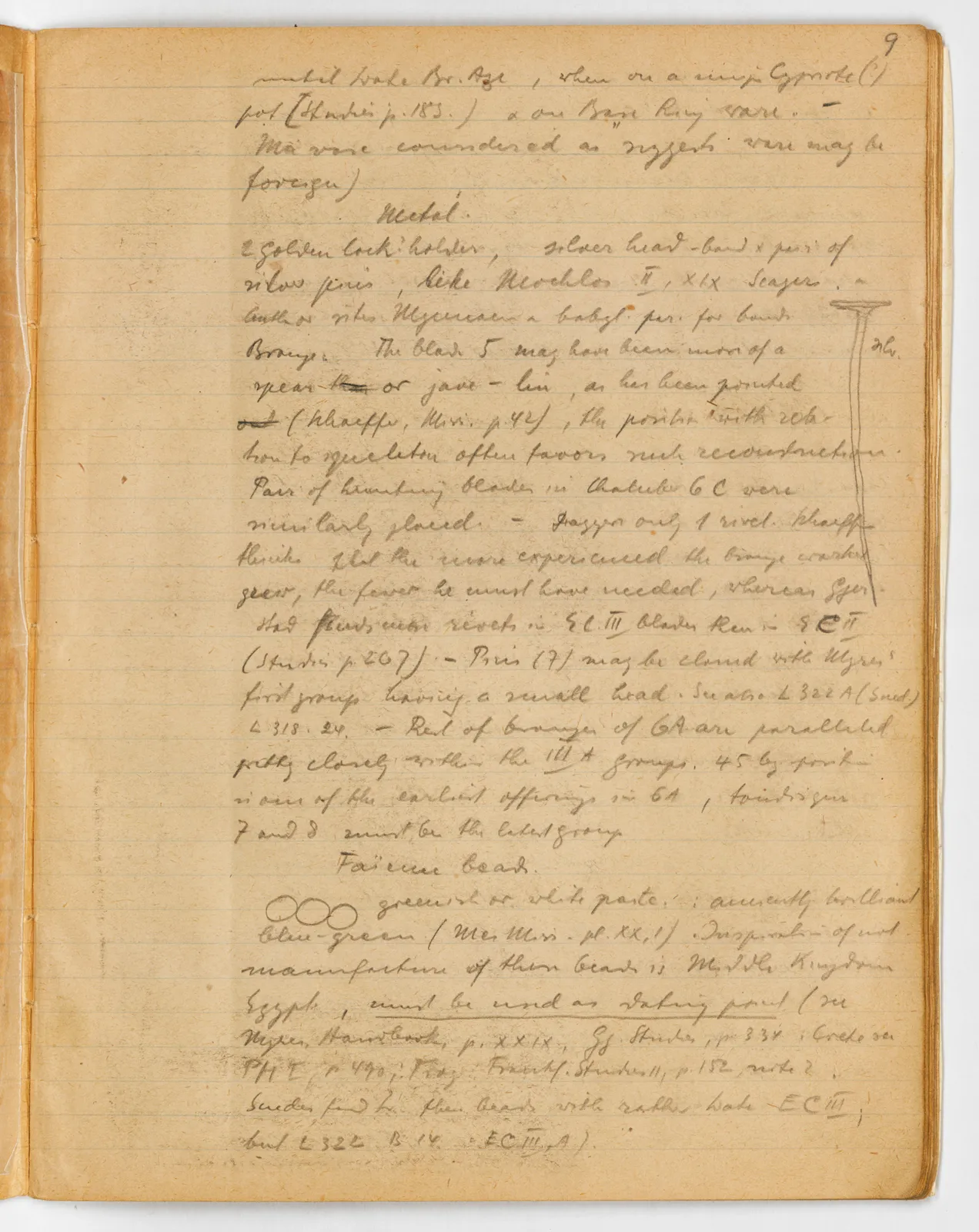
… until Late Br. Age , when on a single Cypriote (?) pot (Studies p. 185.) & on "Base Ring" ware. - Ma ware considered as suggests ware may be foreign) Metal. 2 golden lock-holder, silver head-band & pair of silver pins , like Mochlos II, XIX Seager. - Author cites Mycenaean a babyl. par. for band. Bronze: The blade 5 may have been more of a (drawing) spear tha or jave - lin , as has been pointed out (Schaeffer, Miss., p 42) , the position with rela- tion to squeleton often favors such reconstruction. Pair of hunting blades in chamber 6 C were similarly placed. - Daggers only 1 rivet. Schaeffer thinks that the more experienced the bronze worker grew, the fewer he must have needed , whereas Gjerstad finds more rivets in EC III blades than in S E II (Studies p. 267) . - Pins (7) may be classed with Myres' first group having a small head . See also L 322 A (Swed) L 318. 24. - Rest of bronzes of 6A are paralleled pretty closely within the III A groups. 45 by positis one of the earliest offerings in 6A , foundrigen 7 and 8 must be the latest group Faïence beads.
Drawing: three small circles in a row] greenish or white paste: : anciently brilliant
blue-green (Mes Miss. pl. XX, 1) . Inspiration of not manufacture of these beads is Middle Kingdom Egypt , must be used as dating point (see Myres, Handbook, p. XXIX , Gj. Studies , p. 334 ; Crete see PM I , p 490; Frbg. Frankf. Studies II, p. 152, note 2 . Swedes find tw. the beads with rather late EC III , but L 322 B. 14. = EC III A ) .
65 figures hard to readstruck struck outadded written in above” jug ditto, and what it repeatsword reading not certain