
Page - 3 -Scan 5 of 28
Continued from scan 4
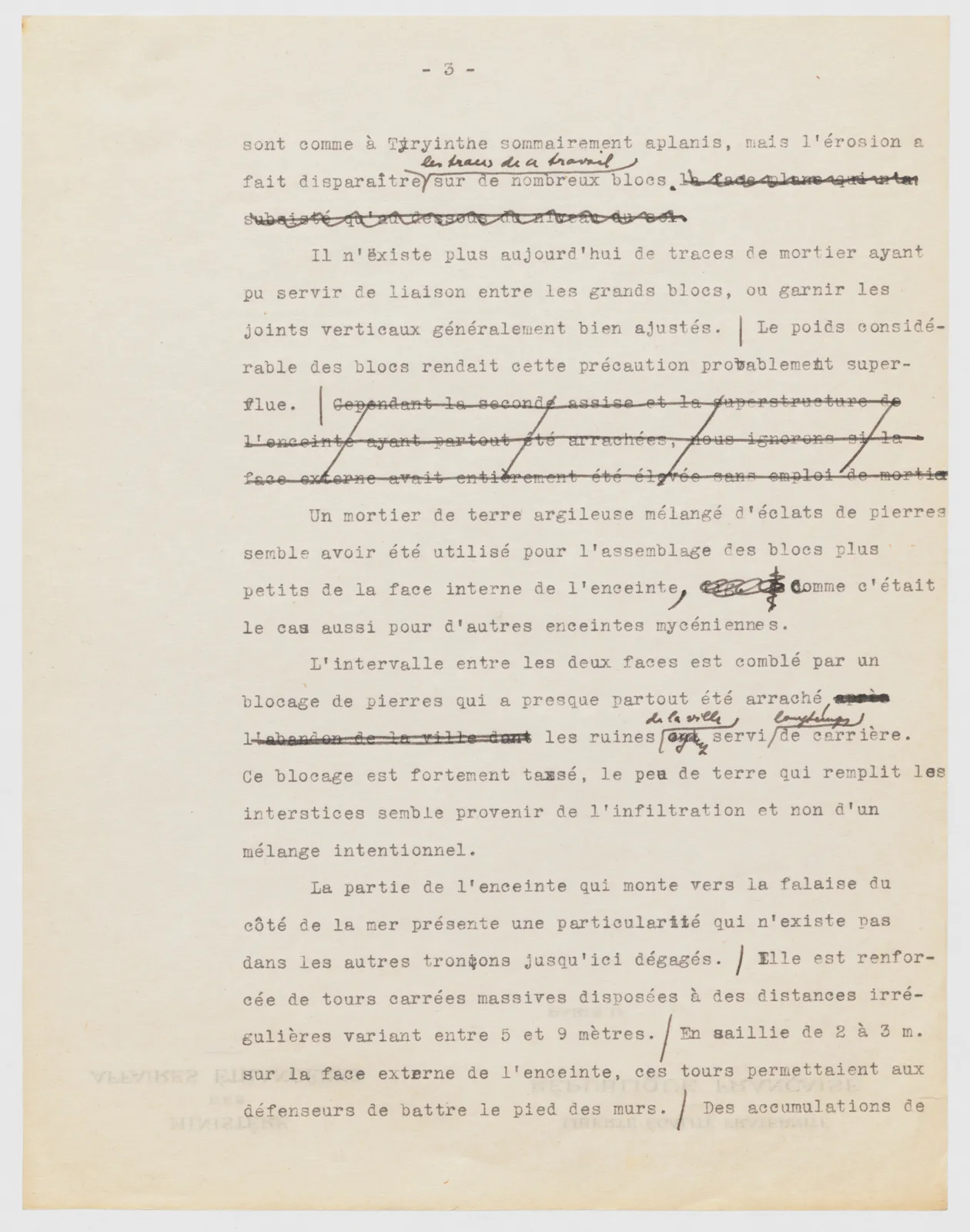
… are, as at Tiryns, roughly levelled, but erosion has removed on many blocks. [handwritten: the traces of work] the flat face which has survived only below ground level.
There are no longer any traces of mortar today which may have served as a bond between the large blocks, or fill the vertical joints, generally well fitted. | The considerable weight of the blocks made this precaution probably superfluous. | However the second course and the superstructure of the enceinte having been everywhere torn away, we do not know whether the outer face had been entirely raised without the use of mortar.
A mortar of clayey earth mixed with stone chips seems to have been used for the assembly of the smaller blocks of the inner face of the enceinte, [illegible] [handwritten: [illegible]] as was also the case for other Mycenaean enceintes.
The interval between the two faces is filled by a rubble infill of stones which has been almost everywhere removed after the abandonment of the town in the ruins [handwritten: of the town] [handwritten: having] served [handwritten: for a long time] as a quarry. This infill is strongly compacted, the little earth which fills the interstices seems to come from infiltration and not from a deliberate mixture.
The part of the enceinte which rises towards the cliff on the sea side presents a feature which does not exist in the other sections cleared so far. | It is reinforced by massive square towers placed at irregular distances varying between 5 and 9 metres. | Projecting 2 to 3 m. from the outer face of the enceinte, these towers allowed the defenders to bombard the foot of the walls. | Accumulations of
65 figures hard to readstruck struck outadded written in above” jug ditto, and what it repeatsword reading not certain