
Unnumbered pageScan 11 of 28
-6-
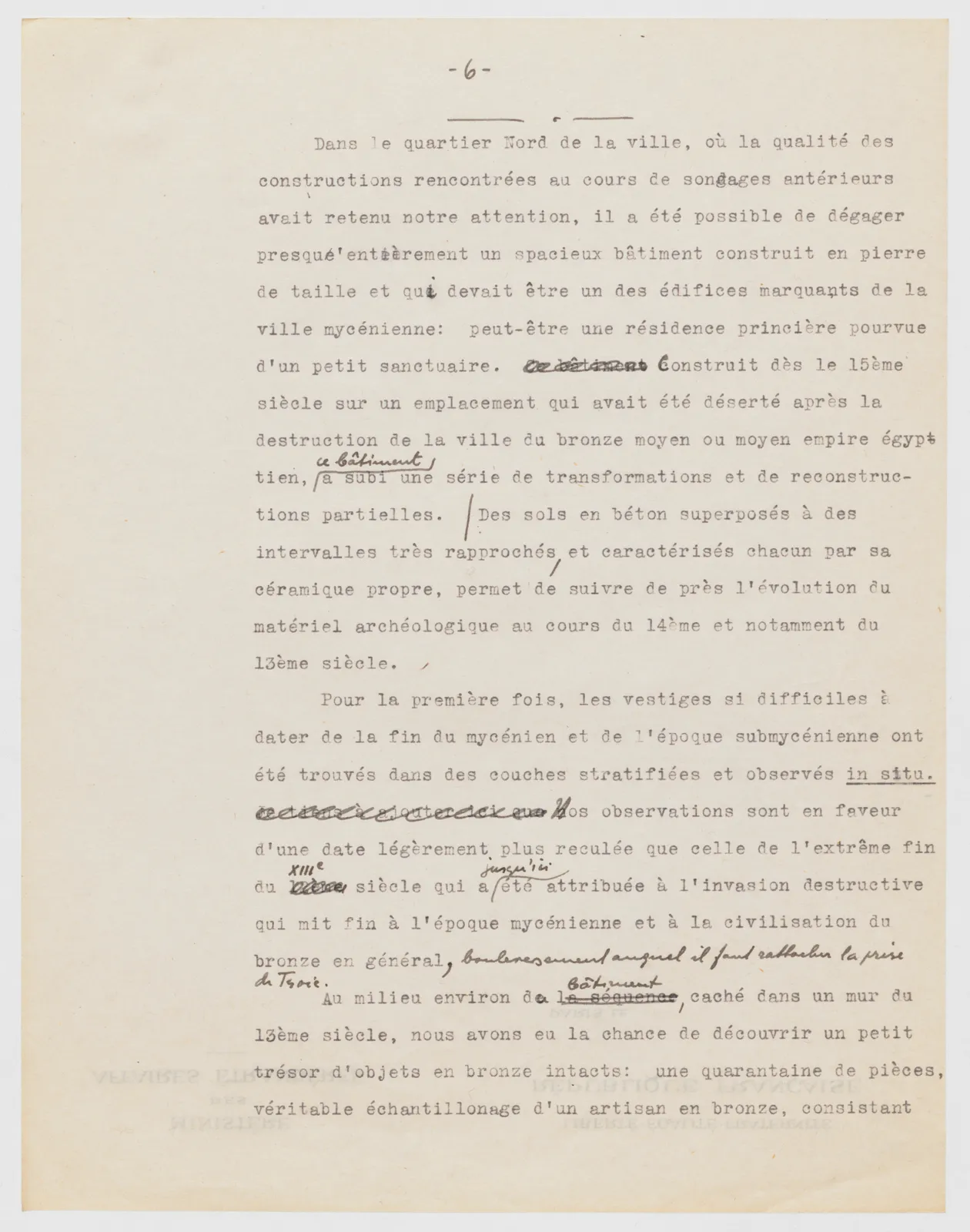
In the northern quarter of the town, where the quality of the structures encountered during earlier soundings had attracted our attention, it was possible to clear almost entirely a spacious building constructed of ashlar and which must have been one of the outstanding buildings of the Mycenaean town: perhaps a princely residence provided with a small sanctuary. [handwritten: this building] This building Built as early as the 15th century on a site which had been abandoned after the destruction of the Middle Bronze town or Middle Kingdom Egyptian, [handwritten: this building] underwent a series of transformations and partial reconstructions. Floors of concrete superimposed at very close intervals, each characterised by its own pottery, allow us to follow closely the evolution of the archaeological material during the 14th and especially the 13th century.
For the first time, remains so difficult to date from the end of the Mycenaean and the Submycenaean period have been found in stratified layers and observed in situ. certain to add here that [handwritten: here] our observations favour a date slightly earlier than that of the very end of the 10th [handwritten: XIIIth] century which has [handwritten: hitherto] been attributed to the destructive invasion which put an end to the Mycenaean period and to the civilisation of the Bronze Age in general, upheaval to which one must connect the capture [handwritten: ...] of Troy.
In the middle of about the sequence [handwritten: building], hidden in a wall of the 13th century, we had the luck to discover a small hoard of intact bronze objects: some forty pieces, a veritable sample set of a bronze craftsman, consisting
65 figures hard to readstruck struck outadded written in above” jug ditto, and what it repeatsword reading not certain