
Unnumbered pageScan 3 of 6
[printed: SECRETARIAT OF STATE FOR CULTURE DIRECTORATE OF MUSEUMS OF FRANCE]
[printed: PALAIS DU LOUVRE (PAVILLON MOLLIEN) TELEPHONE: 260.39.26]
Handwritten: handwritten mark, circled symbol, top right
PARIS. 22 November 1976
Research Laboratory of the Museums of France
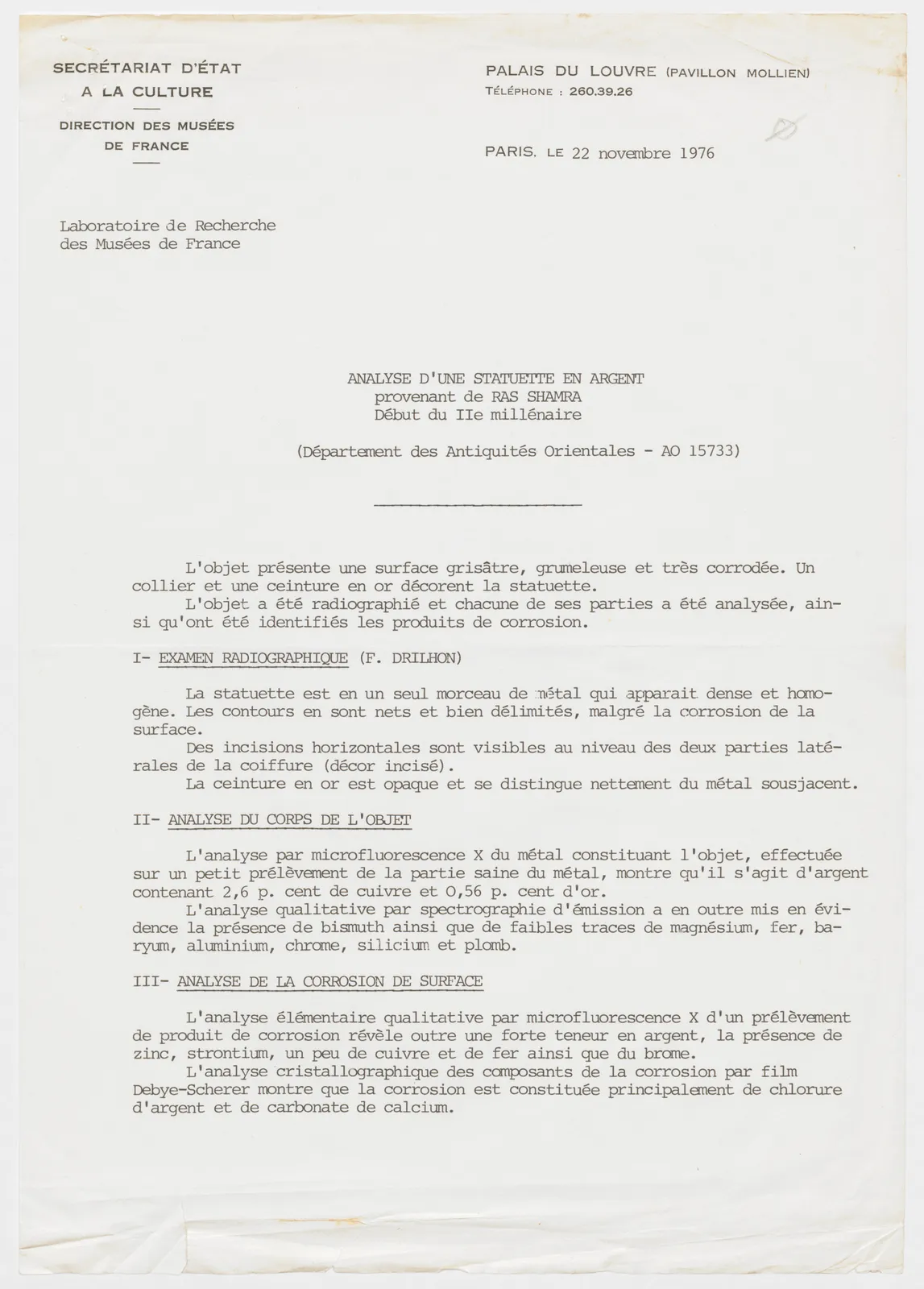
ANALYSIS OF A SILVER STATUETTE from RAS SHAMRA Beginning of the 2nd millennium
(Department of Near Eastern Antiquities - AO 15733)
_________________________
The object has a greyish, lumpy and heavily corroded surface. A necklace and a belt of gold decorate the statuette. The object was radiographed and each of its parts was analysed, as well as the corrosion products were identified.
I- RADIOGRAPHIC EXAMINATION (F. DRILHON)
The statuette is in a single piece of metal which appears dense and homogeneous. Its outlines are clear and well defined, despite the corrosion of the surface. Horizontal incisions are visible at the level of the two lateral parts of the headdress (incised decoration). The gold belt is opaque and clearly stands out from the underlying metal.
II- ANALYSIS OF THE BODY OF THE OBJECT
The X-ray microfluorescence analysis of the metal constituting the object, carried out on a small sample of the sound part of the metal, shows that it is silver containing 2,6 p. cent of copper and 0,56 p. cent of gold. Qualitative emission spectrographic analysis also revealed the presence of bismuth as well as faint traces of magnesium, iron, barium, aluminium, chromium, silicon and lead.
III- ANALYSIS OF THE SURFACE CORROSION
Qualitative elemental X-ray microfluorescence analysis of a sample of corrosion product reveals, besides a strong silver content, the presence of zinc, strontium, a little copper and iron as well as bromine. Crystallographic analysis of the components of the corrosion by Debye-Scherer film shows that the corrosion consists mainly of silver chloride and calcium carbonate.
65 figures hard to readstruck struck outadded written in above” jug ditto, and what it repeatsword reading not certain