
Unnumbered pageScan 4 of 4
-4-
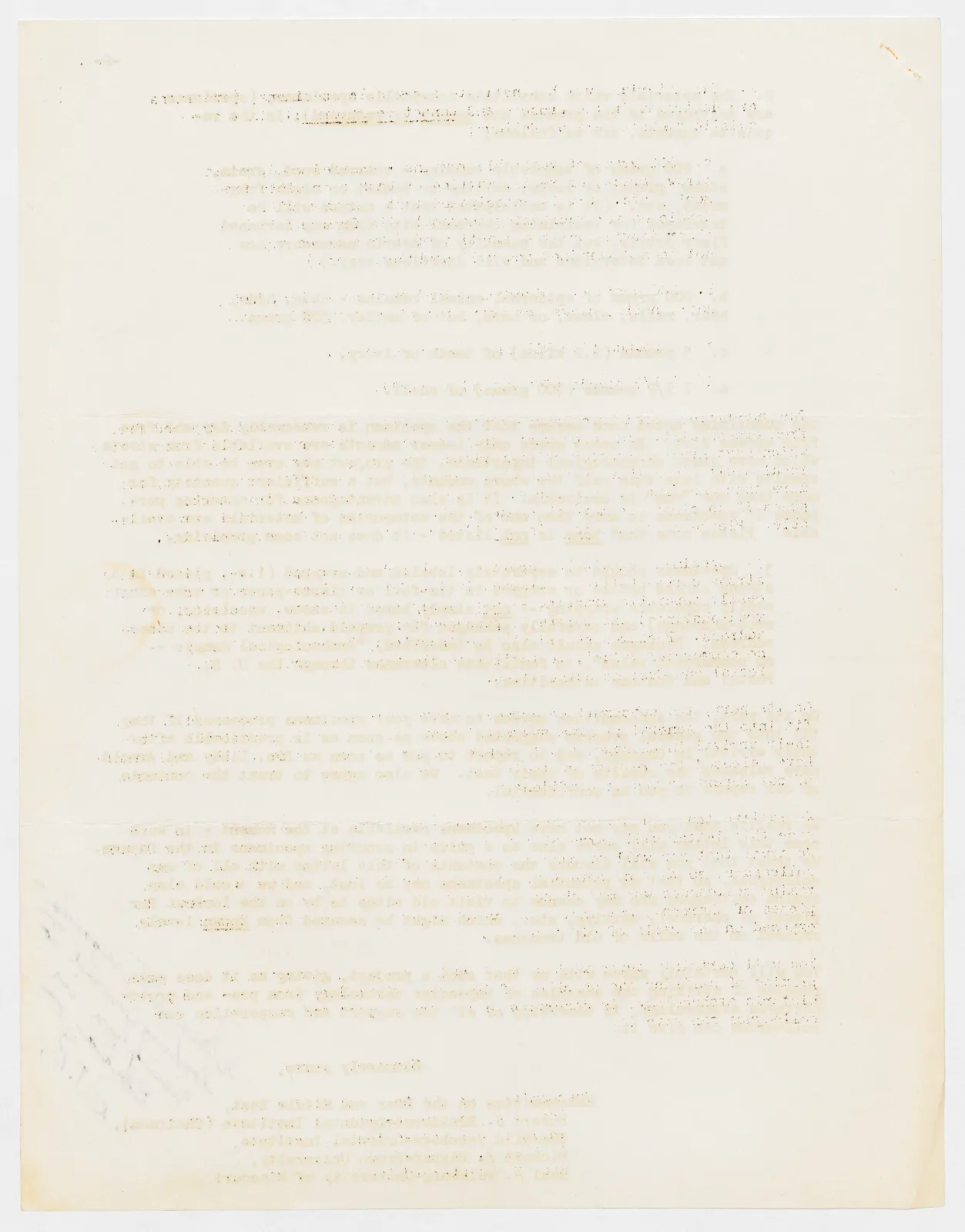
2. The material which could be submitted for radiocarbon dating (charcoal, wood, seeds, [illegible] and bone) should be [illegible] in the re-quisite amounts, as follows:
a. 500 grams of vegetable material (wood, charcoal, seeds, [illegible] etc.), of which only [illegible] is [illegible]. (It is understood that this method will be developed for recalibrating dates of Enkomi, between the floor levels, but the quantity of carbon necessary has not been determined and will be determined very.)
b. 200 grams of spiritual-animal material - shell, bone, hair, nails, [illegible] of teeth, but of antler; 500 grams.
c. 5 pounds (2.2 kilos) of teeth or ivory;
d. 1 1/2 pounds (700 grams) of shell.
The question need not arise that the problem is necessarily dropped. In cases where only lesser amounts are available, from strata which have given chronological importance, the project may even be able to get results with less than half the above amounts, but a sufficient quantity for many tests may be destroyed. It is also advantageous, [illegible] which is [illegible] to have some small amount of material [illegible] available. Please note that here is not Libby - it does not seem possible.
3. Specimens should be separately labelled and wrapped (tiny, plastic) in other closed boxes or wrapped in tinfoil or glass-paper or some other suitable wrapping - not plastic bags. In long, consistent of samples (where possible) and carefully packed for special shipment, the archaeological packages should also be labelled. "Radiocarbon Sample - no economic value", to facilitate clearance through the U. S. Postal and Customs authorities.
4. It may be, the scientific agencies to have your specimens processed. They will not be able to print a large ... [illegible] Libby and Arnold have resumed the publication of their list. We also agree to treat the contents of our report to you as done material.
5. It is possible that you may not have specimens available at the moment - in such case Libby will serve also as a guide in deciding specimens for the future. We would like to know if you could choose the contents of this Libby with all of our collections, and that of potential specimens may be lost, and we could also reach collection(s) and may choose to visit old sites to be on the lookout for pieces of charcoal, wood, etc., which might be sourced from known levels, deposed on the walls of old trenches.
You will certainly agree with us that such a problem, giving us in some sense a series of arbitrary (?) ... of the ability of Libby... by obtaining with the support and cooperation our colleagues can give it.
Sincerely yours,
Committee on the Near and Middle East, Robert J. Braidwood, Oriental Institute (Chairman), Harold J. Ingholt, Yale University, Richard A. Parker, Brown University, Saul S. Weinberg, University of Missouri.
65 figures hard to readstruck struck outadded written in above” jug ditto, and what it repeatsword reading not certain