
Unnumbered pageScan 4 of 20
Continued from scan 3
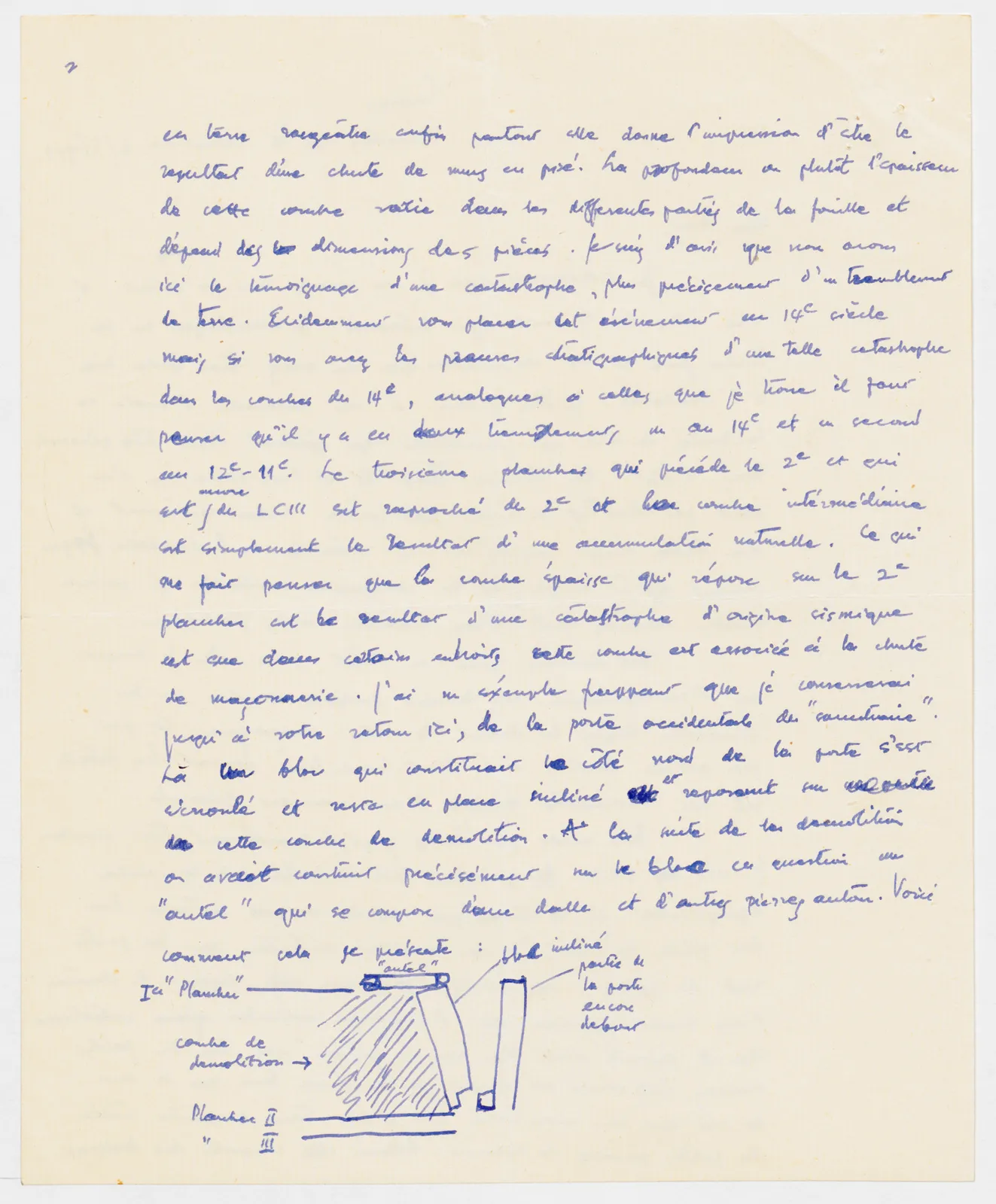
… in vegetable earth; finally everywhere it gives the impression of being the result of a collapse of pisé walls. Its depth, or rather the thickness of this layer varies in the different parts of the excavation and depends on the dimensions of the rooms. I am of the opinion that we have here the evidence of a catastrophe, more precisely of an earthquake . Obviously we will place this event in the 14th century but if we have the stratigraphic traces of such a catastrophe in the 14th-century layers, analogous to those I hold, it is necessary to think that there were two earthquakes, one in the 14th and a second in the 12th-11th. The third floor, which precedes the 2nd and which is of LCIII is attributed to the 2nd, and the "intermediate" layer is simply the result of natural accumulation. This which makes me think that the thick layer which rests on the 2nd floor is the result of a catastrophe of seismic origin and that in certain places, this layer is associated with the fall of masonry. I have a striking example that I will keep until our return here, of the western door of the "sanctuary". There a block which formed the north side of the door has collapsed and remained in place, inclined and resting on the part of this demolition layer. Following the destruction one would have continued precisely on the block to build a "altar" which consists of a slab and other stones around it. Here is how this presents itself:
Figure: hand-drawn section sketch showing a horizontal slab labelled "autel" above an inclined block, hatched layer of demolition below, a standing portion of door on the right, and horizontal lines for planchers; labels: "Ire "Plancher"", "autel", "bloc incliné", "partie de la porte encore debout", "couche de démolition", "Plancher II", "" III"
65 figures hard to readstruck struck outadded written in above” jug ditto, and what it repeatsword reading not certain