
Unnumbered pageScan 6 of 8
Printed: 2
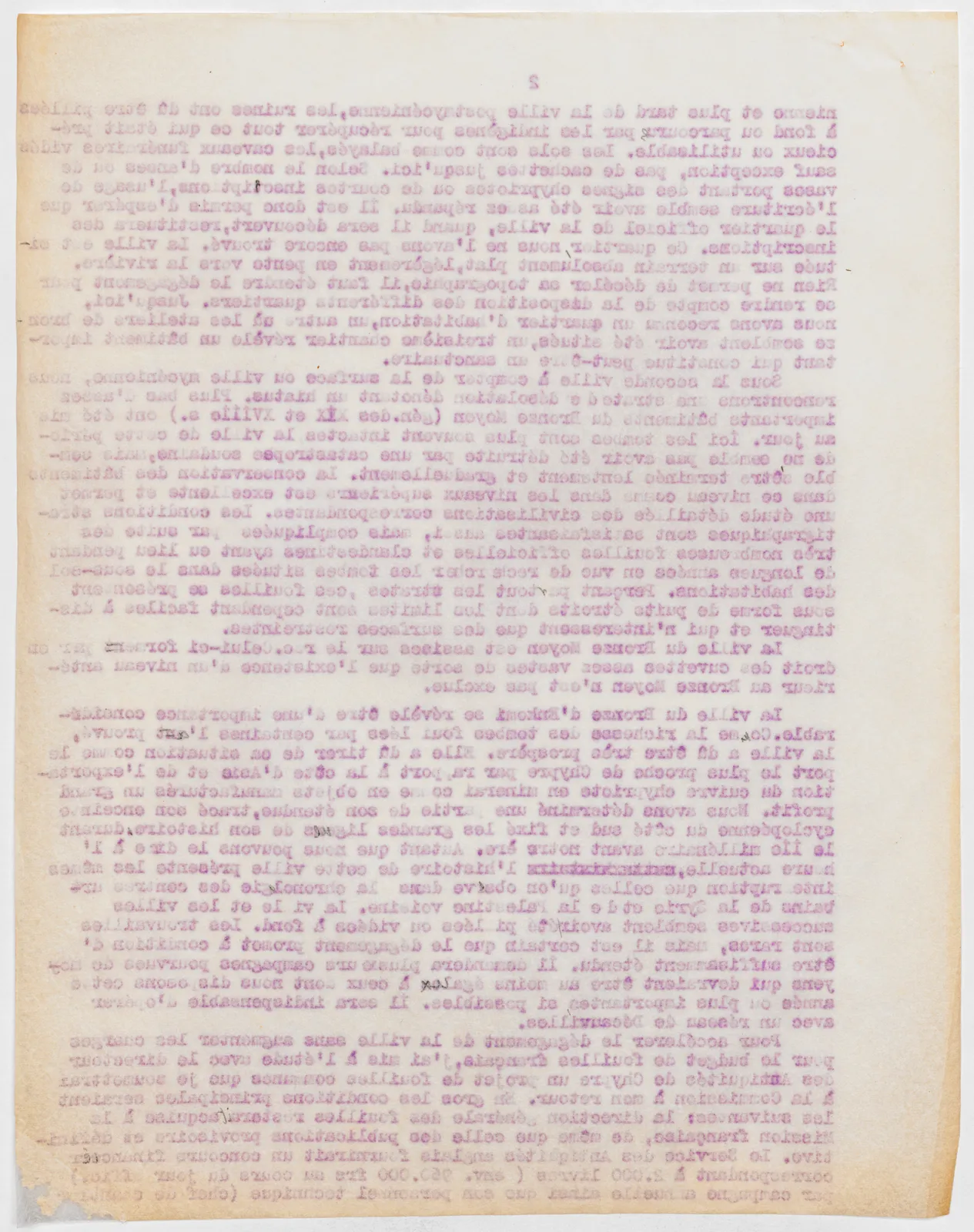
even later, in the post-Homeric city, the roof tiles were taken thoroughly or dug through by the natives to recover everything that was precious or usable. The floors are as if swept, the burial chambers emptied except for exceptions, no bodies so far. According to the number of handles or vessels bearing syllabic signs or inscribed bodies, the use of writing seems to have been fairly widespread. It is therefore permitted to hope that the official quarter of the town, when it is discovered, will yield inscriptions. This quarter we have not yet found. The town is entirely on absolutely flat ground, slightly sloping towards the river. Nothing allows its topography to be detected. One must study the clearing to gauge the layout of the different quarters. So far we have recognised a residential quarter, another where the bronze stelae were situated, a third area revealed a layering building which perhaps constitutes a sanctuary.
Beneath the necropolis, town from the surface to the Mycenaean town, we encounter a stratum of erosion indicating a hiatus. Lower down, quite important Middle Bronze buildings (end of the XIX and 18th c.) have been brought to light. Here the tombs are more often intact; the town of this period does not seem to have been destroyed by a sudden catastrophe but by a rather different one, ended slowly and gradually. The preservation of the buildings in this level as in the upper levels is excellent and allows a detailed study of the corresponding civilisations. The conditions stratigraphic are also satisfactory, but complicated, owing to the very numerous official and clandestine foundations, having taken place during many long years, or to rebuild the tombs cut into the subsoil of the houses. When these were found, these foundations present themselves in the form of "purtes ortes" whose limits are comparatively easy to distinguish and which concern only restricted areas.
The Middle Bronze town sits on the ro. Hill and forms, on the side of the true vastes, so that the existence of an earlier level prior to the Middle Bronze is not excluded.
The Bronze town of Enkomi proves to be of constant importance. As the wealth of the tombs, hundreds of which have been excavated, shows. the town must have been very prosperous. It must have drawn from its situation as the nearest port of Cyprus in relation to the Asian coast, and from exporting Cypriot copper as ore as well as manufactured objects, a great profit. We have determined part of its extent, traced its enceinte, extended on the south side and established the main lines of its history during the 2nd millennium BC. As far as we can say at the present time, we know the history of this town shows the same breaks as those observed in the chronology of the neighbouring regions of Syria and neighbouring Palestine. Ia vi and the vi, the towns successive seem to have been taken or emptied thoroughly. The finds are rare, but it is certain that the clearing provides this lec d' be sufficiently extensive. It will require several seasons provided with newcomers which should be at least equal to those we, like this year or more important and possible. It will be essential to operate with a network of déblayailles.
To speed up the clearing of the town without increasing the burdens on the French excavation budget, I have studied with the Directorate of Antiquities of Cyprus a project of continuous excavations which I will submit to the Commission on my return. The main conditions would be the following: the Antiquities Service engages French assistance corresponding to 2.000 pounds (c. 365.000 frs at the official rate of the day) per season to be provided, as well as its technical staff (area foreman)
65 figures hard to readstruck struck outadded written in above” jug ditto, and what it repeatsword reading not certain