
Unnumbered pageScan 2 of 10
French Archaeological Mission Excavations at Arslan Tépé-Malatya, 30 August 1946.
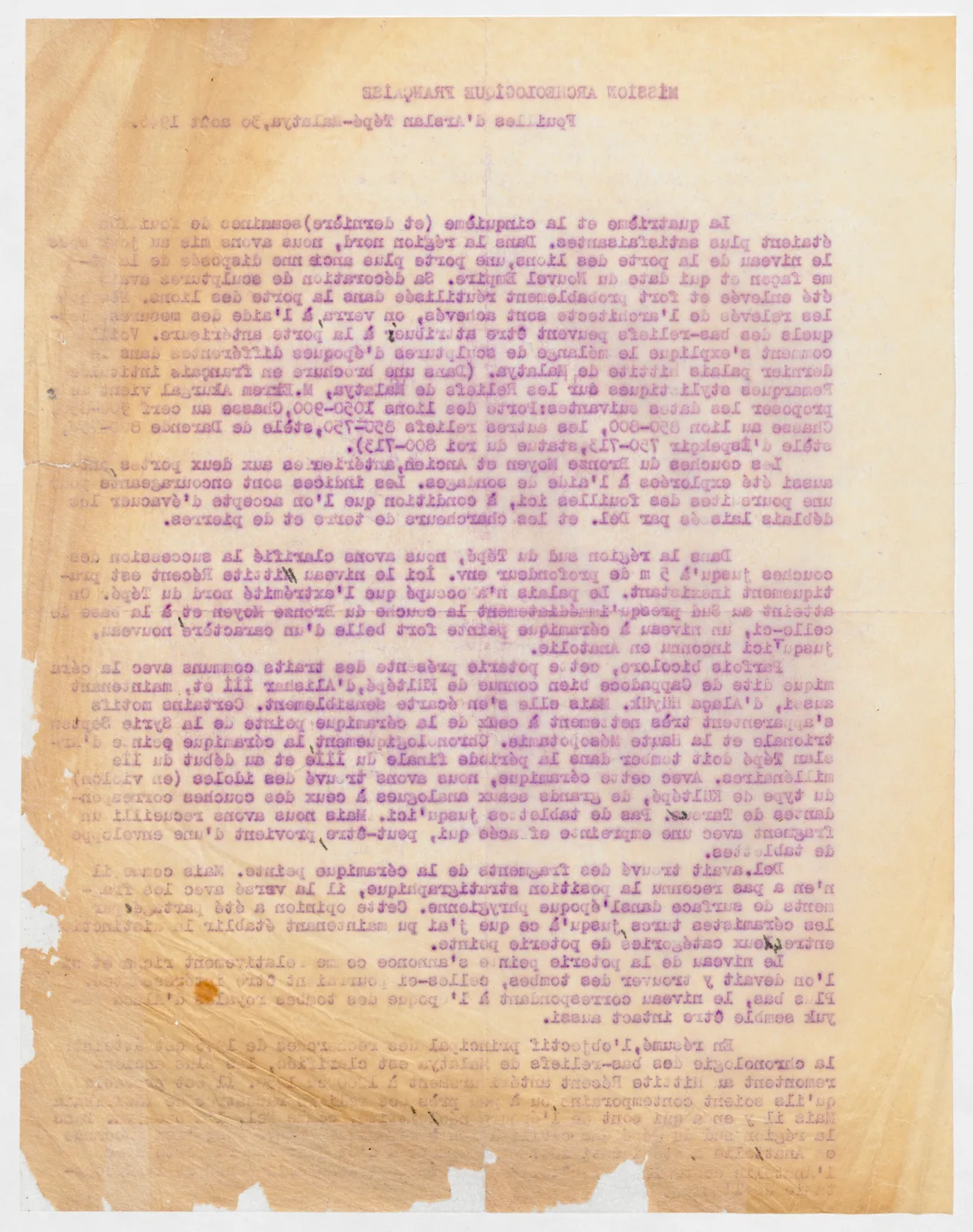
The fourth and fifth (and last) weeks of excavation were more interesting. In the northern area, we uncovered at the level of the Lion Gate an earlier gate arranged in the same way as the Lion Gate, an earlier gate arranged in the same way. Its sculptural decoration had been removed and most probably reused in the Lion Gate. Part of the architect's reliefs are finished; we will see with the help of measurements which of the bas-reliefs can be attributed to the earlier gate. This is how the mixture of sculptures of different periods in the last Hittite palace of Malatya is explained. (In a brochure in French entitled Remarques stylistiques sur les reliefs de Malatya, Mr Ekrem Akurgal has just proposed the following dates: Lion Gate 1050-900, classed at the stag 900-850; classed at the Lion 850-800, the other reliefs 850-750, Darende stele 810-750, Iaspekiz stele 750-713, statue of the king 800-713).
The layers of the Middle and Early Bronze, earlier than the two gates, as well as others, have been explored with the help of soundings. The tombs are encouraging for a gate of the fortifications, on condition that one agrees to remove the lateral spoil by Del. and the earth and plaster areas.
In the southern area and of the Tépé, we have clarified the succession of layers down to a depth of c. 5 m. Here the Late Hittite level is almost entirely absent. The palace occupied only the northern end of the Tépé. In the south one reaches almost immediately the layer of the Middle Bronze, and at the base of this, a level with painted pottery, strong and fine, of a new character, unknown in Anatolia.
Among the chocolate-coloured pottery, this pottery presents features in common with the mixed pottery of Alishar... (illegible)
Del. had found fragments of painted pottery. But as he did not recognise its stratigraphic position, he assigned it with the surface fragments of Amal of Phrygian date. This opinion was shared by the Turkish potters, until I have now been able to establish the distinction between these two categories of painted pottery.
The level of the painted pottery promises to be relatively rich and one should find tombs there, these being able to contain this height below. The level corresponding to the period of the royal tombs of Alaca may also seem to be intact.
In summary, the main objective of last year's research, the chronology of the bas-reliefs of Malatya, is clarified. The tombs go back to the Late Hittite period earlier than 1200 B.C. It is moreover that they be contemporary or nearly so. But there are some which are of the Hittite period. In the northern and southern areas, the layers of Anatolia. (illegible) Anatolia. (illegible)
65 figures hard to readstruck struck outadded written in above” jug ditto, and what it repeatsword reading not certain