
Unnumbered pageScan 1 of 10
FRENCH ARCHAEOLOGICAL MISSION
Excavations at Arslan Tépé-Malatya, 3o August 1945.
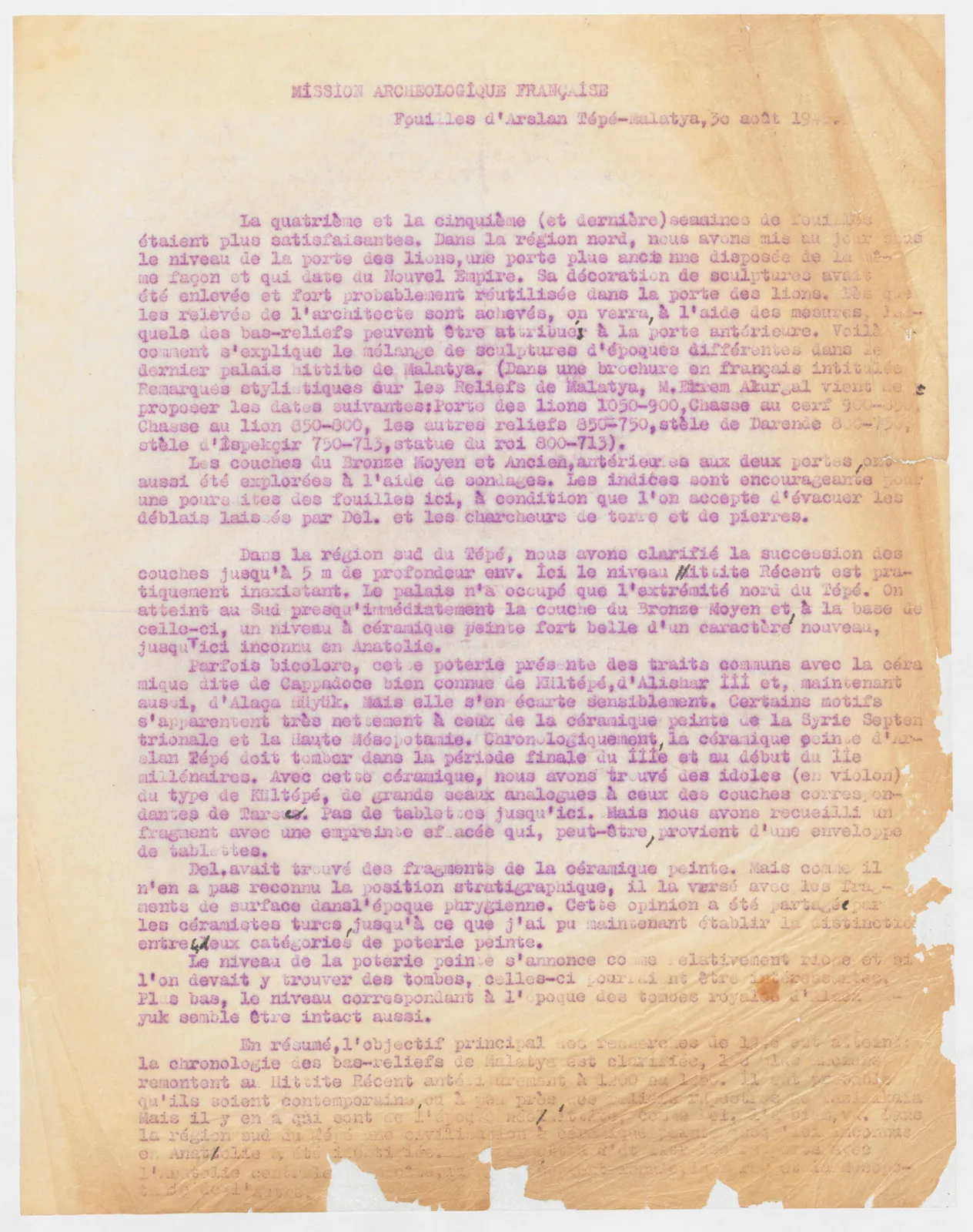
The fourth and fifth (and last) weeks of excavation were more satisfactory. In the northern area, we uncovered, below the level of the Lion Gate, an older gate laid out in the same way and dating from the New Kingdom. Its sculptured decoration had been removed and most probably reused in the Lion Gate. As soon as the architect's drawings are completed, it will be seen from the measurements which of the reliefs can be attributed to the earlier gate. This is how the mixture of sculptures of different periods in the last Hittite palace of Malatya is explained. (In a brochure in French entitled Remarques stylistiques sur les Reliefs de Malatya, Mr Ekrem Akurgal has just proposed the following dates: Lion Gate 1050-900, Stag Hunt 900-850, Lion Hunt 850-800, the other reliefs 850-750, Darende stele 800-750, Ispekçir stele 750-713, statue of the king 800-713).
The layers of the Middle and Early Bronze, earlier than the two gates, were also explored by means of soundings. The indications are encouraging for a continuation of the excavations here, on condition that one agrees to remove the spoil left by Del. and the earth and stone searchers.
In the southern area of the Tépé, we clarified the succession of layers down to c. 5 m depth. Here the Late Hittite level is practically non-existent. The palace occupied only the northern end of the Tépé. In the South one reaches almost immediately the Middle Bronze layer and, at its base, a level with very fine painted pottery of a new character, hitherto unknown in Anatolia.
Sometimes bichrome, this pottery shows features in common with the so-called Cappadocian pottery well known from Kültépé, Alishar III and, now also, Alaça Höyük. But it differs noticeably from it. Certain motifs are very clearly related to those of the painted pottery of Northern Syria and Upper Mesopotamia. Chronologically, the painted pottery of Arslan Tépé must fall in the final period of the 3rd and the beginning of the 2nd millennia. With this pottery we found idols (violin-shaped) of the Kültépé type, large seals analogous to those of the corresponding layers at Tarsus. No tablets so far. But we recovered a fragment with an effaced impression which perhaps comes from a tablet envelope.
Del. had found fragments of the painted pottery. But as he did not recognise its stratigraphic position, he put it together with the surface fragments in the Phrygian period. This opinion was shared by the Turkish ceramists, until I have now been able to establish the distinction between two categories of painted pottery.
The level of the painted pottery promises to be relatively rich, and if tombs were to be found there, these could be interesting. Lower down, the level corresponding to the period of the royal tombs of Alaça Höyük also seems to be intact.
In summary, the main objective of the researches of le se has been achieved: the chronology of the reliefs of Malatya has been clarified; the oldest go back to the Late Hittite period, before 1200 or 1250. They are probably contemporary, or roughly so, with the reliefs of Tell Halaf. But there are some which are of the Neo-Hittite period, as Del. supposed. In the southern area of the Tépé a painted-pottery civilisation, hitherto unknown in Anatolia, has been identified. The problem of et must be situated in its relations with central Anatolia and Mesopotamia, in the period of the domination of the Arbe.
65 figures hard to readstruck struck outadded written in above” jug ditto, and what it repeatsword reading not certain