
Unnumbered pageScan 2 of 10
Continued from p. 3
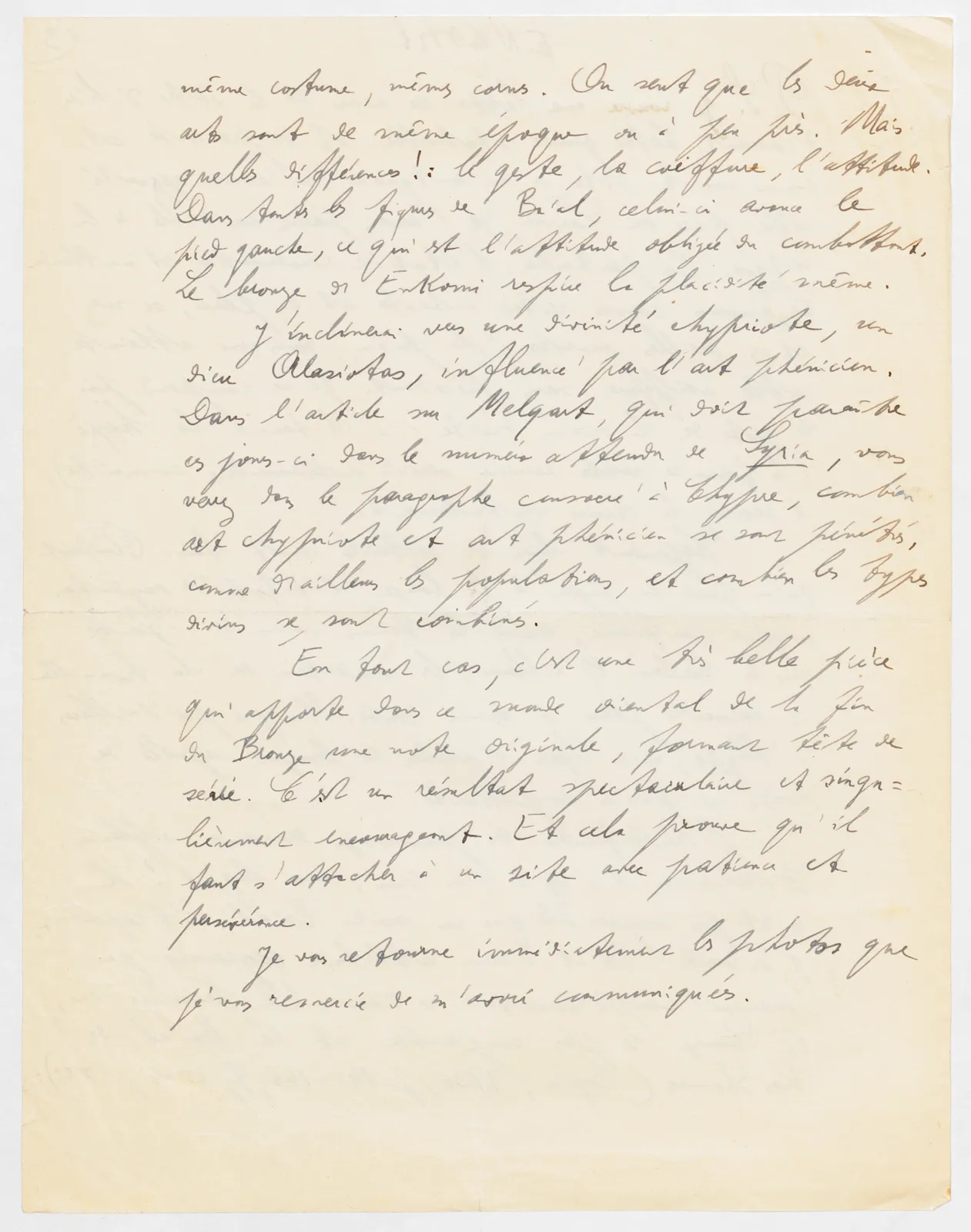
… same costume, same horns. One senses that the two arts are of the same period or roughly so. But what differences!: the gesture, the hairstyle, the attitude. In all the figures of Ba'al, the latter advances the left foot, which is the obligatory attitude of the fighter. The Enkomi bronze breathes pure placidity.
I would incline towards a Cypriot deity, a god Alasiotas, influenced by Phoenician art. In the article on Melqart, which is due to appear these days in the forthcoming issue of Syria, you will see in the paragraph devoted to Cyprus, how much Cypriot art and Phoenician art have interpenetrated, as indeed have the populations, and how much the types divine have combined.
In any case, it is a very fine piece which brings into this Oriental world at the end of the Bronze Age an original note, forming the head of a series. It is a spectacular and singu= larly encouraging result. And this proves that one must devote oneself to a site with patience and perseverance.
I am returning the photographs immediately, which I thank you for having sent me.
65 figures hard to readstruck struck outadded written in above” jug ditto, and what it repeatsword reading not certain