
Unnumbered pageScan 271 of 438
Continued from scan 270
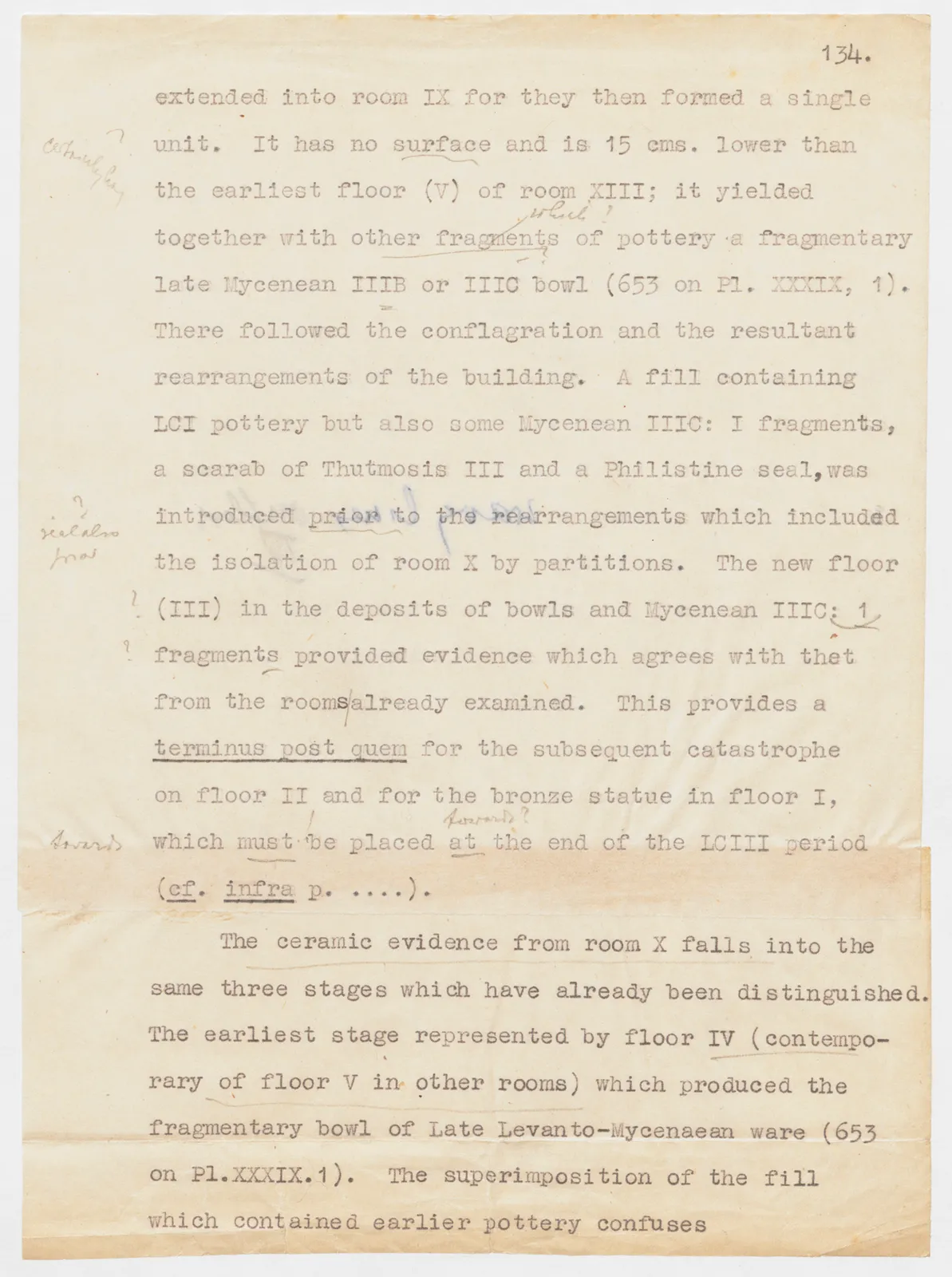
… extended into room IX for they then formed a single unit. It has no surface and is 15 cms. lower than the earliest floor (V) of room XIII; it yielded together with other [handwritten: which ?] fragments of pottery a fragmentary late Mycenean IIIB or IIIC bowl (653 on Pl. XXXIX, 1). There followed the conflagration and the resultant rearrangements of the building. A fill containing LCI pottery but also some Mycenean IIIC: I fragments, a scarab of Thutmosis III and a Philistine seal,was introduced prior to the rearrangements which included the isolation of room X by partitions. The new floor (III) in the deposits of bowls and Mycenean IIIC: 1 fragments provided evidence which agrees with thet from the rooms/already examined. This provides a terminus post quem for the subsequent catastrophe on floor II and for the bronze statue in floor I, which must be placed [handwritten: forward?] at the end of the LCIII period (cf. infra p. ....).
The ceramic evidence from room X falls into the same three stages which have already been distinguished. The earliest stage represented by floor IV (contemporary of floor V in other rooms) which produced the fragmentary bowl of Late Levanto-Mycenaean ware (653 on Pl.XXXIX.1). The superimposition of the fill which contained earlier pottery confuses
65 figures hard to readstruck struck outadded written in above” jug ditto, and what it repeatsword reading not certain