
Unnumbered pageScan 1 of 2
Printed: The Guardian, 18th January, 1969
Handwritten: (Manchester)
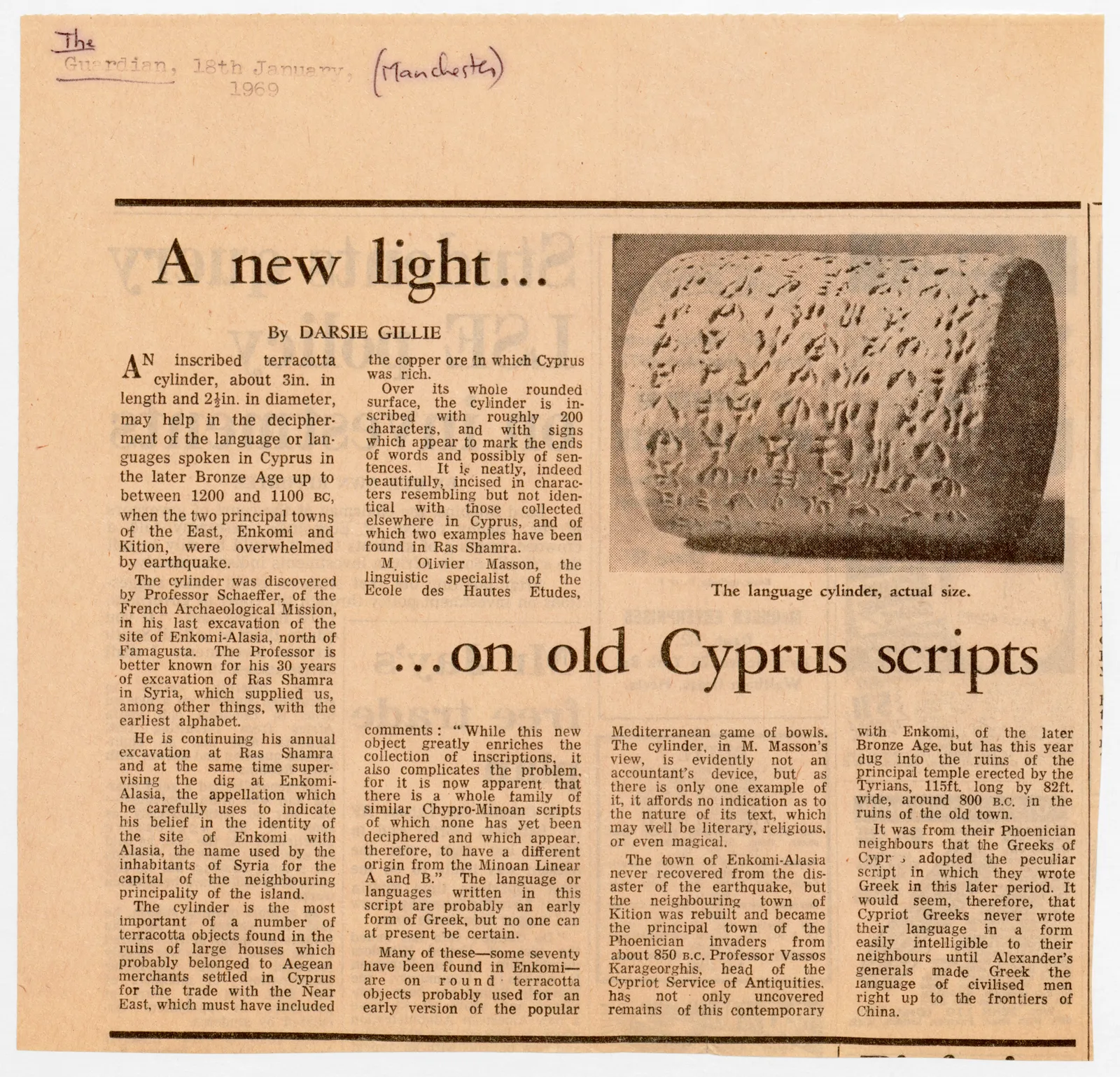
Figure: photograph of an inscribed terracotta cylinder, shown in side view; labels: The language cylinder, actual size.
A new light...
By DARSIE GILLIE
AN inscribed terracotta cylinder, about 3in. in length and 2½in. in diameter, may help in the decipherment of the language or languages spoken in Cyprus in the later Bronze Age up to between 1200 and 1100 BC, when the two principal towns of the East, Enkomi and Kition, were overwhelmed by earthquake.
The cylinder was discovered by Professor Schaeffer, of the French Archaeological Mission, in his last excavation of the site of Enkomi-Alasia, north of Famagusta. The Professor is better known for his 30 years of excavation of Ras Shamra in Syria, which supplied us, among other things, with the earliest alphabet.
He is continuing his annual excavation at Ras Shamra and at the same time supervising the dig at Enkomi- Alasia, the appellation which he carefully uses to indicate his belief in the identity of the site of Enkomi with Alasia, the name used by the inhabitants of Syria for the capital of the neighbouring principality of the island.
The cylinder is the most important of a number of terracotta objects found in the ruins of large houses which probably belonged to Aegean merchants settled in Cyprus for the trade with the Near East, which must have included
the copper ore in which Cyprus was rich.
Over its whole rounded surface, the cylinder is inscribed with roughly 200 characters, and with signs which appear to mark the ends of words and possibly of sentences. It is neatly, indeed beautifully, incised in characters resembling but not identical with those collected elsewhere in Cyprus, and of which two examples have been found in Ras Shamra.
M. Olivier Masson, the linguistic specialist of the Ecole des Hautes Etudes,
...on old Cyprus scripts
comments: "While this new object greatly enriches the collection of inscriptions, it also complicates the problem, for it is now apparent that there is a whole family of similar Chypro-Minoan scripts of which none has yet been deciphered and which appear. therefore, to have a different origin from the Minoan Linear A and B." The language or languages written in this script are probably an early form of Greek, but no one can at present be certain.
Many of these—some seventy have been found in Enkomi— are on round terracotta objects probably used for an early version of the popular
Mediterranean game of bowls. The cylinder, in M. Masson's view, is evidently not an accountant's device, but as there is only one example of it, it affords no indication as to the nature of its text, which may well be literary, religious, or even magical.
The town of Enkomi-Alasia never recovered from the disaster of the earthquake, but the neighbouring town of Kition was rebuilt and became the principal town of the Phoenician invaders from about 850 B.C. Professor Vassos Karageorghis, head of the Cypriot Service of Antiquities, has not only uncovered remains of this contemporary
with Enkomi, of the later Bronze Age, but has this year dug into the ruins of the principal temple erected by the Tyrians, 115ft. long by 82ft. wide, around 800 B.C. in the ruins of the old town.
It was from their Phoenician neighbours that the Greeks of Cypr s adopted the peculiar script in which they wrote Greek in this later period. It would seem, therefore, that Cypriot Greeks never wrote their language in a form easily intelligible to their neighbours until Alexander's generals made Greek the language of civilised men right up to the frontiers of China.
65 figures hard to readstruck struck outadded written in above” jug ditto, and what it repeatsword reading not certain