
Unnumbered pageScan 5 of 12
3
Handwritten at top: illegible heading
according to (struck, handwritten "according to" above)
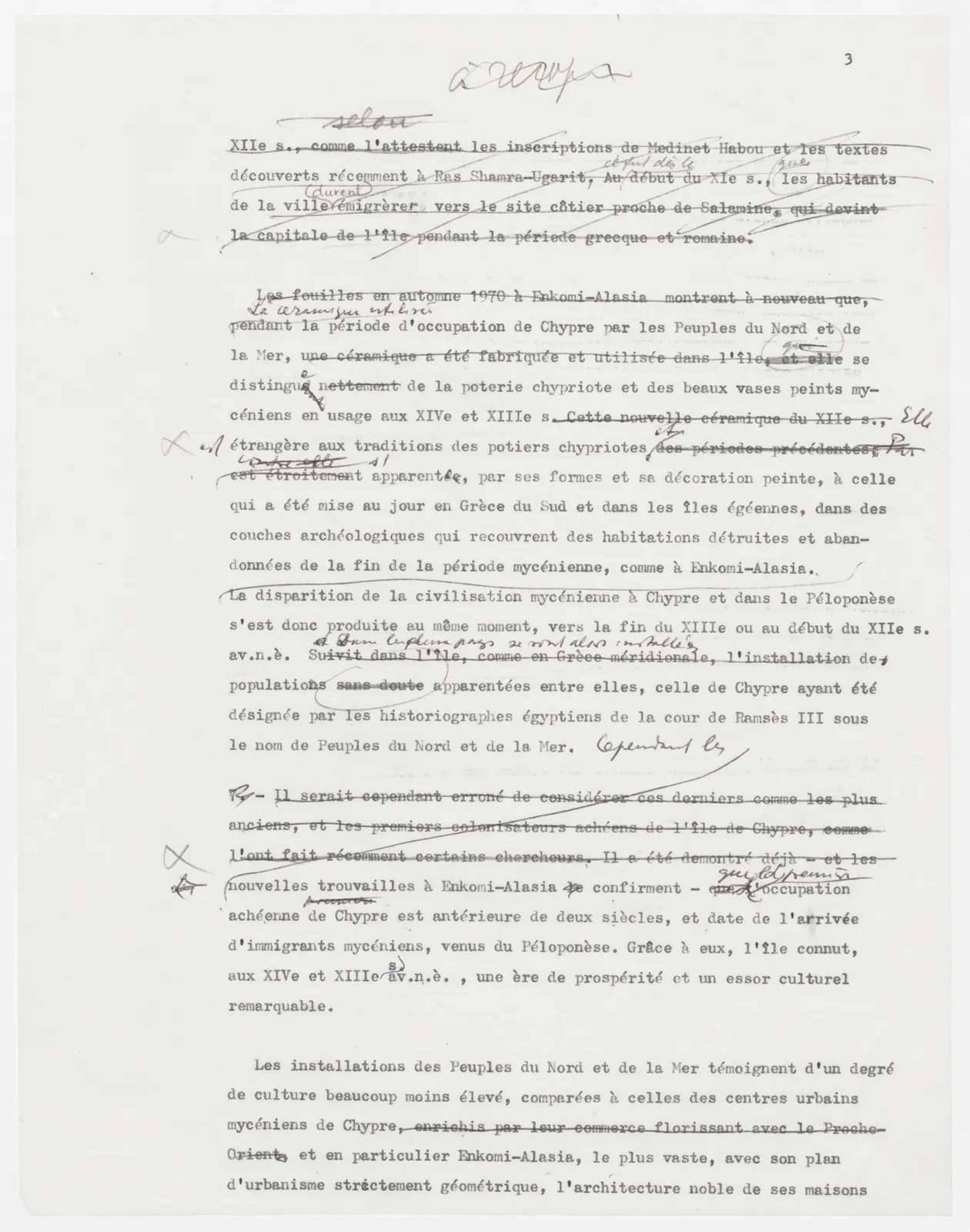
12th c., as attested by the inscriptions of Medinet Habou and the texts recently discovered at Ras Shamra-Ugarit, [handwritten: beginning of the] At the beginning of the 11th c., [handwritten: that] the inhabitants of the town [handwritten: had to] emigrate to the coastal site near Salamis, which became the capital of the island during the Greek and Roman period.
The excavations in autumn 1970 at Enkomi-Alasia again show that, [handwritten: The pottery used] during the period of occupation of Cyprus by the Peoples of the North and of the Sea, a pottery was made and used on the island, [handwritten: and it] is clearly distinct from Cypriot pottery and from the fine painted Mycenaean vases in use in the 14th and 13th c. This new pottery of the 12th c., [handwritten: It] foreign to the traditions of Cypriot potters of the preceding periods, [handwritten: In] [handwritten: contrast] is closely related, in its forms and painted decoration, to that which was brought to light in southern Greece and in the Aegean islands, in archaeological layers overlying destroyed and abandoned houses of the end of the Mycenaean period, as at Enkomi-Alasia.
The disappearance of Mycenaean civilisation in Cyprus and in the Peloponnese therefore occurred at the same moment, towards the end of the 13th or the beginning of the 12th c. B.C. [handwritten: and no doubt not then settled] Followed on the island, as in southern Greece, by the settlement of populations no doubt related to one another, that of Cyprus having been designated by the Egyptian historiographers of the court of Ramsès III under the name of Peoples of the North and of the Sea. [handwritten: However the]
It would however be wrong to consider the latter as the oldest, and the first Achaean colonisers of the island of Cyprus, as some researchers have recently done. It has already been shown - and the [handwritten: They] new finds at Enkomi-Alasia [handwritten: of] confirm - [handwritten: that the first] an Achaean occupation of Cyprus is two centuries earlier, and dates from the arrival of Mycenaean immigrants, coming from the Peloponnese. Thanks to them, the island knew, in the 14th and 13th c. B.C. , an era of prosperity and a remarkable cultural flowering.
The installations of the Peoples of the North and of the Sea show a much lower degree of culture, compared with those of the Mycenaean urban centres of Cyprus, enriched by their flourishing trade with the Near East, and in particular Enkomi-Alasia, the largest, with its strictly geometric town plan, the noble architecture of its houses
65 figures hard to readstruck struck outadded written in above” jug ditto, and what it repeatsword reading not certain