
Unnumbered pageScan 4 of 12
2
to be reread
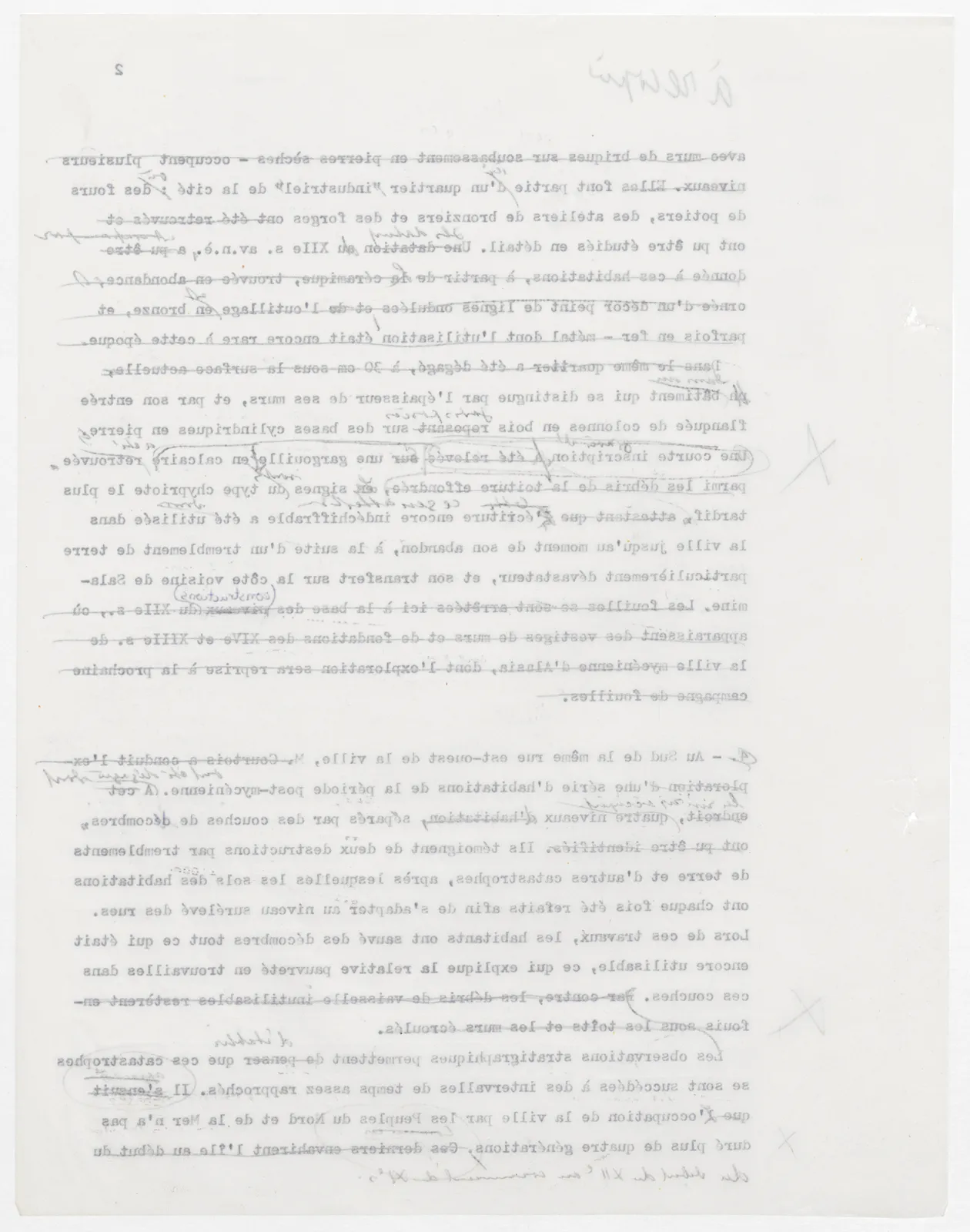
with brick walls on dry-stone foundations – occupy several levels. They form part of an "industrial" quarter of the city: kilns for potters, workshops of bronze-workers and forges have been found and could be studied in detail. A dating to the 12th c. B.C. could be given to these houses, on the basis of the pottery, found in abundance, decorated with painted wavy-line decoration, and of the bronze tools, and sometimes of iron – a metal whose use was still rare at that time. In the same quarter was cleared, 30 cm below the present surface, a building distinguished by the thickness of its walls, and by its entrance flanked by wooden columns resting on cylindrical stone bases. A short inscription was recorded on a limestone gargoyle found among the debris of the collapsed roof, in signs of the latest Cypriot type, attesting that the still undeciphered script was used in the city until the moment of its abandonment, following an earthquake partly devastating, and its transfer to the neighbouring coast of Salamis. The excavations stopped here at the base of the remains of walls and foundations of the 14th and 13th c. of the Mycenaean city of Alasia, whose exploration will be resumed at the next excavation campaign.
4 – To the South of the same east-west street of the city, Mr Courtois conducted the exploration of a series of houses of the post-Mycenaean period. (At this spot, four levels of occupation, separated by layers of debris, could be identified. They bear witness to two destructions by earthquakes and other catastrophes, after which the floors of the houses were each time raised to adapt to the raised level of the streets. During these works, the inhabitants salvaged from the debris everything that was still usable, which explains the relative poverty of finds in these layers. On the other hand, the unusable pottery debris remained buried under the collapsed roofs and walls.
The stratigraphic observations allow us to think that these catastrophes followed one another at fairly close intervals of time. It follows that the occupation of the city by the Peoples of the Sea n'a pas lasted more than four generations. The latter invaded the island at the beginning of the 12th c. B.C.
65 figures hard to readstruck struck outadded written in above” jug ditto, and what it repeatsword reading not certain