
Unnumbered pageScan 33 of 68
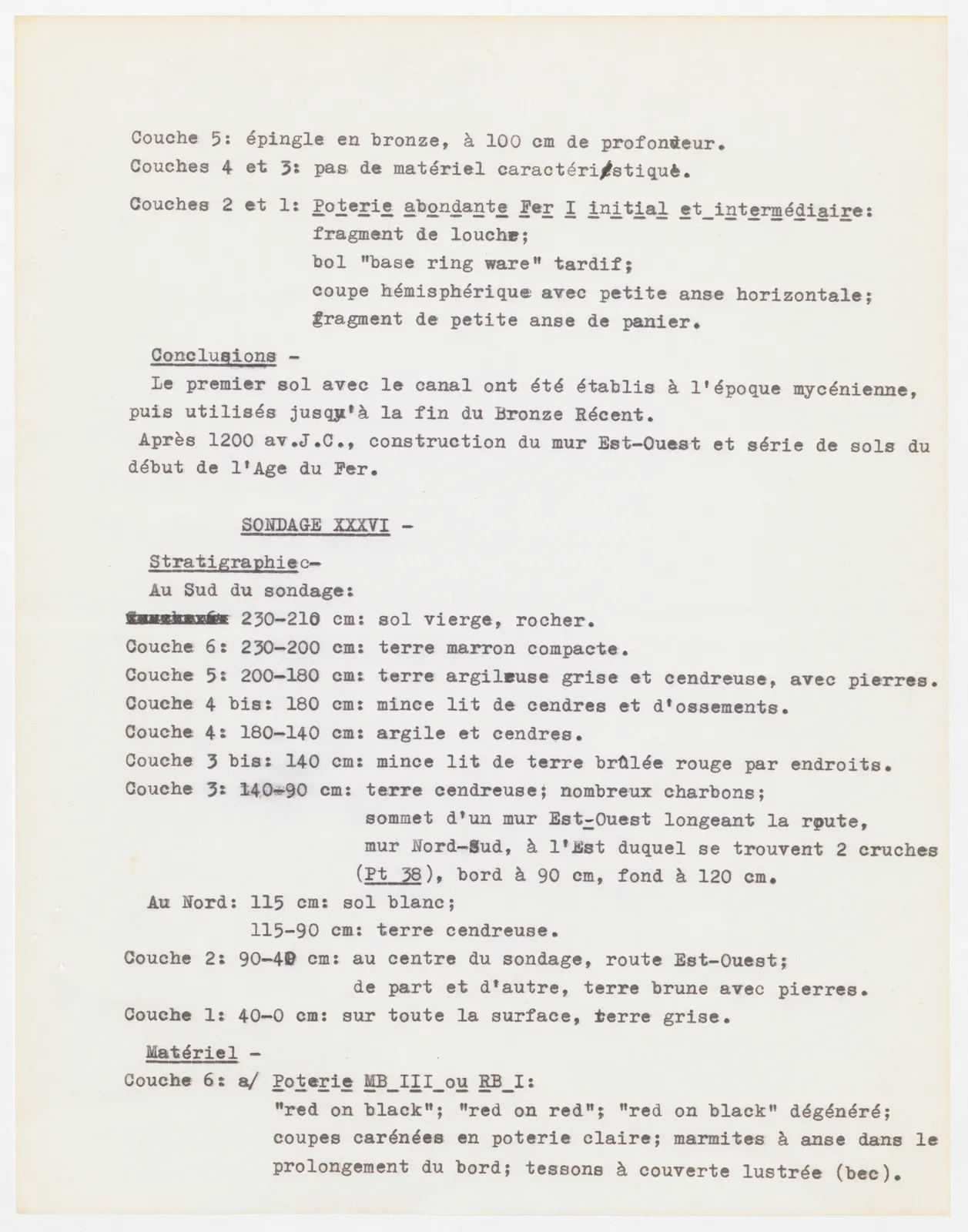
Layer 5: bronze pin, at a depth of 100 cm. Layers 4 and 3: no characteristic material.
Layers 2 and 1: Abundant pottery of Early and Middle Iron I: ladle fragment; late "base ring ware" bowl; hemispherical cup with small horizontal handle; fragment of small basket handle.
Conclusions - The first floor with the channel were established in the Mycenaean period, then used until the end of the Late Bronze. After 1200 B.C., construction of the E.-W. wall and series of floors of the beginning of the Iron Age.
SOUNDING XXXVI -
Stratigraphy- To the south of the sounding: [struck-through text: illegible] 230-210 cm: virgin floor, rock. Layer 6: 230-200 cm: compact brown earth. Layer 5: 200-180 cm: grey ashy clayey earth, with stones. Layer 4 bis: 180 cm: thin bed of ash and bones. Layer 4: 180-140 cm: clay and ash. Layer 3 bis: 140 cm: thin bed of burnt red earth in places. Layer 3: 140-90 cm: ashy earth; numerous charcoal; top of an E.-W. wall running along the road, N.-S. wall, to the East of which lie 2 jugs (Pt 38), rim at 90 cm, base at 120 cm. To the north: 115 cm: white floor; 115-90 cm: ashy earth. Layer 2: 90-40 cm: in the centre of the sounding, E.-W. road; on either side, brown earth with stones. Layer 1: 40-0 cm: over the whole surface, grey earth.
Material - Layer 6: a/ Pottery MB III or LB I: "red on black"; "red on red"; degenerate "red on black"; carinated cups in light pottery; cooking pots with handle in the extension of the rim; sherds with lustrous coating (spout).
65 figures hard to readstruck struck outadded written in above” jug ditto, and what it repeatsword reading not certain