
Unnumbered pageScan 24 of 68
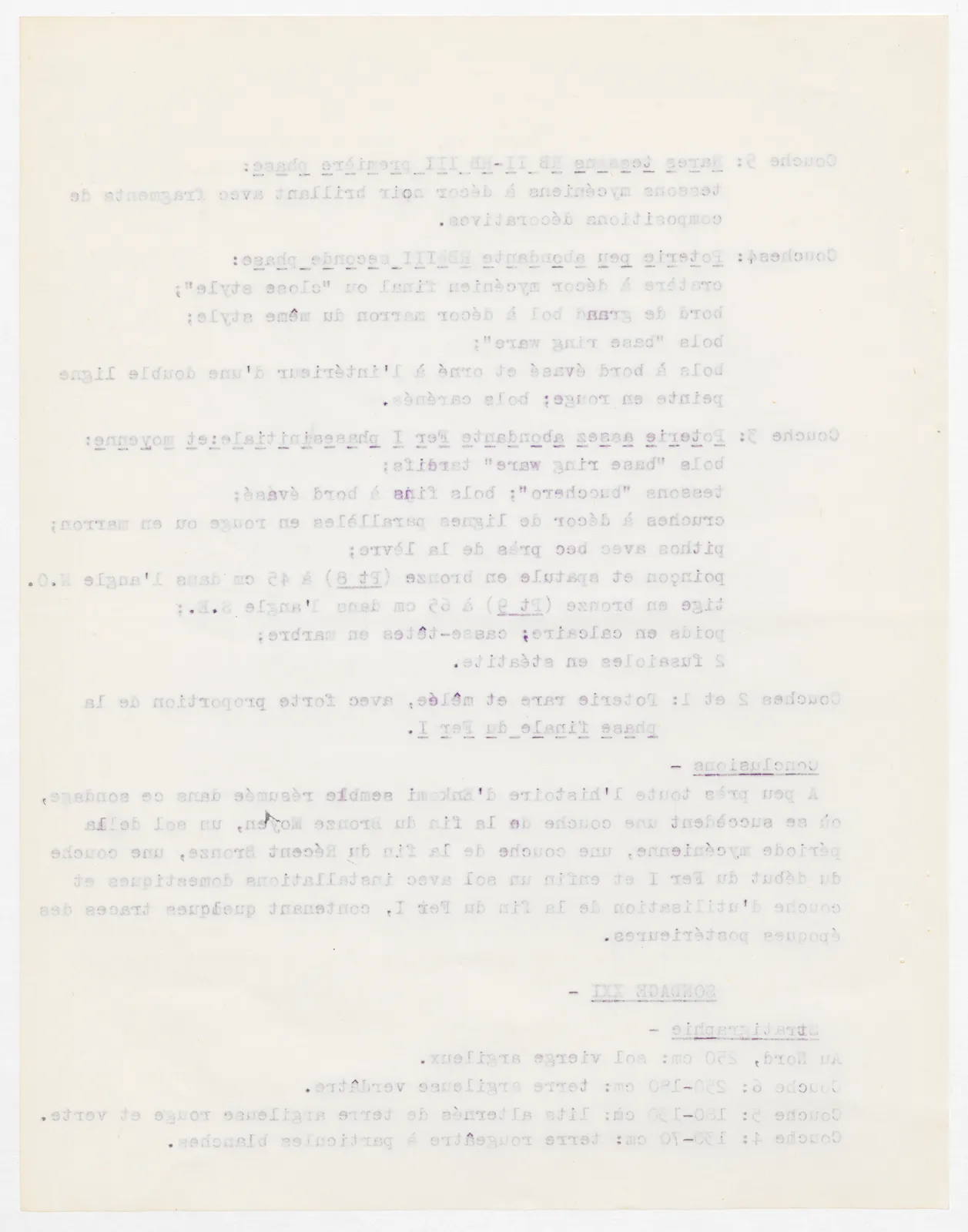
Layer 5: Rare sherds LB II-LB III first phase: Mycenaean sherds with lustrous black decoration with fragments of decorative compositions.
Layer 4: Pottery not very abundant LB III second phase: krater with final Mycenaean or "close style" decoration; rim of large bowl with brown decoration of the same style; "base ring ware" bowls; bowls with flaring rim and decorated on the inside with a double line painted in red; carinated bowls.
Layer 3: Fairly abundant pottery Iron I initial and middle phase: late "base ring ware" bowls; "bucchero" sherds; fine bowls with flaring rim; jugs with decoration of parallel lines in red or brown; pithos with spout taken from the rim; bronze awl and spatula (Pl 8) at 45 cm in the N.-W. corner; bronze rod (Pl 9) at 65 cm in the S.E. corner; limestone weight; marble club-heads; 2 steatite spindle whorls.
Layers 2 and 1: Rare and mixed pottery, with a strong proportion of the final phase of Iron I.
Conclusions –
Almost the whole history of Enkomi seems summed up in this sounding, where there succeed a layer of the end of the Middle Bronze, a floor of the Mycenaean period, a layer of the end of the Late Bronze, a layer of the beginning of Iron I and finally a floor with domestic installations and a use layer of the end of Iron I, containing some traces of later periods.
SONDAGE XXI –
Stratigraphy – To the North, 250 cm: virgin clay floor. Layer 6: 250-150 cm: greenish clayey earth. Layer 5: 180-130 cm: alternating beds of red and green clayey earth. Layer 4: 130-70 cm: reddish earth with white particles.
65 figures hard to readstruck struck outadded written in above” jug ditto, and what it repeatsword reading not certain