
Unnumbered pageScan 25 of 42
13
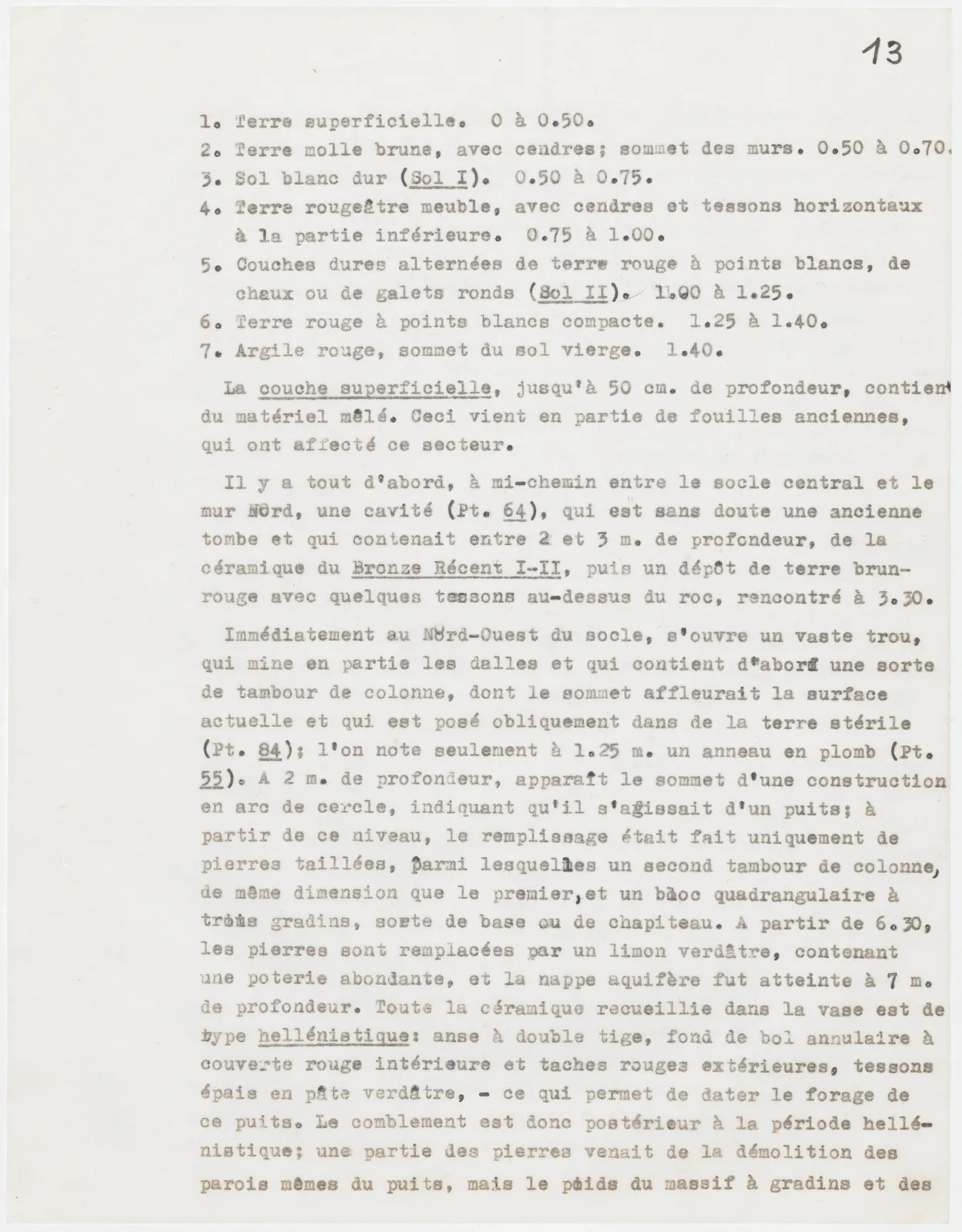
1o Surface earth. 0 to 0.50. 2o Soft brown earth, with ashes; top of the walls. 0.50 to 0.70. 3o Hard white floor (Floor I). 0.50 to 0.75. 4o Loose reddish earth, with ashes and horizontal sherds at the lower part. 0.75 to 1.00. 5o Hard alternating layers of red earth with white specks, of lime or round pebbles (Floor II). 1.00 to 1.25. 6o Compact red earth with white specks. 1.25 to 1.40. 7o Red clay, top of the virgin soil. 1.40.
The surface layer, down to 50 cm. depth, contains mixed material. This comes in part from old excavations, which affected this sector.
First of all, halfway between the central plinth and the North wall, there is a cavity (Pt. 64), which is no doubt a former tomb and which contained, between 2 and 3 m. depth, pottery of the Late Bronze I-II, then a deposit of brownred earth with some sherds above the rock, met at 3.30.
Immediately north-west of the plinth, a large hole opens, which partly undermines the slabs and which first contains a sort of column drum, whose top was level with the surface present and which is set obliquely in sterile earth (Pt. 84); only a lead ring is noted at 1.25 m. (Pt. 55). At 2 m. depth, the top of a construction in circular arc appears, indicating that it was a well; at from this level, the filling was made solely of dressed stones, among which a second column drum, of the same dimension as the first, and a quadrangular block with three steps, a sort of base or capital. From 6.30 on, the stones are replaced by greenish silt, containing abundant pottery, and the water table was reached at 7 m. depth. All the pottery recovered from the silt is of Hellenistic type: double-stemmed handle, ring base of bowl with red interior slip and red external spots, sherds thick in greenish fabric, - which makes it possible to date the boring of this well. The infilling is therefore later than the Hellenistic period; part of the stones came from the demolition of the very walls of the well, but the weight of the stepped mass and of
65 figures hard to readstruck struck outadded written in above” jug ditto, and what it repeatsword reading not certain