
Page -11-Scan 6 of 160
Continued from scan 5
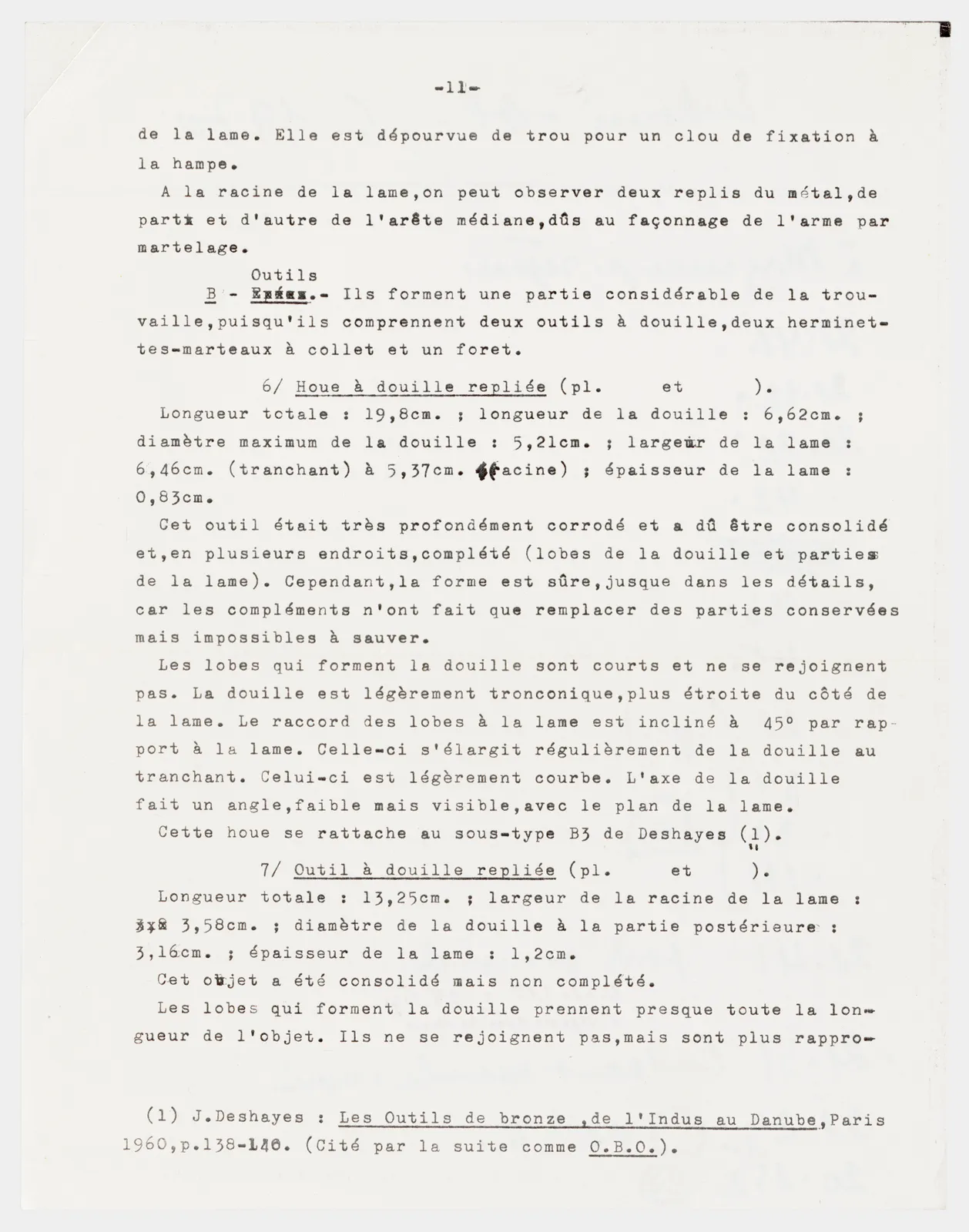
… of the blade. It is without a hole for a fixing nail to the shaft. At the root of the blade, two folds of the metal can be observed, partx and other side of the median ridge, due to shaping of the weapon by hammering. B - Epées Tools.- They form a considerable part of the findgroup, since they comprise two socketed tools, two herminette-hammers with collar and one drill.
6/ Folded-socket hoe (pl. and ). Total length: 19,8cm.; length of the socket: 6,62cm.; maximum diameter of the socket: 5,21cm.; width of the blade: 6,46cm. (cutting edge) to 5,37cm. ( (root); thickness of the blade: 0,83cm. This tool was very deeply corroded and had to be consolidated and, in several places, completed (lobes of the socket and parts of the blade). However, the form is certain, down to the details, for the restorations only replaced parts that were preserved but impossible to save. The lobes forming the socket are short and do not meet . The socket is slightly truncated-conical, narrower on the side of the blade. The junction of the lobes with the blade is inclined at 45° to the blade. The latter widens regularly from the socket to the cutting edge. The latter is slightly curved. The axis of the socket makes an angle, slight but visible, with the plane of the blade. This hoe belongs to subtype B3 of Deshayes (1).
7/ Folded-socket tool (pl. and ). Total length: 13,25cm.; width of the root of the blade: 3,8 3,58cm.; diameter of the socket at the rear part: 3,16cm.; thickness of the blade: 1,2cm. Cet oubjet a été consolidé mais non complété. The lobes forming the socket take up almost the whole length of the object. They do not meet, but are closer
(1) J.Deshayes: Les Outils de bronze ,de l'Indus au Danube,Paris 1960,p.138-140. (Cited hereafter as O.B.O.).
65 figures hard to readstruck struck outadded written in above” jug ditto, and what it repeatsword reading not certain