
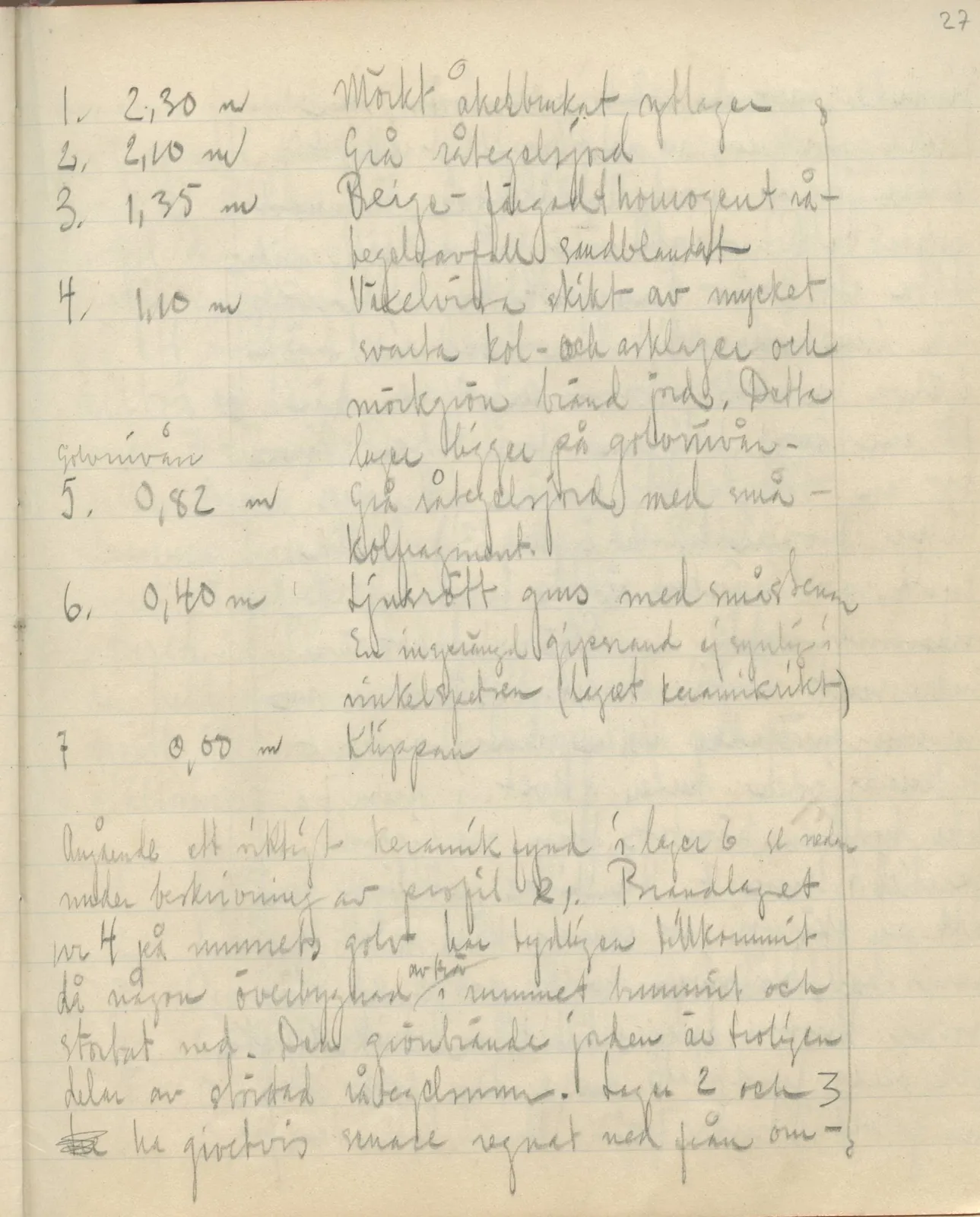
Page 27Scan 57 of 164
| 1. | 2,30 m | Dark plough-worked surface layer |
| 2. | 2,10 m | Grey mudbrick earth |
| 3. | 1,35 m | Beige-coloured, homogeneous mud- |
| brick debris mixed with sand | ||
| 4. | 1,10 m | Alternating levels of much |
| black charcoal and ash layers and | ||
| dark green burnt earth. This | ||
| floor level | layer lies at floor level. | |
| 5. | 0,82 m | Grey mudbrick earth with small- |
| charcoal fragments. | ||
| 6. | 0,40 m | Light red gravel with small stones |
| A embedded gypsum edge not visible in | ||
| the angle tip (layer rich in pottery) | ||
| 7 | 0,00 m | The rock |
Regarding an important pottery find in layer 6, see below under the description of section B 1. The burnt layer no. 4 on the floor of the room has evidently arisen when some wooden superstructure in the room burnt and collapsed. The green-burnt earth is probably parts of a collapsed mudbrick wall. Layers 2 and 3 be have of course later rained down from the above- … continues
65 figures hard to readstruck struck outadded written in above” jug ditto, and what it repeatsword reading not certain