
Unnumbered pageScan 31 of 92
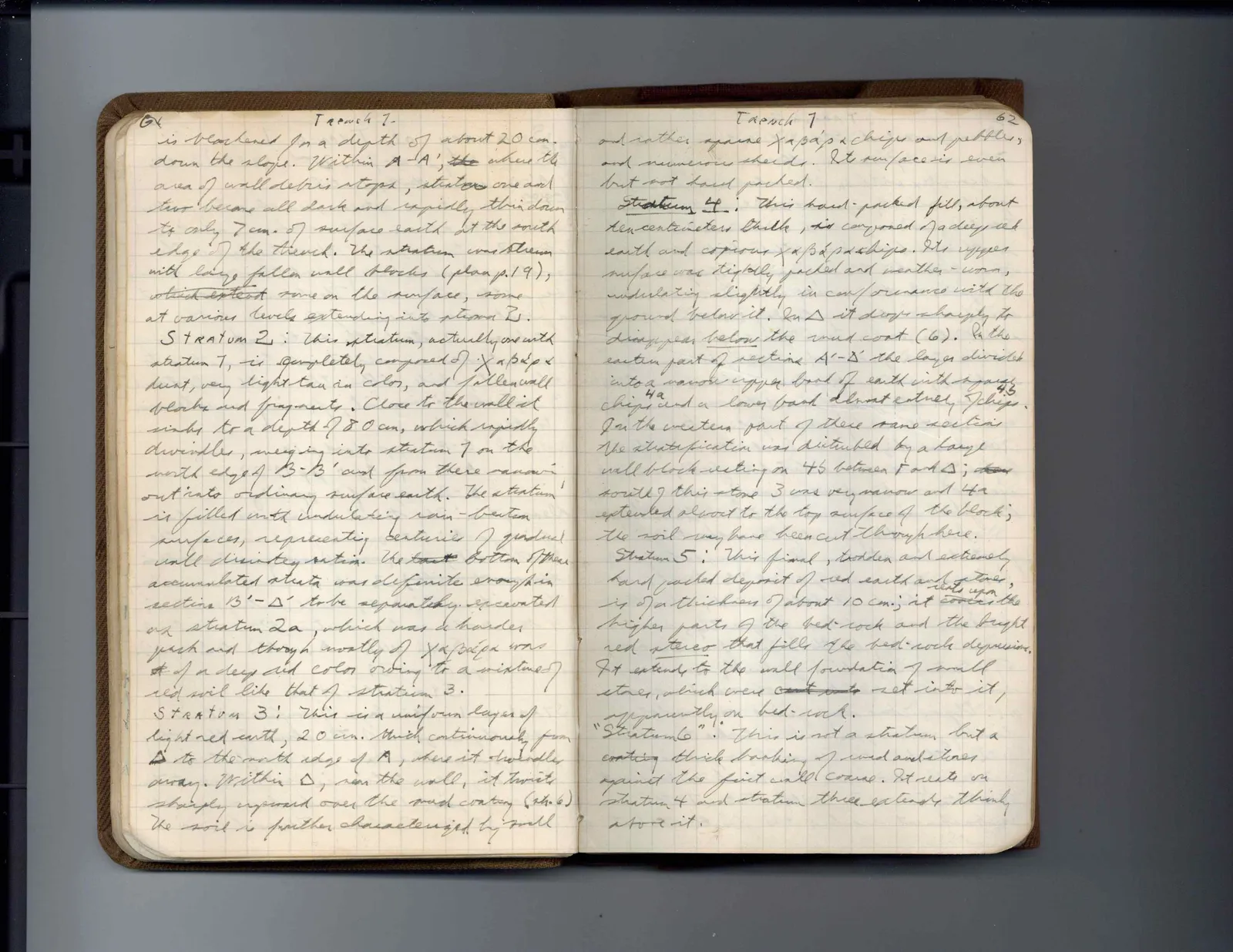
61 Trench 1. is weathered to a depth of about 20 cm. down the slope. Within A-A', the where the area of wall debris stops, stratums one and two become all dark and rapidly thin down to only 7 cm. of surface earth at the south edge of the trench. The stratum was strewn with large fallen wall blocks (plan p. 19), which extend some on the surface, some at various levels extending into stratum 2. STRATUM 2: this stratum, actually one with stratum 1, is completely composed of χαράρα dust, very light tan in color, and fallen wall blocks and fragments. Close to the wall it sinks to a depth of 80 cm, which rapidly dwindles, merging into stratum 1 on the north edge of B-B' and from there ranows out into ordinary surface earth. The stratum is filled with undulating rain-beaten surfaces, representing centuries of gradual wall disintegration. The last bottom of these accumulated strata was definite enough in section B'-A' to be separately excavated as stratum 2a, which was a harder pack and though mostly of χαράρα was of a deep red color owing to a mixture of red soil like that of stratum 3. STRATUM 3: this is a uniform layer of light red earth, 20 cm. thick continuously from Δ to the north edge of A, where it dwindles away. Within Δ, near the wall, it twists sharply upward over the mud coating (str. 6) the soil is further characterized by small
Right page
Trench 1 62 and rather sparse χαράρα chips and pebbles, and numerous sherds. Its surface is even but not hard-packed. Stratum 4: This hard-packed fill, about ten centimeters thick, is composed of a deep red earth and copious χαράρα chips. Its upper surface was tightly packed and weather-worn, undulating slightly in conformance with the ground below it. In Δ it drops sharply to disappear below the mud coat (6). In the eastern part of section A'-Δ the layer divides into a narrow upper bank 4a of earth with sparse chips, and a lower bank 4b almost entirely chips. In the western part of these same sections the stratification was disturbed by a large wall block resting on 4b between Γ and Δ; the south of this stone 3 was very narrow and 4a extended almost to the top surface of the block; the soil may have been cut through here. Stratum 5: this final, trodden and extremely hard packed deposit of red earth and stones, is of a thickness of about 10 cm.; it rests upon covers the higher parts of the bed-rock and the bright red stereo that fills the bed-rock depressions. It extends to the wall foundation of small stones, which were cut into set into it, apparently on bed-rock. "Stratum 6": this is not a stratum but a coating thick backing of mud and stones against the first wall course. It rests on stratum 4 and stratum three extends thinly above it.
65 figures hard to readstruck struck outadded written in above” jug ditto, and what it repeatsword reading not certain