
Unnumbered pageScan 6 of 85
6. November4-5, 1938.
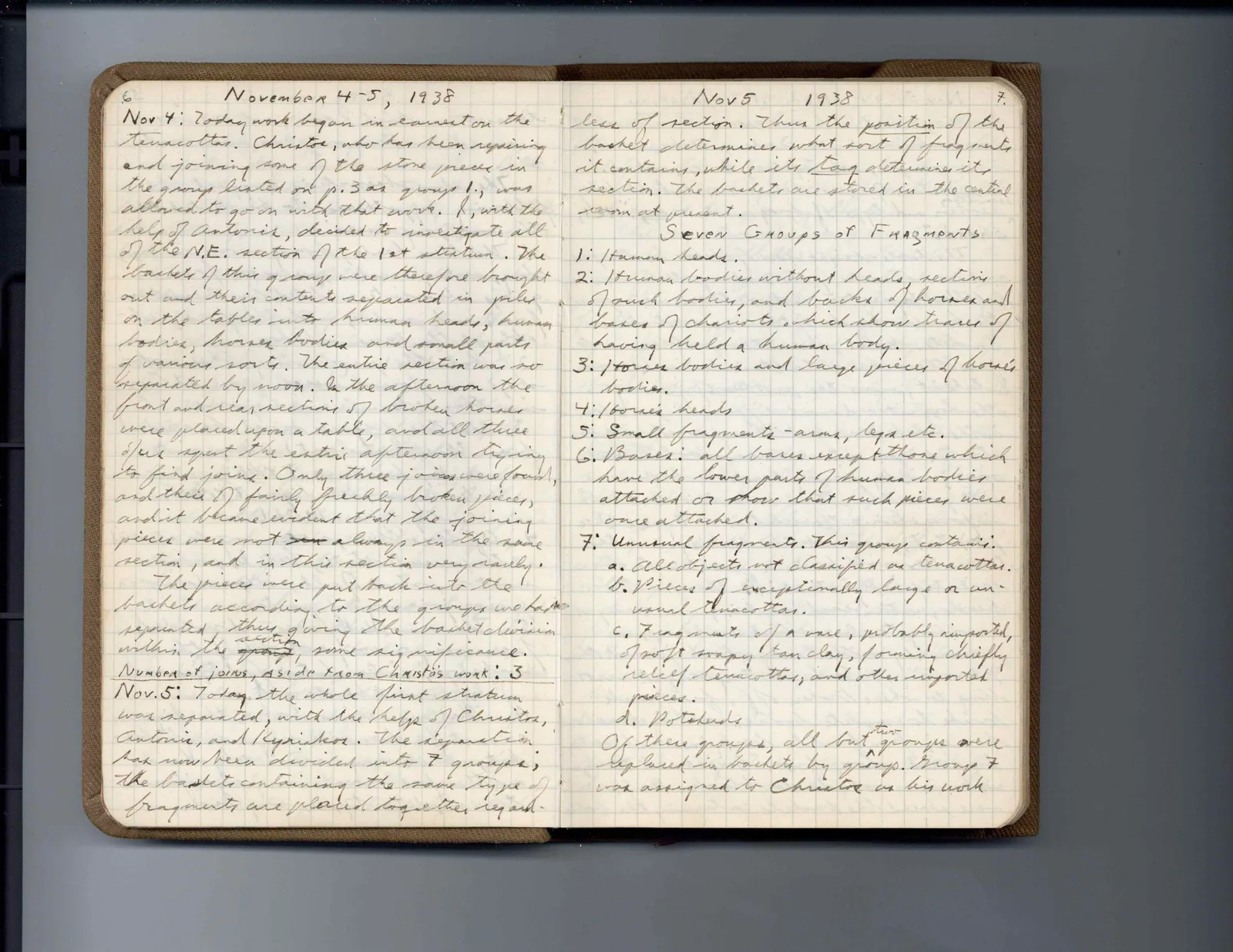
Nov 4Today work began in earnest on the terracottas. Christos, who has been repairing and joining some of the stone pieces in the group listed on p. 3 as group 1., was allowed to go on with that work. I, with the help of Antonis, decided to investigate all of the N.E. section of the 1st stratum. The baskets of this group were therefore brought out and their contents separated in piles on the tables into human heads, human bodies, horses bodies and small parts of various sorts. The entire section was so separated by noon. In the afternoon the front and rear sections of broken horses were placed upon a table, and all three of us spent the entire afternoon trying to find joins. Only three joins were found, and these of fairly freshly broken pieces, and it became evident that the joining pieces were not so always in the same section, and in this section very rarely.
The pieces were put back into the baskets according to the groups we had separated, thus giving the basket division within the section group, some significance. Number of joins, aside from Christos' work: 3
Nov. 5Today the whole first stratum was separated, with the help of Christos, Antonis, and Kyriakos. The separation has now been divided into 7 groups; the baskets containing the same type of fragments are placed together regard-
Right page
Nov 5 19387.
less of section. Thus the position of the basket determines what sort of fragments it contains, while its tag determines its section. The baskets are stored in the central room at present.
Seven Groups of Fragments
1: Human heads. 2: Human bodies without heads, sections of such bodies, and backs of horses and bases of chariots which show traces of having held a human body. 3: Horses bodies and large pieces of horse's bodies. 4: Horse's heads 5: Small fragments - arms, legs etc. 6: Bases: all bases except those which have the lower parts of human bodies attached or show that such pieces were once attached. 7: Unusual fragments. This group contains: a. All objects not classified as terracottas. b. Pieces of exceptionally large or unusual terracottas. c. Fragments of a vase, probably imported, of soft soapy tan clay, forming chiefly relief terracottas, and other imported pieces. d. Potsherds.
Of these groups, all but two groups were replaced in baskets by group. Group 7 was assigned to Christos as his work
65 figures hard to readstruck struck outadded written in above” jug ditto, and what it repeatsword reading not certain