
Unnumbered pageScan 6 of 33
8 10
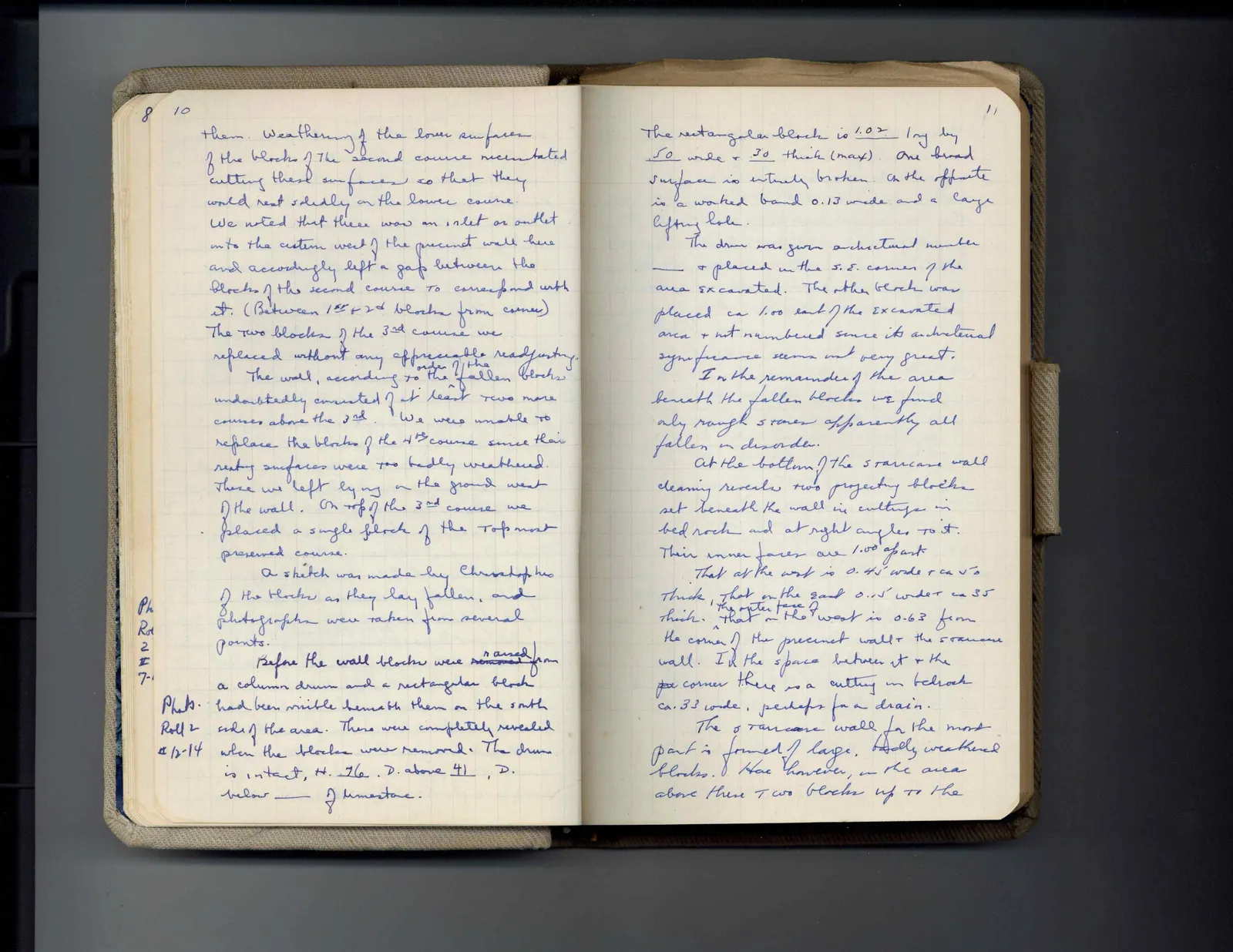
them. Weathering of the lower surfaces of the blocks of the second course necessitated cutting these surfaces so that they would rest solidly on the lower course. We noted that there was an inlet or outlet into the cistern west of the precinct wall here and accordingly left a gap between the blocks of the second course to correspond with it. (Between 1st & 2d blocks from corner) The two blocks of the 3d course we replaced without any appreciable readjusting. The wall, according to the order of the fallen blocks undoubtedly consisted of at least two more courses above the 3d. We were unable to replace the blocks of the 4th course since their resting surfaces were too badly weathered. These we left lying on the ground west of the wall. On top of the 3d course we placed a single block of the topmost preserved course.
A sketch was made by Christophis of the blocks as they lay fallen, and photographs were taken from several points.
Before the wall blocks were raised removed from a column drum and a rectangular block had been visible beneath them on the south side of the area. These were completely revealed when the blocks were removed. The drum is intact, H. .76, D. above .41, D. below —— of limestone.
[margin left: Ph Rol 2 # 7-1
Phto. Roll 2 #12-14]
Right page
11
The rectangular block is 1.02 long by .50 wide & .30 thick (max). One broad surface is entirely broken. On the opposite is a worked band 0.13 wide and a large lifting hole.
The drum was given architectural number —— & placed in the S.E. corner of the area excavated. The other block was placed ca 1.00 east of the excavated area & not numbered since its architectural significance seems not very great.
In the remainder of the area beneath the fallen blocks we found only rough stones apparently all fallen in disorder.
At the bottom of the staircase wall cleaning reveals two projecting blocks set beneath the wall in cuttings in bed rock and at right angles to it. Their inner faces are 1.00 apart.
That at the west is 0.45 wide & ca .50 thick, that on the east 0.15 wide & ca 35 thick. That on the the outer face of west is 0.63 from the corner of the precinct wall & the staircase wall. In the space between it & the px corner there is a cutting in bedrock ca. 33 wide, perhaps for a drain.
The staircase wall for the most part is formed of large, badly weathered blocks. Here, however, in the area above these two blocks up to the
65 figures hard to readstruck struck outadded written in above” jug ditto, and what it repeatsword reading not certain