
Unnumbered pageScan 2 of 31
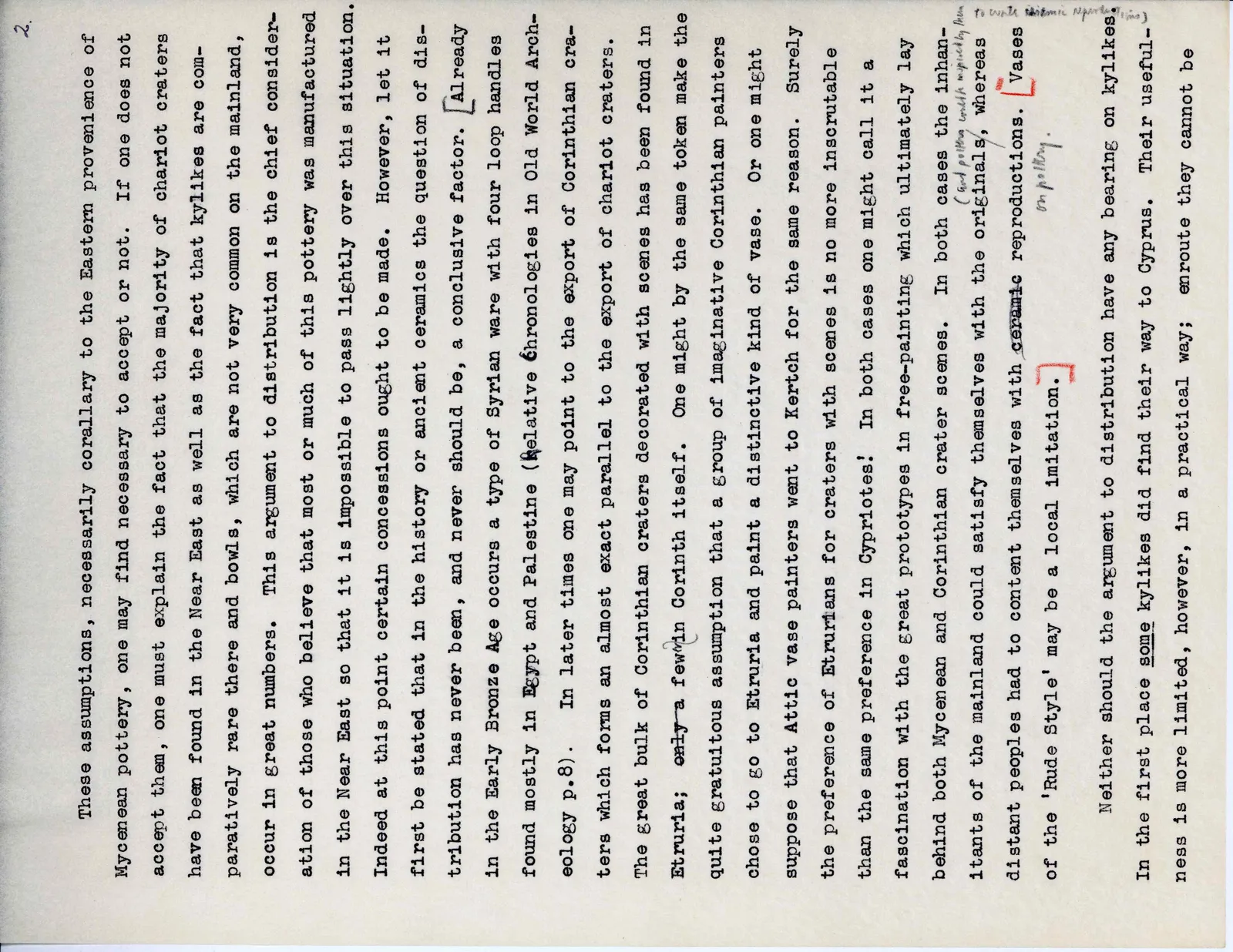
These assumptions, necessarily corallary to the Eastern provenience of Mycenean pottery, one may find necessary to accept or not. If one does not accept them, one must explain the fact that the majority of chariot craters have been found in the Near East as well as the fact that kylikes are comparatively rare there and bowls, which are not very common on the mainland, occur in great numbers. This argument to distribution is the chief consideration of those who believe that most or much of this pottery was manufactured in the Near East so that it is impossible to pass lightly over this situation. Indeed at this point certain concessions ought to be made. However, let it first be stated that in the history or ancient ceramics the question of distribution has never been, and never should be, a conclusive factor. [Already in the Early Bronze Age occurs a type of Syrian ware with four loop handles found mostly in Egypt and Palestine (Relative Chronologies in Old World Archeology p.8). In later times one may point to the export of Corinthian craters which forms an almost exact parallel to the export of chariot craters. The great bulk of Corinthian craters decorated with scenes has been found in Etruria; only a few in Corinth itself. One might by the same token make the quite gratuitous assumption that a group of imaginative Corinthian painters chose to go to Etruria and paint a distinctive kind of vase. Or one might suppose that Attic vase painters went to Kerch for the same reason. Surely the preference of Etruritans for craters with scenes is no more inscrutable than the same preference in Cypriotes! In both cases one might call it a fascination with the great prototypes in free-painting which ultimately lay behind both Mycenean and Corinthian crater scenes. In both cases the inhanitants of the mainland could satisfy themselves with ceramic reproductions, whereas distant peoples had to content themselves with ceramic reproductions. Vases of the 'Rude Style' may be a local imitation.
Neither should the argument to distribution have any bearing on kylikes. In the first place some kylikes did find their way to Cyprus. Their usefulness is more limited, however, in a practical way; enroute they cannot be
Printed: 2.
Handwritten marginalia: to write Bamboula ... (and pottery could be imported ...); on pottery
65 figures hard to readstruck struck outadded written in above” jug ditto, and what it repeatsword reading not certain