
Unnumbered pageScan 1 of 31
POTTERY CLASSIFICATION.
Mycenean (I)
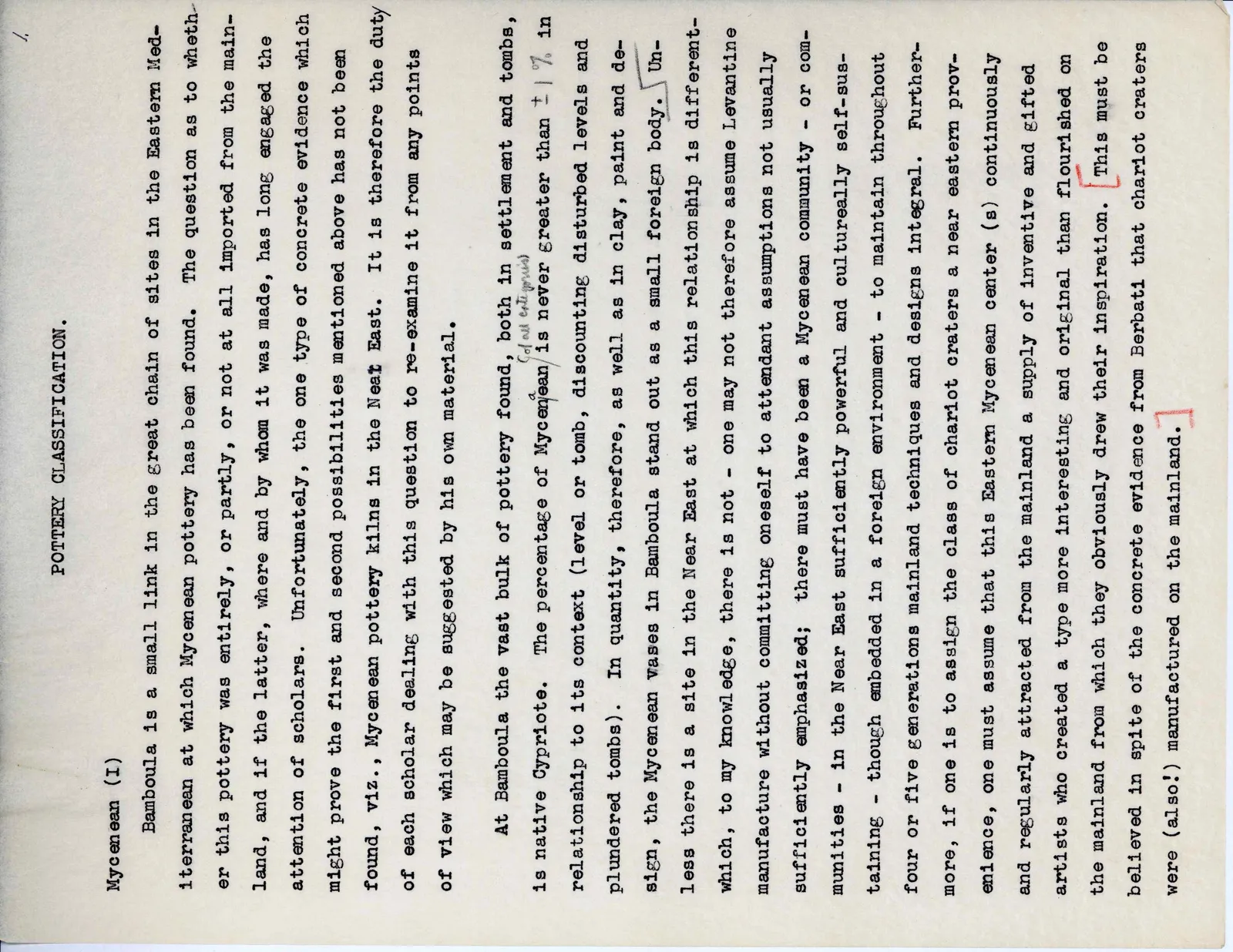
Bamboula is a small link in the great chain of sites in the Eastern Mediterranean at which Mycenean pottery has been found. The question as to whether this pottery was entirely, or partly, or not at all imported from the mainland, and if the latter, where and by whom it was made, has long engaged the attention of scholars. Unfortunately, the one type of concrete evidence which might prove the first and second possibilities mentioned above has not been found, viz., Mycenean pottery kilns in the Near East. It is therefore the duty of each scholar dealing with this question to re-examine it from any points of view which may be suggested by his own material.
At Bamboula the vast bulk of pottery found, both in settlement and tombs, is native Cypriote. The percentage of [handwritten: Mycenean] Mycenean (of all categories) is never greater than ± 1 % in relationship to its context (level or tomb, discounting disturbed levels and plundered tombs). In quantity, therefore, as well as in clay, paint and design, the Mycenean vases in Bamboula stand out as a small foreign body. Unless there is a site in the Near East at which this relationship is different- which, to my knowledge, there is not - one may not therefore assume Levantine manufacture without committing oneself to attendant assumptions not usually sufficiently emphasized; there must have been a Mycenean community - or communities - in the Near East sufficiently powerful and culturally self-sustaining - though embedded in a foreign environment - to maintain throughout four or five generations mainland techniques and designs integral. Furthermore, if one is to assign the class of chariot craters a near eastern provenience, one must assume that this Eastern Mycenean center(s) continuously and regularly attracted from the mainland a supply of inventive and gifted artists who created a type more interesting and original than flourished on the mainland from which they obviously drew their inspiration. This must be believed in spite of the concrete evidence from Berbati that chariot craters were (also?) manufactured on the mainland.
65 figures hard to readstruck struck outadded written in above” jug ditto, and what it repeatsword reading not certain