
Unnumbered pageScan 1 of 43
BAMBOULA
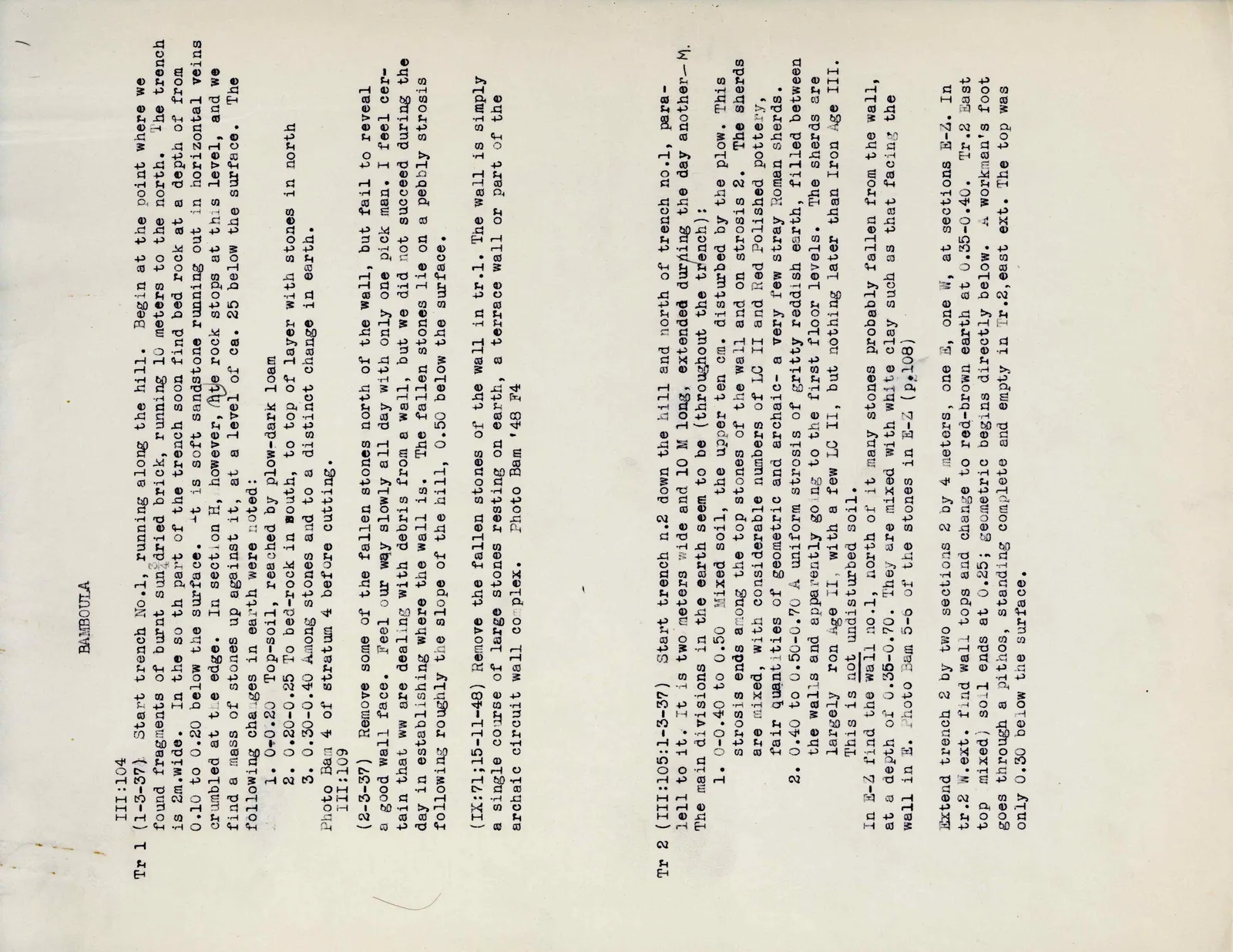
III:104 Tr 1 (1-3-37) Start trench No.1, running along the hill. Begin at the point where we found fragments of burnt sun-dried brick, running 10 meters to the north. The trench is 2m.wide. In the so th part of the trench soon find bed rock at a depth of from 0.10 to 0.20 below the surface. [handwritten: ↑] It is soft sandstone running out in horizontal veins crumbled at the edge. In section H, however, the rock stops at this level, and we find a mass of stones up against it, at a level of ca. 25 below the surface. The following changes in earth were noted: 1. 0-0.20 Top-soil, reached by plow-dark loam 2. 0.20-0.25 To bed-rock in south, to top of layer with stones in north 3. 0.30-0.40 Among stones and to a distinct change in earth. Photo Bam 4 of stratum 4 before cutting. III:109 (2-3-37) Remove some of the fallen stones north of the wall, but fail to reveal a good wall face. Feel our way slowly all day with only one pick man. I feel certain that ww are dealing with debris from a wall, but we did not succeed during the day in establishing where the wall is. The fallen stones lie on a pebbly strosis following roughly the slope of the hill, 0.50 below the surface.
(IX:71;15-11-48) Remove the fallen stones of the wall in tr.1. The wall is simply a single course of large stones resting on earth, a terrace wall or part of the archaic circuit wall complex. Photo Bam '48 F4
Right page
Tr 2 (III:105:1-3-37) Start trench n.2 down the hill and north of trench no.1, parallel to it. It is two meters wide and 10 M long, extended during the day another-[handwritten: M]. The main divisions in the earth seem to be (throughout the trench): 1. 0-0.40 to 0.50 Mixed soil, the upper ten cm. disturbed by the plow. This strosis ends among the top stones of the wall and on strosis 2. The sherds are mixed, with considerable numbers of LC II and Red Polished pottery, fair quantities of geometric and archaic- a very few stray Roman sherds. 2. 0.40 to 0.50-0.70 A uniform strosis of gritty reddish earth, filled between the walls and apparently going to the first floor levels. The sherds are largely Iron Age III, with a few LC II, but nothing later than Iron Age III. This is not undisturbed soil. In E-Z find the wall no.1, north of it many stones probably fallen from the wall, at a depth of 0.35-0.70. They are mixed with white clay such as that facing the wall in E-Z (p.108) Extend trench 2 by two sections 2 by 4 meters, one E, one W, at sections E-Z. In tr.2 W.ext. find wall tops and change to red-brown earth at 0.35-0.40. Tr.2 East top mixed} soil ends at 0.25; geometric begins directly below. A workman's foot goes through a pithos, standing complete and empty in Tr.2, east ext. The top was only 0.30 below the surface. In E-Z of the stones in E-Z (p.108)
65 figures hard to readstruck struck outadded written in above” jug ditto, and what it repeatsword reading not certain