
Unnumbered pageScan 30 of 79
Continued from p. -4-
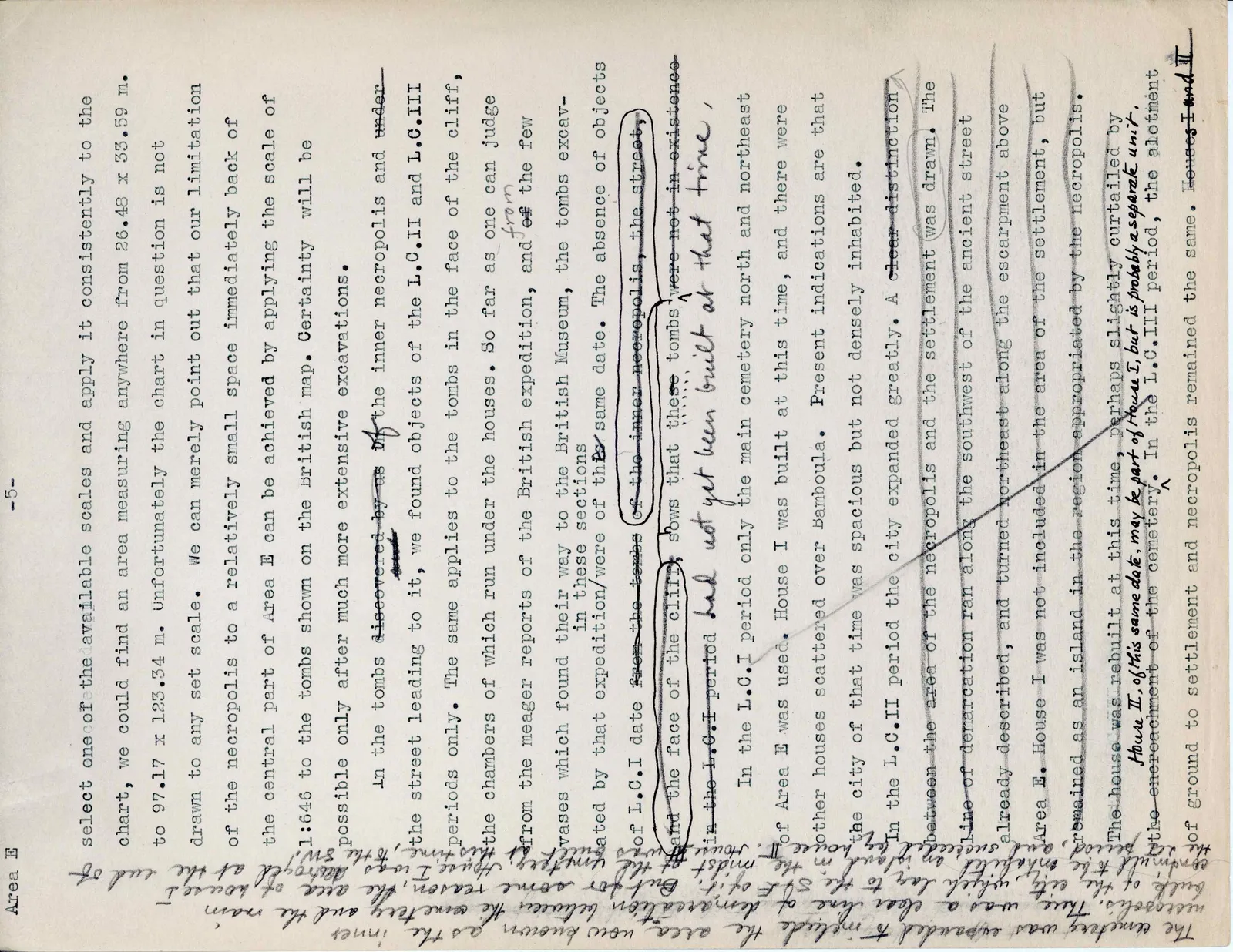
… select one of the available scales and apply it consistently to the chart, we could find an area measuring anywhere from 26.48 x 33.59 m. to 97.17 x 123.34 m. unfortunately the chart in question is not drawn to any set scale. We can merely point out that our limitation of the necropolis to a relatively small space immediately back of the central part of Area E can be achieved by applying the scale of 1:646 to the tombs shown on the british map. Certainty will be possible only after much more extensive excavations.
In the tombs discovered by us of the inner necropolis and under the street leading to it, we found objects of the L.C.II and L.C.III periods only. The same applies to the tombs in the face of the cliff, the chambers of which run under the houses. So far as one can judge from the meager reports of the British expedition, and of the few vases which found their way to the British Museum, the tombs excavated by that expedition were of the same date. The absence of objects in these sections [handwritten: from] of L.C.I date from the tombs of the inner necropolis, the street, and the face of the cliff, shows that these tombs were not in existence in the L.C.I period [handwritten: had not yet been built at that time,]
In the L.C.I period only the main cemetery north and northeast of Area E was used. House I was built at this time, and there were other houses scattered over Bamboula. Present indications are that the city of that time was spacious but not densely inhabited.
In the L.C.II period the city expanded greatly. A clear distinction between the area of the necropolis and the settlement [handwritten: was drawn]. The line of demarcation ran along the southwest of the ancient street already described, and turned northeast along the escarpment above Area E. House I was not included in the area of the settlement, but remained as an island in the region appropriated by the necropolis. The house was rebuilt at this time, perhaps slightly curtailed by the encroachment of the cemetery. In the L.C.III period, the alotment of ground to settlement and necropolis remained the same. [handwritten: House II, of this same date, may be part of House I, but is probably a separak unit.]
Handwritten marginal note, rotated: The vaults was extended & included the area now known as the inner necropolis. The tombs may be the early ones of the cliff, which were most of the cemetery, the area of house I was included in the necropolis, and the area of house II was marked at the end of the L.C.II period
65 figures hard to readstruck struck outadded written in above” jug ditto, and what it repeatsword reading not certain